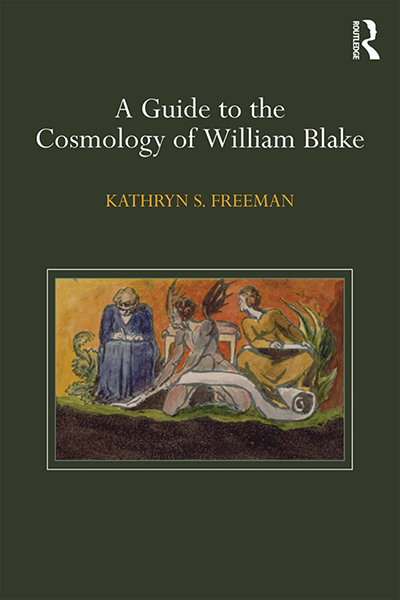
Kathryn S. Freeman’s A Guide to the Cosmology of William Blake, like S. Foster Damon’s A Blake Dictionary, is an encyclopedia of terms, works, characters, and figures relevant to Blake’s corpus, one especially useful to newcomers to Blake’s works who are trying to find their way through the labyrinth of his mythology. Supplements have been published since Damon’s time, including Alexander Gourlay’s “A Glossary of Terms, Names, and Concepts in Blake” in The Cambridge Companion to William Blake (2003), which he republished in expanded form on the William Blake Archive website, but nothing has appeared until now on the scale of the 181 entries Freeman has written. Her guide is neither as comprehensive as Damon’s dictionary nor limited only to entries strictly relevant to Blake’s cosmology, so it is perhaps best understood as her own selective updating of Damon’s entries and a correction of some omissions in Damon, such as a much-needed separate entry for Catherine Blake.
Entries vary in length from about one-half page, such as that for All Religions are One, to about three pages, such as that for Milton. Each entry is accompanied by a bibliography, and Freeman’s bibliographies vary widely in quality and usefulness. Some consist of excellent, selective lists of recent scholarship about their topics, while others cite only Erdman’s edition of Blake’s writings, or perhaps Blake Records, but that’s it. I would say the typical bibliographic entry doesn’t mention substantial scholarship after 2005 and could have been drawn from the reading list for my Blake exam in graduate school. For example, her entry on “The Ancients” cites only Bentley’s biography of Blake, while that for “Auguries of Innocence” cites only Erdman’s Complete Poetry and Prose. However, many are quite lengthy and draw from more recent scholarship, such as the bibliography for “America: A Prophecy.”
Freeman’s entry on “Blake, Catherine” is everything I could hope for: objective, informed by recent scholarship up to the time of her writing, and as long as it needs to be for an encyclopedia-style entry. That for Milton is similarly very good, but there’s no separate entry for illuminated books, which could discuss medieval influences on Blake, among other things. Instead, there is just a cross-reference to “Engraving.” Most of her entries present multiple points of view about their topics, but others present a pithy, satisfying thesis of their own, such as the entry on “Loom; weaving; garment”: “The veil represents the delusion of the dualism between nature, or the objective world, and the human subject” (153), an argument that has implications for her reading of Blake and gender, which she spells out in brief. I should add that Damon has no equivalent entry on either weaving or engraving, while Gourlay has a short entry on “weaving/woven” that associates this concept with Eve and contrasts it to Blake’s version of the traditional work of Adam, which is plowing. This example illustrates one of the book’s purposes beyond serving as a guide to Blake’s terms, which is to promulgate Freeman’s thesis about Blake’s rejection of dualism articulated in Blake’s Nostos: Fragmentation and Nondualism in “The Four Zoas” (1997) and in her entry here on “Contraries; binaries; dualism and nondualism,” a thread woven throughout many of these entries.
I should confess to the biases informing this review, and in doing so commit the grave sin of reviewing the book Freeman did not write instead of the book she did. I picked up the guide hoping for an exhaustive Blake encyclopedia in which every entry was written in the form of a neutral presentation of each topic informed by all relevant scholarship in the field up to the last three years prior to publication. I didn’t want a supplement to Damon’s work, but a replacement for it. In other words, I wanted her to have had nothing else to do but spend the last ten years continually writing and updating this guide. Surely that’s not unreasonable? What we have instead is Freeman daring to write what she wanted about what she wanted to the extent that she wanted, and no more. If your interests align with hers, her entries offer just the coverage that you want on the topics that you want. If they do not, you’ll be very gratified by some entries and hoping for more on others. In truth, the dictionary or encyclopedia I want would have to be written by numerous contributors guided by an editorial board, and that would be a completely different kind of work, one that does not yet exist. My suspicion is that all current Blake encyclopedias are in effect publications of the reading notes of Blake scholars, who are required by the complexities of Blake’s mythology to write such extensive notes that they deserve publication credit for them.
Overall, while Freeman did not write the one Blake encyclopedia to rule them all, she has put together a very useful work that should be kept alongside Damon’s Dictionary and supplements to it available in Blake scholarship. It serves as a useful guide for new readers of Blake at all levels, including graduate students, as well as a compendium of reminders for experienced readers of Blake.