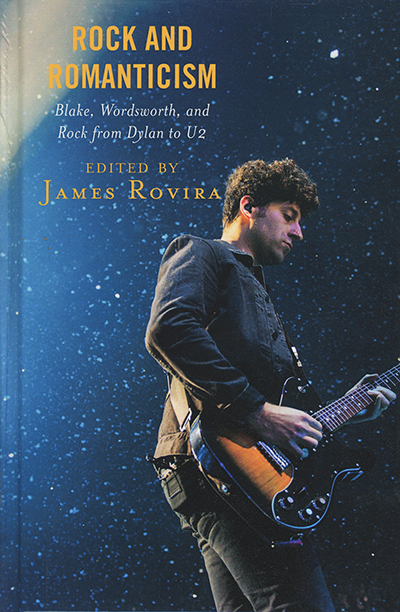
At the first ever World of Bob Dylan symposium in May-June 2019 in Tulsa, Oklahoma, Betsy Bowden, one of the founders of Dylan criticism, called for the development of a critical language that not only recognizes the similarities between songs and poems, but also respects their differences. Rock and Romanticism: Blake, Wordsworth, and Rock from Dylan to U2, edited by James Rovira, participates in this development by connecting Romantic-period poetry to rock-’n’-roll songs, although that is not its primary agenda. Instead, Rovira says that the book “seeks not only to demonstrate the influence of Romantic literature on rock, which is already the subject of much attention, but to argue that rock itself is a late-twentieth-century expression of Romanticism” (xi-xii). He grounds this argument in the work of Robert Sayre and Michael Löwy, and most of the contributors acknowledge a debt to them as well. Sayre and Löwy defined Romanticism as “‘opposition to capitalism in the name of pre-capitalist values’” (quoted in Rovira xiii),The book makes a distinction between Sayre and Löwy (“Figures of Romantic Anti-Capitalism,” New German Critique 32 [1984]: 42-92) and Löwy and Sayre (Romanticism against the Tide of Modernity, trans. Catherine Porter [Durham, NC: Duke University Press, 2001]). and Rovira uses this definition to describe Romanticism “not as an era but as a response to historical conditions in a condition/response model” (xv). Liberated from the limits of a Romantic period, the essays in the collection “assume that Romanticism continues into the present as an essential feature of modern culture and takes on a specific, musical transformation in the period following World War II” (xiv). The persuasiveness of the collection depends largely on how one views the persuasiveness of that understanding of Romanticism.
The book comprises eleven essays by various hands, plus the introduction by Rovira. Four essays concern Blake, four focus on Wordsworth, one on Wordsworth and Coleridge together, one on Shelley, and one has a more continental focus on the scapigliatura and poètes maudits. The musicians discussed range from Bob Dylan, Leonard Cohen, and Jackson Browne to the Rolling Stones, Nirvana, Rush, U2, and American roots musician Martha Redbone. All of the essays run roughly ten to twelve pages of text, plus notes. Unfortunately, there seems to have been some confusion about the final organization. In his introduction Rovira writes, “An initial chapter engaging Shelley and the Rolling Stones is followed by four chapters about Blake and different figures in rock. The next chapter engages Wordsworth and Coleridge and is then followed by four chapters about Wordsworth” (xviii), before the concluding chapter on the scapigliatura. This organization makes sense; it gathers the essays into cohesive groups that allow for relatively easy comparisons focused on particular poets. The problem is that the book does not follow this organization, as the table of contents reveals. Instead of opening with Janneke van der Leest’s essay on Shelley and the Rolling Stones, it begins with Luke Walker on Blake and Dylan, so that the four chapters concerning Blake are interrupted by the chapter on Shelley. The Wordsworth group is similarly disrupted: instead of opening the second group, David S. Hogsette’s essay on Wordsworth and Coleridge appears after David Boocker’s and Gary L. Tandy’s essays on Wordsworth. In the balance of the introduction, Rovira himself follows the table of contents (and actual organization) as he describes the essays. It is not clear how the error occurred, but the book would be more focused with the arrangement that appears to have been canceled.
“Romanticism in the Park: Mick Jagger Reading Shelley” would have been an excellent opening for the book, given the editor’s emphasis on the continuity of Romanticism across periods. Van der Leest considers the implications of Jagger’s 1969 reading of parts of Shelley’s Adonais as a tribute to the recently deceased Rolling Stones founder, Brian Jones. She sees in Jagger’s tribute the same aligning of poets to commemorate past poets that extends beyond Shelley and Keats all the way to the beginning of pastoral elegy in Bion’s Lament for Adonis and Moschus’s Lament for Bion. Van der Leest focuses primarily on attitudes toward death among Romantics and rockers, and concludes that the shared characteristics of Romanticism and rock music “lead us to believe that a focus on rock music and its youth culture offers a way to study Romanticism and Romantic literature. At the same time, it reveals how Romanticism lives on, and how rock culture can be put in a historical perspective that goes all the way back to Romanticism” (30). All the essays in the collection offer variations on this theme.
While the four chapters on Blake do not really talk to one another, together they reveal fault lines in our conception of Romanticism. In “Tangled Up in Blake: The Triangular Relationship among Dylan, Blake, and the Beats,” Walker invokes a “Blakean Romanticism” (7) as he examines the “complex set of personal and cultural anxieties relating to influence and canonicity, Romanticism and counterculture, Beat poetry and rock music, and [how] these interlinked anxieties provide the key contexts for Dylan’s relationship with the poetry of William Blake” (1). “Beat poetry” here mostly means Allen Ginsberg, who famously hallucinated Blake and was also a friend of Dylan. Walker sees Dylan and Ginsberg as representative figures both to each other and to their public—Ginsberg representing the older Beat generation and Dylan the new musical threat to the Beats’ relevance—and he wisely cautions that “the oft-stated connection between [Dylan and Blake] has too rarely been subjected to rigorous critical analysis” (3). Walker himself has little to say about the Dylan songs we often associate with Blake (“Gates of Eden,” “Every Grain of Sand,” “Golden Loom”), but he does an admirable job of documenting points of contact between Dylan and Blake early and late in Dylan’s career, questioning whether and how much Ginsberg was involved.
In “William Blake: The Romantic Alternative,” Douglas T. Root looks at Blake and Kurt Cobain as parallel members of parallel movements. According to Root, “Both the Romantic (with or without Blake) and grunge movements were fueled by a desire to break away from the popular works that preceded them” (44). He refers to what he calls Blake’s “macabre Romanticism” (35) without really saying what he means by that, but he does focus on the “‘prickly relationship between Blake and [the critical establishment’s] constructions of romanticism’” (37, quoting David Simpson) as paralleling Cobain’s rejection of the rock establishment. For Root, both artists reject not simply the inherited methods or means of production, but also the entire system in which these methods are used.
Nicole Lobdell’s “Digging at the Roots: Martha Redbone’s The Garden of Love: Songs of William Blake” is part critical analysis, part album review. Lobdell identifies an “Appalachian Romanticism” resulting from Redbone’s interpretation of “Blake’s poetry through memory, eulogizing what has been lost to time and progress, and celebrating, through lyric and melody, what remains” (52). She says that Redbone’s album “showcases a collective lyrical history that joins, across centuries and continents, Blake’s Romantic England with Redbone’s modern America” (51); Lobdell defines “the overlapping ideals of Appalachia and Romanticism” as “organic imagination, self-reliance, and a spiritual connection to nature” (53). She notes that Redbone’s “organic, diverse language of sound pushes against definitions of Romanticism by reimagining Blake’s canonical poetry in a feminine voice set against the musical backdrop of Appalachia” (56). The album’s song selection, organization, and musical arrangements, Lobdell says, chart “a loose narrative of fall and redemption alongside one about the individual’s search for community and home” (57).
In “‘Tangle of Matter and Ghost’: U2, Leonard Cohen, and Blakean Romanticism,” Lisa Crafton “situates this triangle of artists [Blake, U2, Cohen] in terms of acknowledged debts to their precursors, but, more importantly, the profound metaphorical and thematic connections that brand both Cohen and U2 as Romantic” (66). She discusses three “areas of intersection” among these writers: “social and cultural protest, the conflation of erotic/spiritual love, and the representation of the rupture of that symbiosis, especially in the poetic treatment of Judas, Yahweh, and Jesus” (67). Crafton’s is the most theoretically self-aware essay of the collection, as she explicitly addresses the issue of influence, noting that while she does “acknowledge statements of ‘influence,’” she also concurs with Steve Clark, Tristanne Connolly, and Jason Whittaker in Blake 2.0: William Blake in Twentieth-Century Art, Music and Culture in rejecting “‘writer-on-writer models of influence and residually patrilineal concepts of inheritance’” in favor of “‘alternative models’” that are “‘less defined and confined by various forms of affiliation or resistance’” (quoted in Crafton 67). Be that as it may, Crafton’s argument is also among the most persuasive, at least in part because its “‘alternative models’” begin with those acknowledged “statements of ‘influence.’”
In the organization that Rovira initially describes, the Blake essays would have been followed by “‘Swimming against the stream’: Rush’s Romantic Critique of Their Modern Age,” in which Hogsette draws on Löwy and Sayre and seeks to place Rush among the Romantics by redefining Romanticism “as a visionary worldview that indeed began in the mid-to-late eighteenth century but did not end with the emergence of the Victorian era” (111). Relying mostly on correspondences between Rush and Wordsworth and Coleridge, Hogsette finds in Rush’s work a Romantic nostalgia for an idealized pastoral, coupled with a belief that individual freedom can be turned to social good. He acknowledges that Rush’s perspective has been (mis)interpreted as ultraconservative, even fascistic, but argues that the band undercuts its own hard line with irony at both the verbal and musical levels. While Hogsette explicitly disavows any reliance on formal definitions of Romanticism, the nature of Rush’s music as he describes it cannot but emphasize the element of quest-romance that informs so much of traditional British Romanticism.
Four essays that flank Hogsette’s, two on either side, align Wordsworth with the Beatles, Jackson Browne, recent Southern rock band Blackberry Smoke, and a trio of literary works related to contemporary music by at least one degree of separation. The chapters on Wordsworth almost all depend on parallel approaches or concerns, with only one point of explicit contact, in Rachel Feder’s discussion of Brandon Brown’s invocation of The Prelude in Top 40.
In “The Inner Revolution(s) of Wordsworth and the Beatles,” Boocker compares Lyrical Ballads to Sgt. Pepper’s Lonely Hearts Club Band, focusing on how both works invoke nostalgia to identify the goals and strategies for the internal personal changes necessary to bring about larger-scale social change. He finds that “in the end, what ultimately links the English Romantic movement to the Beatles is that they both signal momentous transitions after which poetry and music were never the same again,” so that “the acts of reading the poetry and listening to the music become progressive acts that move us toward restoring social order” (90).
In “‘When the light that’s lost within us reaches the sky’: Jackson Browne’s Romantic Vision,” Tandy focuses “not on proving influence but on identifying those elements of Browne’s lyrics that demonstrate the continuity of his worldview with that of the European Romantic movement, specifically of the Revolutionary and Utopian type” (107). While Tandy’s references to specific Romantic passages are relatively scant, as if he assumes (perhaps correctly) that his reader is already familiar with the lines one might expect him to cite, his discussion of Browne’s songs provides one of the strongest, most detailed examinations of rock lyrics in the collection. In those lyrics he finds the Romantic traits of melancholy, nostalgia (not to mention “melancholic nostalgia” [101]), and a forward-looking utopianism that projects Browne’s lost idyllic state into the future as a personal and political possibility.
Ronald D. Morrison’s “Wordsworth’s ‘Michael,’ the Georgic, and Blackberry Smoke” argues that “both Wordsworth’s poem and many of the songs of Blackberry Smoke should be considered as revitalized versions of the georgic that are focused on nuanced meanings of the term ‘environment,’ including human-created environments and culture” (127). Morrison distinguishes between the timelessness of what Keats called “cold pastoral” and the temporality of Michael’s labor in the more realistic workaday world of the georgic. The discussion of “Michael” is deeper than most of the discussions of Romantic poetry in the collection, and Morrison does a very good job of drawing out the georgic parallels between the issues addressed by Wordsworth and those addressed by the working-class focus of Blackberry Smoke.
In “Wordsworth on the Radio,” Feder examines three poetry collections that use popular music as their starting points: Brown’s Top 40, Lauren Ireland’s Dear Lil Wayne, and Sarah Blake’s Mr. West. Brown explicitly invokes Wordsworth and The Prelude in a collection of poems, each based on a top 40 song, in which, Feder says, he addresses Wordsworth’s “forms of refusal” (141), delaying both beginning and ending. Ireland’s Dear Lil Wayne collects postcards Ireland wrote to Lil Wayne during his incarceration, and Feder finds in them an ambiguity of private and public audience akin to the ambiguity of address in The Prelude, as well as an emphasis on isolated moments that recalls Wordsworth’s “spots of time.” In Blake’s Mr. West, “celebrity emerges as an alternative to memory,” such that “celebrities … might provide us, after all, with a different way to consume memory” (148). Feder concludes that, in these three collections, “pop music functions as a vehicle of memory and futurity, a preludian thinking back into the past and casting into the future” (150).
Five of the first ten essays operate deliberately or not on those “‘writer-on-writer models of influence’” of which Crafton expresses suspicion. As such, they build on demonstrable points of contact between the Romantic writer and rock music—Jagger recites a Shelley poem, Dylan discusses Blake with Ginsberg, Redbone records Blake songs, U2 explicitly cite Blake as an influence, and Brown relates The Prelude to a variety of top 40 hits. The other essays almost all depend less on sequential influence than on parallel concerns shared by Romantic and modern writers; rather than evidence of influence, the arguments are built on comparing the different writers’ approaches to melancholy, nostalgia, labor, and the relationship of the individual to the larger world. The former approach emphasizes writers defined as Romantic, while the latter focuses on issues that have been defined as Romantic. Indeed, my strongest reservation about the book concerns its operating definition of Romanticism. To be sure, Romanticism is not just one thing, and at different points in the collection we hear about “Blakean Romanticism,” “macabre Romanticism,” “Appalachian Romanticism,” and “‘Restitutionist Romanticism.’” Romanticism has always been difficult to define, and that is probably as it should be. Liberation from the long eighteenth or nineteenth century, not to mention the traditional Romantic period, will certainly make Romanticism more inclusive. My concern is that it may also make the term so loose as to make it useless. Once the Romantic is defined as a movement “fueled by a desire to break away from the popular works that preceded [it]” (Root 44), I’m not sure there is much basis left on which to make meaningful distinctions among literary types. Assuming we still want to do that.
The last essay, Lorenzo Sorbo’s “The Scapigliatura and Poètes Maudits in the Songs of Piero Ciampi (1934–1980),” shows just how complicated our notions of Romanticism can be. Like so many of the other contributors, Sorbo cites Löwy and Sayre, but the focus on Italian Romanticism, directed at a primarily Anglo-American audience, requires that he approach his topic from the beginning, defining the “scapigliati” (the “disheveled”) and their antagonism to the bourgeoisie, identifying key figures in the movement, and outlining parallels with British Romanticism. For example, quoting Rosa Giovanna, Sorbo notes that for the scapigliati “their disheveled narrative style focuses on a ‘hypertrophied ego’ enhancing ‘the solitude of the self-centered author’” (157). Despite these parallels, Sorbo recognizes that “the scapigliati railed against Romanticism” (154). When he turns to Ciampi, whose “musical production consists of only five albums produced between 1963–1975, several singles and collections, different unpublished songs, and many other songs written for other singers” (156), he again has to start at the beginning, with Ciampi’s birth in 1934 in Livorno. But Sorbo’s conclusion nicely encapsulates the complications of trying to align Romantic poetry and modern music: Ciampi “has a Romantic view of love in the literary sense, but his poems are in many ways completely anti-academic and anti-Romantic” (162).
Sorbo’s conclusion points to the need for caution in this sort of work: comparisons based on abstract notions of Romanticism make it all too easy to overreach in our generalities and to overlook the sorts of nuances and inconsistencies that Sorbo is careful to document. The collection raises important questions about how Romanticism is defined, and implicitly whether it is fair even to try to discuss Romanticism or rock as a coherent concept. The questions of the book’s audience and how to address them are also tricky. In an essay on, say, Blake and Dylan, how much can you assume Romanticists know about Dylan? What do most Dylanologists know about Blake? How much can Rush fans be expected to know about Wordsworth and Coleridge, or vice versa? If you are a Romanticist already, you will not learn a lot about Romanticism per se in Rock and Romanticism. You will learn much about rock music and how rock musicians have engaged with something that might be called Romanticism. But you will also learn that there is no such thing as monolithic “rock music” any more than there is such a thing as a monolithic “Romanticism.” If Bowden is correct that we need to develop a critical vocabulary that recognizes the real similarities and differences between poems and songs, and if, as this collection contends, rock music really is the twentieth-century expression of Romanticism, then that critical vocabulary of poems and songs in the modern era will necessarily include elements of Romantic discourse. Rock and Romanticism is hardly the final word on that, but the essays do help us to understand the challenges involved in getting there.