Blake and Exhibitions, 2019
Luisa Calè (l.cale@bbk.ac.uk), Birkbeck, University of London, works on practices of reading, viewing, and collecting in the Romantic period. Her publications include Fuseli’s Milton Gallery: “Turning Readers into Spectators”; co-edited volumes on Dante on View: The Reception of Dante in the Visual and Performing Arts and Illustrations, Optics and Objects in Nineteenth-Century Literary and Visual Cultures; and special issues on “The Disorder of Things” (Eighteenth-Century Studies, 2011), “The Nineteenth-Century Digital Archive” (19: Interdisciplinary Studies in the Long Nineteenth Century, 2015), “Literature and Sculpture at the Fin de Siècle” (Word and Image, 2018), and “Sibylline Leaves” (Studies in Romanticism, 2020). Her current project, entitled The Book Unbound, explores practices of collecting and dismantling the book, with chapters on Walpole, Blake, and Dickens. She is the exhibitions editor for Blake.
2019 was an extraordinary year for Blake. The retrospective at Tate Britain reassessed his work in the context of the choices that shaped the making of an artist’s career in Romantic-period London; elsewhere, individual works were reinterpreted within thematic exhibitions. The Judgment of Paris, illustrating Homer’s Iliad, was displayed as part of Troy: Myth and Reality. A selection of Blake’s illustrations represented the tension between fact and fantasy in an exhibition accompanying the 2019 biennial conference of the British Association for Romantic Studies in Nottingham. In Extreme Nature!, Behemoth and Leviathan from Illustrations of the Book of Job came across as an attempt to imagine all-powerful biblical beasts, captured within the frame of a book illustration, as examples of restrained, domesticated, and vanquished pride. The National Maritime Museum used Blake’s miniature emblem captioned “I want! I want!,” featuring a tiny figure propping up a long ladder across the sky to bridge the distance between earth and moon, to introduce the imagining of moon travel among mythical and scientific specimens brought together to mark the fiftieth anniversary of the moon landing. Blake’s watercolor Christ Refusing the Banquet Offered by Satan from John Milton’s Paradise Regained exemplified the dynamic of temptation and abstinence in a religious relationship with food in Feast and Fast: The Art of Food in Europe, 1500–1800, while earlier series illustrating Paradise Lost and On the Morning of Christ’s Nativity were on view at Tate Britain as examples of the patronage of the Rev. Joseph Thomas. Versions of The Good and Evil Angels were on display in three exhibitions. The pen and watercolor from 1793–94 was central in shaping the demonic power and active energy of the elements in Fire: Flashes to Ashes in British Art, 1692–2019 from June to September, while in October it went home to The Higgins, where its child-snatching element was inflected in a new context in Dreams and Nightmares. Meanwhile, Tate Britain’s impression of the color print of 1795 appeared on the wall of an outdoor basketball court as part of the animation of a series of iconic works in Sam Gainsborough’s trailer for the Blake retrospective.The works in the trailer are The Ghost of a Flea (Tate), “The Ancient of Days” (The Whitworth, Manchester), Satan Smiting Job with Sore Boils (Tate), The Good and Evil Angels (Tate), and Newton (Tate). On the site-specific installations accompanying the retrospective, see the Blake Archive blog post “‘I again display my Giant forms to the Public’: Q&A with Tate Britain” (30 March 2020). Inside the gallery, it was hung among the twelve large color prints—whose only known contemporary collector was Thomas Butts—showing how they might work as a series translating the experience of Renaissance cycles within a bourgeois interior.
10 November 2018–24 February 2019
Clark Art Institute, Williamstown
Extreme Nature!
Blake’s illustration to the book of Job shows Behemoth and the Leviathan among the examples of pride brought down and controlled by the awful power of the Lord in Job 40-41. While the text’s questions exhibit the violence of domestication, the artist’s skill contains the “fearful symmetry” of biblical beasts as vanquished subjects within a circle inscribed on a rectangular printing surface. Another biblical image of vanquished pride featured in the exhibition was John Martin’s mezzotint “The Fall of the Rebel Angels” (1825), where the sense of extremes is conveyed through a dangerous landscape. Together with William Westall’s watercolor Entrance to the Peak Cavern, Derbyshire (c. 1822) and the engraving after it by E. F. Finden, these Romantic works joined a mostly later corpus. Works on display included classical personifications of natural might, such as centaurs and Triton, an underwater landscape illustration of Jules Verne’s Vingt mille lieues sous les mers, images of the four elements, and more realistic attempts to capture floods, fires, fireworks, eclipses, winds, and arctic ice in a range of media, including hand-colored lithographs, wood engravings on newsprint, albumen prints, and gelatin silver prints.
Illustrations of the Book of Job (1826), plate numbered 15, “Behold now Behemoth which I made with thee.”
Clark Art Institute, 2007.8.1.16.
30 April–5 July 2019
Coventry Cathedral
Light in Darkness: The Mystical Philosophy of Jacob Böhme
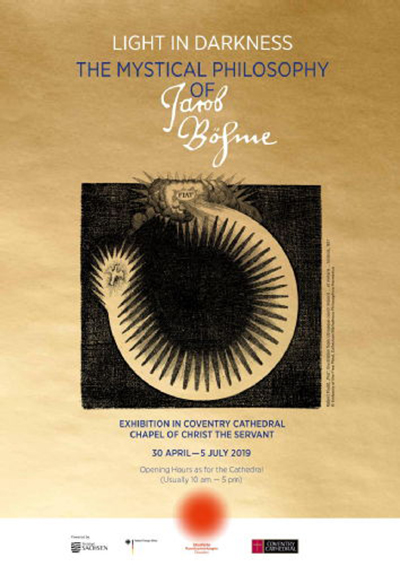
Exhibition catalogue: Claudia Brink, Lucinda Martin, and Cecilia Muratori, eds. Light in Darkness: The Mystical Philosophy of Jacob Böhme. Dresden: Sandstein, 2019.
This exhibition had some overlap with the Böhme exhibition curated by Claudia Brink and Lucinda Martin for the Staatliche Kunstsammlungen Dresden in 2017, discussed in Blake 52.1 (summer 2018).
Illustrations to Edward Young’s Night Thoughts (c. 1795–97), frontispiece, “The Christian Triumph.” Butlin #330.1.
Reproduction on cardboard panel.
Illustrations to Edward Young’s Night Thoughts (c. 1795–97), Night VIII, page 69. Butlin #330.415.
Reproduction on cardboard panel.
Newton (1795–c. 1805). Butlin #306.
Reproduction on cardboard panel.
10 May–25 August 2019
Weston Gallery, University of Nottingham
Romantic Facts and Fantasies: Culture and Heritage of the Romantic Age, c. 1780–1840
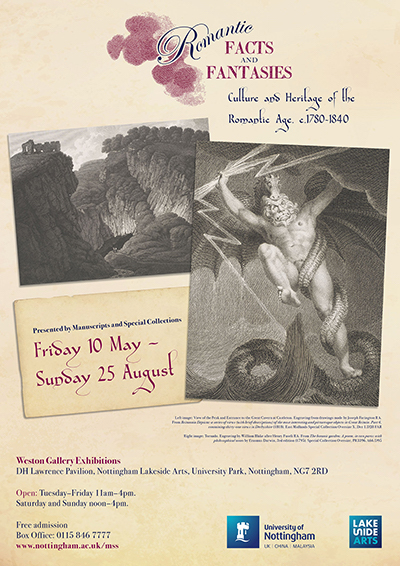
Blake’s engraving “Tornado” from Henry Fuseli’s design for Erasmus Darwin’s The Botanic Garden documented the tension between the “empirical observation of material reality” and “the power of the imagination” in this exhibition, curated by a team from the School of English and Manuscripts and Special Collections at the University of Nottingham to accompany the conference of the British Association for Romantic Studies. The exhibition also featured “The Reunion of the Soul & the Body,” engraved from Blake’s design for Robert Blair’s The Grave, to exemplify “a preoccupation with matters of the mind, the body and the soul” in the section entitled “Imagined Bodies and the Individual.” A Trianon facsimile of plate 57 of Jerusalem, displayed in the same section, represented the visionary power of “reimagined national bodies.” The curators used an excerpt from the plate as a title: “What is a Wife & what is a Harlot?” For plate 46 they adopted the title “Chimera,” a word that is absent from Blake’s corpus. This choice harnesses Blake’s imagination to the neoclassical world of Robert Adam’s grotesques and John Flaxman’s Hesiod.The closest point of contact with the classical figure of the chimera is Blake’s engraving of “Typhaon Echidna Geryon” in John Flaxman’s Compositions from the Works Days and Theogony of Hesiod (1817), where the chimera is represented as a fire-breathing half-lion, half-goat figure compressed in the bottom right corner of the composition. The scene represents a chariot drawn by hybrid human-animal creatures with the heads of bearded elders. A serpentine curl of hair coming out of each of their foreheads ends in a hand, one of which extends backward to grasp a writing implement from a bird-headed figure on its back, while the other points the way forward. They have quadruped bodies. Morton Paley argues that this illustration provides “almost a Rorschach test”: while Blake may have illustrated “the Plow of Jehovah, and the Harrow of Shaddai” (46.14, E 188), Foster Damon sees “the Serpent of Nature … drawn by the human-headed bulls of Luvah” and David Erdman sees unicorns. Paley thinks the hybrid animals evoke the sculptures of Nineveh and Persepolis, while the shaft and wheels of the chariot made of serpents allude to “the serpent-wheeled chariot in which Ceres rides in search of her daughter Proserpine,” reproduced in Abbé Montfaucon’s Antiquity Explained.Morton D. Paley, The Continuing City: William Blake’s “Jerusalem” (Oxford: Clarendon Press, 1983) 107-10. Susanne Sklar considers the chariot a mutated form of an interlinear illustration on plate 33, a georgic scene in which a plough is drawn by human-headed quadrupeds.Susanne M. Sklar, Blake’s “Jerusalem” as Visionary Theatre: Entering the Divine Body (Oxford: Oxford University Press, 2011) 190. In both plates 33 and 46 Blake’s decision to give human heads to the beasts of burden suggests a critique of animal labor, made much more dramatic by their intense eyes and apocalyptic cross-species multiplicity in plate 46. In presenting the human form subjected to the sprawling physicality of its hybrid animal limbs, Blake’s chariots may tease out the tension within the compound nature of Plato’s charioteer in Thomas Taylor’s Neoplatonic work, or the triumphal car of Dante’s Purgatory (Purgatorio 29-30). As the prophetic poem is turned into a series of plates for exhibition, titles recreate the individual elements as alternative forms, becoming what different readers behold in them. The dialectic of forms underlying Blake’s iconography of the chariot might feel lost in translation.
Erasmus Darwin, The Botanic Garden (3rd ed., 1795). Open to Blake after Henry Fuseli, “Tornado.”
University of Nottingham, Special Collection Oversize, PR3396.A66.D95.
Robert Blair, The Grave (2nd ed., 1813). Open to Luigi Schiavonetti after Blake, “The Reunion of the Soul & the Body.”
University of Nottingham, Special Collection Oversize, PR3318.B7.G7.
Jerusalem copy E (composed 1804–c. 1820, printed c. 1821), plate 57.
From “Jerusalem”: A Facsimile of the Illuminated Book (Trianon Press/Blake Trust, 1951), University of Nottingham, Special Collection Oversize X, PR4144.J4.
Jerusalem copy E (composed 1804–c. 1820, printed c. 1821), plate 46.
From “Jerusalem”: A Facsimile of the Illuminated Book (Trianon Press/Blake Trust, 1951), University of Nottingham, Special Collection Oversize X, PR4144.J4.
Jerusalem copy E (composed 1804–c. 1820, printed c. 1821), plate 37.
From “Jerusalem”: A Facsimile of the Illuminated Book (Trianon Press/Blake Trust, 1951), University of Nottingham, Special Collection Oversize X, PR4144.J4.
15 June–1 September 2019
Royal West of England Academy, Bristol
Fire: Flashes to Ashes in British Art, 1692–2019
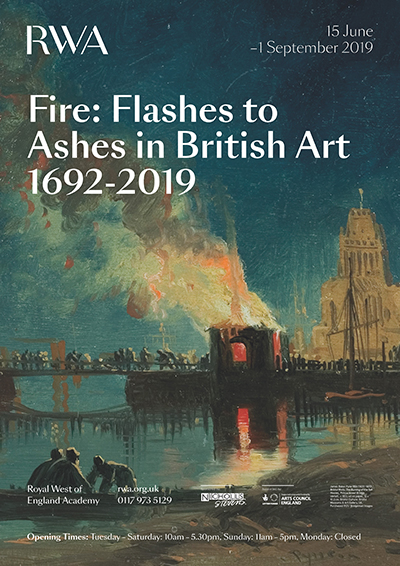
Exhibition catalogue: Gemma Brace, Rachael Nee, and Christiana Payne. Fire: Flashes to Ashes in British Art, 1692–2019. Bristol: Sansom and Company, 2019.
“It shines in Paradise. It burns in Hell. It is gentleness and torture. It is cookery and it is apocalypse. … Fire can contradict itself; thus, it is one of the principles of universal explanation”: Gaston Bachelard’s words from The Psychoanalysis of Fire were used as an epigraph to the third exhibition dedicated to the elements, after The Power of the Sea (2014) and Air (2017). This exhibition explored the destructive and beneficial aspects of fire. The fiery energy of Blake’s biblical visions joined company with Romantic works that illuminate mythical and historical conditions shaping the material imagination of fire: Godfried Schalcken’s A Boy Blowing on a Firebrand to Light a Candle (c. 1692–98), the spectacle of ships on fire in Samuel Scott’s French Firerafts Attacking the British Fleet off Quebec, 28 June 1759 (1767), John Robert Cozens’s Satan Summoning His Legions (c. 1776), Joseph Wright of Derby’s Vesuvius in Eruption, with a View over the Islands in the Bay of Naples (c. 1776–80), John Martin’s Sadak in Search of the Waters of Oblivion (1812), J. B. Pyne’s Bristol Riots: The Burning of the Toll Houses, Prince Street Bridge (c. 1831), and J. M. W. Turner’s Fire at the Grand Storehouse of the Tower of London (1841). From this rich Romantic nucleus, the exhibition ranged through nineteenth- and twentieth-century art. Just as in the 2018–19 Visions and Visionaries exhibition at the Guildhall Art Gallery, Blake’s work joined a canon of artist books that included the work of John Latham. Blake’s watercolor God Writing upon the Tables of the Covenant associates fire with divine writing on the tablets on Mount Sinai, while Latham shows how fire can mutate books in The Original Reading and Writing Machine (c. 1960), a mixed-media bookwork wired to electrical heating as part of his book-burning experiments of the 1960s. Among twenty-first-century engagements with fire on display, Douglas Gordon reflects on idol worship through the burnt photographic print, smoke and mirror Self Portrait of You + Me (2-piece Andy) (2008) and Tim Shaw captures Man on Fire (2009) in the medium of sculpture. Jeremy Deller’s textile banner Come Friendly Bombs and Fall on Eton (2018) shifts John Betjeman’s infamous line about Slough to the public school that most symbolizes the elitism of the British establishment; in another work on show, Deller has painted on wood the scene of the college burning.
God Writing upon the Tables of the Covenant (c. 1805). Butlin #448.
National Galleries of Scotland, D 2281.
The Good and Evil Angels (c. 1793–94). Butlin #257.
The Higgins, Bedford, P.272.
19 July 2019–5 January 2020
National Maritime Museum, Greenwich
The Moon
Exhibition catalogue: Melanie Vandenbrouck, Megan Barford, Louise Devoy, and Richard Dunn, eds. The Moon: A Celebration of Our Celestial Neighbour. London: Collins, 2019.
Blake’s book of emblems, open to the miniature image of the ladder held up to reach the moon, inaugurated the imagined and real experiences of travel commemorated in the landmark exhibition marking the fiftieth anniversary of the moon landing.
For the Sexes: The Gates of Paradise copy L (composed 1793, c. 1818; printed c. 1826–27), plate numbered 9 [Bentley 11], “I want! I want!”
Fitzwilliam Museum, P.444-1985.
11 September 2019–2 February 2020
Tate Britain, London
William Blake
Exhibition catalogue: Martin Myrone and Amy Concannon, with an afterword by Alan Moore. William Blake. London: Tate Publishing, 2019.
Tate Britain’s Blake retrospective reassessed Blake’s career as an artist, two decades since its previous retrospective had focused on him as a printmaker. We documented this exhibition with an interview with co-curator Martin Myrone before it opened, as well as a review after it closed that examined the works in the order in which they were hung on the walls; see Blake 53.1 (summer 2019) and 53.4 (spring 2020). The order given below follows the “List of Exhibited Works” in the catalogue (209-15), which differs from the exhibition hang discussed in the review. The most notable difference is that in the exhibition the last phase of Blake’s production was introduced by works associated with the patronage of John Linnell, with Jerusalem displayed in the final room.
Introduction
“Albion Rose” (first state, 1795). Butlin #284.
Huntington Library, Art Collections, and Botanical Gardens, 000.124.
Study for “Albion Rose” (c. 1780). Butlin #73 verso.
Victoria and Albert Museum, 8764C.
Academy Study: Standing Male Nude Seen from Behind (c. 1779–80). Butlin #72.
British Museum, 1874,1212.110.
Portrait of William Blake (c. 1802).
Collection of Robert N. Essick.
Catherine Blake (c. 1805). Butlin #683.
Tate, N05188.
“Blake Be an Artist!”
The Royal Academy
Anonymous, Cincinnatus (plaster cast, 1700s).
Royal Academy of Arts, 03/1488.
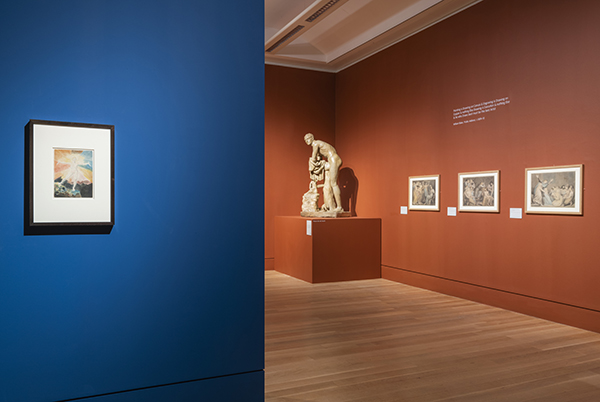
Drawing of Legs of Cincinnatus (c. 1779–80). Butlin #104A verso.
Bolton Museum & Archive.
Part of a Face: Copy from a Plaster Cast: A Daughter of Niobe? (c. 1779–80).
Butlin #178 verso.
Tate, A00045.
Abias (c. 1785). Butlin #168 verso.
British Museum, 1867,1012.206.
Thomas Stothard, Reclining Female Nude Viewed from the Back (c. 1800).
Royal Academy of Arts, 05/3082.
Attributed to Robert Blake, Sketchbook (1777). Butlin #R1.
Huntington Library, Art Collections, and Botanical Gardens, 000.54.
Attributed to Edward Francis Burney, Sketchbook (c. 1779–80).
Royal Academy of Arts, 09/1808.
Thomas Stothard, A Scene on the Medway (c. 1780–81).
Tate, T07042.
Early Watercolors and Drawings
Moses Receiving the Law (c. 1780). Butlin #111.
Yale Center for British Art, Paul Mellon Collection, B1975.4.1883.
Robert Blake, The Preaching of Warning (c. 1785). Butlin #R6 recto.
Tate, A00003.
The Good Farmer, Probably the Parable of the Wheat and the Tares (c. 1780–85). Butlin #123 recto.
Tate, N05198.
An Allegory of the Bible (c. 1780–85). Butlin #127.
Tate, T01128.
Job, His Wife, and His Friends: The Complaint of Job (c. 1785). Butlin #162 recto.
Tate, N05200.
Age Teaching Youth (c. 1785–90). Butlin #91.
Tate, N05183.
Joseph’s Brethren Bowing Down before Him (1784–85). Butlin #155.
Fitzwilliam Museum.
Joseph Ordering Simeon to Be Bound (1784–85). Butlin #156.
Fitzwilliam Museum.
Joseph Making Himself Known to His Brethren (1784–85). Butlin #157.
Fitzwilliam Museum.
The Exhibition of the Royal Academy, M.DCC.LXXXV. The Seventeenth (catalogue, 1785).
Tate Library and Archive.
The Spirit of a Just Man Newly Departed Appearing to His Mourning Family (c. 1780–85). Butlin #135.
Royal Collection, RCIN 913598.
Enoch Walked with God (c. 1780–85). Butlin #146.
Cincinnati Art Museum, 1977.214.
Oberon, Titania, and Puck with Fairies Dancing (c. 1786). Butlin #161.
Tate, N02686.
The Death of the Wife of the Biblical Prophet Ezekiel (c. 1785). Butlin #166.
Philadelphia Museum of Art, 1964-110-11.
Tiriel
Tiriel Supporting the Dying Myratana and Cursing His Sons (c. 1789). Butlin #198.1.
Yale Center for British Art, Paul Mellon Collection, B1977.14.4150.
John Boydell and Josiah Boydell, A Collection of Prints, from Pictures Painted for the Purpose of Illustrating the Dramatic Works of Shakspeare, by the Artists of Great Britain (1803). Open to Richard Earlom after Henry Fuseli, “King Lear, Act 1, Scene 1” (“King Lear Casting Out His Daughter Cordelia”) (1792).
Lord Egremont.
Har and Heva Bathing, Mnetha Looking On (c. 1789). Butlin #198.2.
Fitzwilliam Museum, PD.13-1953.
James Barry, “Jupiter and Juno on Mount Ida” (c. 1804–05).
Tate, T06584.
Har Blessing Tiriel While Mnetha Comforts Heva (c. 1789). Butlin #198.4.
British Museum, 1913,0528.7.
The Blind Tiriel Departing from Har and Heva (c. 1789). Butlin #198.6.
Collection of Robert N. Essick.
Tiriel Cursing His Sons and Daughters (c. 1789). Butlin #198.8.
Fitzwilliam Museum.
“Tiriel” (manuscript, c. 1789). Open to page numbered 5, “And aged Tiriel stood ….”
British Library, Egerton MS 2876.
Har and Heva Asleep with Mnetha Guarding Them (c. 1789). Butlin #198.11.
Fitzwilliam Museum, PD.161-1985.
Tiriel and His Children (c. 1789). Butlin #88 recto.
Harvard Art Museums/Fogg Museum, 1967.45.
Making Prints, Making a Living
Engraving and Illustration
“Joseph of Arimathea among the Rocks of Albion” (second state, c. 1820–25).
Fitzwilliam Museum.
James Basire after Benjamin West, “Pylades and Orestes” (1771).
Tate.
Blake after William Hogarth, “Beggar’s Opera, Act III” (probably third published state, c. 1795).
Tate, T06462.
Joseph Ritson, A Select Collection of English Songs, vol. 1 (1783).
Tate Library and Archive.
Wit’s Magazine, vol. 1 (1784).
Tate Library and Archive.
C. G. Salzmann, trans. Mary Wollstonecraft, Elements of Morality (3rd ed., 1792).
Tate Library and Archive.
Erasmus Darwin, The Botanic Garden (3rd ed., 1795).
Tate Library and Archive.
Mary Wollstonecraft, Original Stories from Real Life (new ed., 1796). Open to the frontispiece.
Tate Library and Archive.
John Gabriel Stedman, Narrative, of a Five Years’ Expedition (1796).
City of Westminster Archives.
William Enfield, The Speaker (new ed., 1797).
Tate Library and Archive.
William Shakespeare, The Plays of William Shakspeare, vol. 6 (1805).
Tate Library and Archive.
The History of England
“Edward and Elenor” (1793).
British Museum, 1938,0409.6.
The House of Death (c. 1790). Butlin #259.
Tate, N05192.
Pestilence (c. 1795–1800). Butlin #192.
Bristol Museum & Art Gallery, K2081.
Relief Etching and the Illuminated Books
Los and Orc (c. 1792–93). Butlin #255.
Tate, T00547.
“Hell beneath is moved for thee, to meet thee at thy coming”—Isaiah XIV.9 (c. 1780–85). Butlin #145.
Royal Collection, RCIN 913600.
Lucifer and the Pope in Hell (c. 1794–96). Butlin #287.
Huntington Library, Art Collections, and Botanical Gardens, 000.125.
There is No Natural Religion copy B (composed c. 1788, printed c. 1794). Open to plate 10 [Bentley b3], “Mans perceptions are not bounded ….”
Yale Center for British Art, Paul Mellon Collection, B1992.8.15(10).
For Children copy E (composed and printed 1793). Open to plate 1, “What is Man!”
Yale Center for British Art, Paul Mellon Collection, B1978.43.1484.
The Book of Thel copy I (composed 1789, printed c. 1789). Open to the title page.
Bodleian Libraries, Arch. A d.22.
The Marriage of Heaven and Hell copy B (composed and printed 1790). Open to the title page.
Bodleian Libraries, Arch. G d.53.
The Marriage of Heaven and Hell copy H (composed and printed 1790). Open to plates 14, “The ancient tradition …,” and 15, “A Memorable Fancy.”
Fitzwilliam Museum, P.123-1950.
Europe a Prophecy copy A (composed 1794, printed 1795). Open to the title page.
Yale Center for British Art, Paul Mellon Collection, B1992.8.4(2).
Europe a Prophecy copy E (composed and printed 1794). Open to plates 17, “Ethinthus queen of waters …,” and 18, “Shot from the heights of Enitharmon ….”
Library of Congress, Lessing J. Rosenwald Collection, 1806.
The First Book of Urizen copy G (composed 1794, printed c. 1818). Open to plate numbered 14 [Bentley 16].
Library of Congress, Lessing J. Rosenwald Collection, 1807.
Songs of Innocence and Songs of Innocence and of Experience
Songs of Innocence and of Experience copy S (composed 1789, 1794, printed c. 1811, 1795). Open to “The Tyger.”
Cincinnati Art Museum, 1969.509.8.
Songs of Innocence copy X (composed and printed 1789). All fourteen plates (seven leaves recto/verso) displayed.
National Gallery of Victoria, P122.1-14-1988.
Songs of Innocence, “The Shepherd” (c. 1795). Butlin #262A.
Yale Center for British Art, Paul Mellon Fund, B1978.1.2.
Songs of Innocence, “Spring” (c. 1795). Butlin #262B.
Yale Center for British Art, Paul Mellon Fund, B1978.1.1.
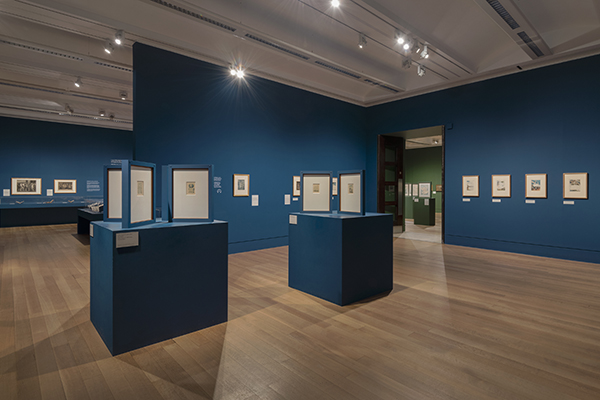
America a Prophecy
Frontispiece to America a Prophecy (1793).
Harvard Art Museums/Fogg Museum, G4316.
Three canceled plates from America a Prophecy bound in with six other plates (1793). Open to canceled plate c, “Then Albions Angel rose ….”
Library of Congress, Lessing J. Rosenwald Collection, 1805.
America a Prophecy copy M (composed 1793, printed c. 1807). All eighteen plates displayed.
Yale Center for British Art, Paul Mellon Collection, B1992.8.2(1-18).
The Books of Designs
A Large Book of Designs copy B (1796):
Visions of the Daughters of Albion, frontispiece. Butlin #264.
Visions of the Daughters of Albion, plate 4 [Bentley 7]. Butlin #265.
Tate, N03373, N03374.
A Small Book of Designs copy B (1796, c. 1818):
Urizen, plate 2. Butlin #261.5.
Tate, N03696.
A Small Book of Designs copy A (1796):
Plate 2. Butlin #260.2.
Plate 1. Butlin #260.1.
Plate 4. Butlin #260.4.
Plate 5. Butlin #260.5.
Plate 6. Butlin #260.6.
Plate 7. Butlin #260.7.
Plate 8. Butlin #260.8.
Plate 9. Butlin #260.9.
Plate 11. Butlin #260.11.
Plate 12. Butlin #260.12.
Plate 21. Butlin #260.21.
British Museum, 1856,0209.426, 425, 428-33, 435-36, 445.
A Large Book of Designs copy A (1796):
Plate 3. Butlin #262.3.
Plate 7. Butlin #262.7.
British Museum, 1856,0209.419, 423.
A Small Book of Designs copy B (1796, c. 1818):
Thel, plate 6 [Bentley 7].
Marriage, plate 16.
Urizen, plate 6 [Bentley 7].
Urizen, plate 10 [Bentley 11].
Urizen, plate 11 [Bentley 12].
Urizen, plate 15 [Bentley 17].
Urizen, plate 17 [Bentley 19].
Urizen, plate 21 [Bentley 23].
Tate, T13000-04, T12997-99.
Patronage and Independence
John Flaxman and George Cumberland
John Flaxman, Studies after William Blake (1792).
Private collection.
John Flaxman, Portrait of William Blake (c. 1804).
Yale Center for British Art, Paul Mellon Collection, B1992.8.11(59).
Edward Young, Night Thoughts (1797). Colored copy F.
Sir John Soane’s Museum, 3653.
Illustrations to Thomas Gray’s Poems (1797–98). “Ode on the Spring,” pages 1-2, and “Elegy Written in a Country Church-Yard,” pages 1-12, displayed. Butlin #335.1-2, 105-16.
Yale Center for British Art, Paul Mellon Collection, B1992.8.11(1), (53-58).
George Cumberland, Thoughts on Outline (1796).
Tate Library and Archive.
Thomas Butts
Thomas Butts (c. 1809). Butlin #376.
British Museum, 1942,1010.4.
Elizabeth Butts (1809). Butlin #377.
British Museum, 1942,1010.5.
Thomas Butts II (c. 1809). Butlin #378.
British Museum, 1942,1010.6.
The Body of Christ Borne to the Tomb (c. 1799–1800). Butlin #426.
Tate, N01164.
The Christ Child Asleep on the Cross (1799–1800). Butlin #411.
Victoria and Albert Museum, P.27-1953.
Christ Blessing the Little Children (1799). Butlin #419.
Tate, N05893.
The Conversion of Saul (c. 1800). Butlin #506.
Huntington Library, Art Collections, and Botanical Gardens, 000.29.
Samson Subdued (c. 1800). Butlin #455.
Philadelphia Museum of Art, 1964-110-4.
The Number of the Beast Is 666 (c. 1805). Butlin #522.
The Rosenbach, Philadelphia, 1954.0011.
Moses Striking the Rock (1805). Butlin #445.
Philadelphia Museum of Art, on loan from the Evangelical Lutheran Church in America.
Christ Girding Himself with Strength (c. 1805). Butlin #464.
Bristol Museum & Art Gallery, K2082.
The Crucifixion: “Behold Thy Mother” (c. 1805). Butlin #497.
Tate, N05895.
The Entombment (c. 1805). Butlin #498.
Tate, N05896.
The Magdalene at the Sepulchre (c. 1805). Butlin #504.
Yale Center for British Art, Paul Mellon Collection, B1975.4.1794.
Satan in His Original Glory: “Thou Wast Perfect Till Iniquity Was Found in Thee” (c. 1805). Butlin #469.
Tate, N05892.
The Great Red Dragon and the Beast from the Sea (c. 1805). Butlin #521.
National Gallery of Art, Washington, Rosenwald Collection, 1943.3.8997.
The Angel Rolling Away the Stone (c. 1805). Butlin #501.
Victoria and Albert Museum, P.7-1972.
David Delivered out of Many Waters (c. 1805). Butlin #462.
Tate, N02230.
The River of Life (c. 1805). Butlin #525.
Tate, N05887.
The Assumption (1806). Butlin #513.
Royal Collection, RCIN 913379.
Twelve Large Color Prints
Satan Exulting over Eve (c. 1795). Butlin #291.
Tate, T07213.
The Night of Enitharmon’s Joy (formerly Hecate) (c. 1795). Butlin #316.
Tate, N05056.
Pity (c. 1795). Butlin #310.
Tate, N05062.
Nebuchadnezzar (1795–c. 1805). Butlin #301.
Tate, N05059.
Newton (1795–c. 1805). Butlin #306.
Tate, N05058.
Elohim Creating Adam (1795–c. 1805). Butlin #289.
Tate, N05055.

The House of Death (1795–c. 1805). Butlin #320.
Tate, N05060.
The Good and Evil Angels (1795–c. 1805). Butlin #323.
Tate, N05057.
Lamech and His Two Wives (1795). Butlin #297.
Tate, N05061.
Christ Appearing to the Apostles after the Resurrection (c. 1795). Butlin #327.
Tate, N05875.
God Judging Adam (1795). Butlin #294.
Tate, N05063.
Naomi Entreating Ruth and Orpah to Return to the Land of Moab (c. 1795). Butlin #299.
Victoria and Albert Museum, 69-1894.
Illustrations to Milton for the Rev. Joseph Thomas
Illustrations to John Milton’s Paradise Lost (1807). All twelve watercolors displayed. Butlin #529.
Huntington Library, Art Collections, and Botanical Gardens, 000.1-2, 4-13.
Illustrations to John Milton’s On the Morning of Christ’s Nativity (1809). All six watercolors displayed. Butlin #538.
The Whitworth, Manchester, D.1892.26-31.
Illustrations to Shakespeare for the Rev. Joseph Thomas
Six Extra-Illustrations to a Second Folio Edition of Shakespeare (1806, 1809). Four watercolors displayed: Brutus and Caesar’s Ghost, Queen Katharine’s Dream, Jacques and the Wounded Stag, and Richard III and the Ghosts. Butlin #547.4, 3, 1, 2.
British Museum, 1954,1113.1.26, 22, 11, 21.
William Hayley and Sussex
Milton a Poem copy D (composed c. 1804–11, printed 1818). Open to plate 40 [Bentley 36], “When on the highest lift ….”
Library of Congress, Lessing J. Rosenwald Collection, 1810.
Blake after George Romney, William Cowper (1801). Butlin #353.
Cowper and Newton Museum.
The Rev. John Johnson (1802). Butlin #347.
Cowper and Newton Museum.
Attributed to Blake, Thomas Alphonso Hayley (c. 1800). Butlin #345.
Yale Center for British Art, Yale Art Gallery Collection, B1979.12.741.
Landscape near Felpham (c. 1800). Butlin #368.
Tate, A00041.
The Entrance Front of Hayley’s House at Eartham (1801). Butlin #369.
Yale Center for British Art, Paul Mellon Collection, B1981.25.2396.
Landscape with Spire (c. 1801). Butlin #371.
Yale Center for British Art, Paul Mellon Collection, B1977.14.4922.
A Woody Landscape (c. 1801). Butlin #372.
Yale Center for British Art, Paul Mellon Collection, B1977.14.4923.
Heads of the Poets (1800–03). Five temperas displayed: William Shakespeare, William Cowper, Edmund Spenser, John Milton, and Dante Alighieri. Butlin #343.10, 17, 9, 11, 4.
Manchester City Galleries, 1885.2, 9, 5, 3, 16.
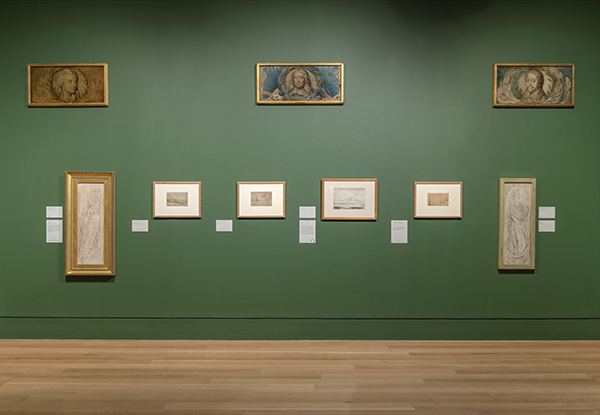
West Sussex Record Office, Crookshank 327.
Sketch for the Frontispiece to “The Lion” (1802). Butlin #364 verso.
Royal Academy of Arts, 07/1418.
The Horse (c. 1805). Butlin #366.
Yale Center for British Art, Paul Mellon Collection, B2001.2.34.
William Hayley, The Life, and Posthumous Writings, of William Cowper, vols. 1-2 (1803).
Tate Library and Archive.
William Hayley, The Triumphs of Temper (13th ed., 1807).
Tate Library and Archive.
Evening (c. 1805). Butlin #809.
National Gallery of Art, Washington, 1990.22.1.
Winter (c. 1805). Butlin #808.
Tate, T02387.
Paintings for Elizabeth Ilive, Countess of Egremont
Satan Calling Up His Legions (1800–05). Butlin #662.
Petworth House (National Trust), NT 486264.
The Vision of the Last Judgment (1808). Butlin #642.
Petworth House (National Trust), NT 486270.
Independence and Despair
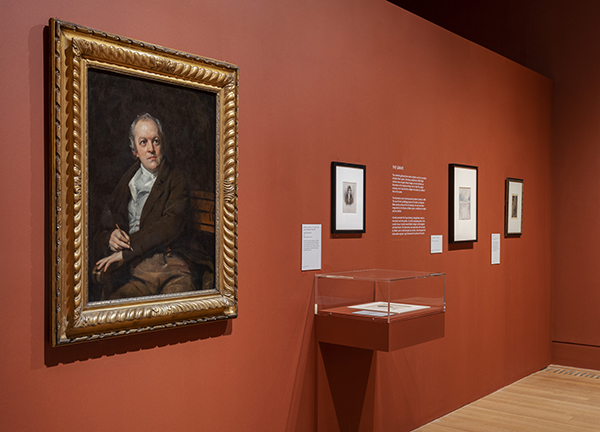
Thomas Phillips, William Blake (1807).
National Portrait Gallery, NPG 212.
Benjamin Malkin, A Father’s Memoirs of His Child (1806).
Tate Library and Archive.
John Flaxman, Portrait of Robert Hartley Cromek (c. 1804).
Fitzwilliam Museum.
Anthony Cardon after Henry Edridge, “Luigi Schiavonetti” (1811).
National Portrait Gallery, NPG D48178.
Title Page for “The Grave” (1806). Butlin #616.
Huntington Library, Art Collections, and Botanical Gardens, 000.30.
The Death of the Good Old Man (1805).
Collection of Robert N. Essick.
Death of the Strong Wicked Man (1805).
Musée du Louvre, RF 54420 recto.
The Soul Hovering over the Body Reluctantly Parting with Life (1805). Butlin #625.
Tate, N05300.
The Counseller, King, Warrior, Mother and Child, in the Tomb (1805).
Collection of Robert N. Essick.
Heaven’s Portals Wide Expand to Let Him In (1805).
Collection of Robert N. Essick.
Christ Descending into the Grave (1805).
Private collection.
Friendship (1805).
Private collection.
“Deaths Door” (1805).
Collection of Robert N. Essick.
Robert Blair, The Grave. Four copies displayed: three from 1808 and one from 1813.
Tate Library and Archive, Lord Egremont, Sir John Soane’s Museum, City of Westminster Archives.
José Joaquín de Mora, Meditaciones poéticas (1826).
University of Liverpool Library.
The 1809 Exhibition and Fresco Painting
The Spiritual Form of Nelson Guiding Leviathan (c. 1805–09). Butlin #649.
Tate, N03006.
The Spiritual Form of Pitt Guiding Behemoth (1805?). Butlin #651.
Tate, N01110.
The Bard, from Gray (1809?). Butlin #655.
Tate, N03551.
Satan Calling Up His Legions (1795–1800). Butlin #661.
Victoria and Albert Museum, P.8-1950.
The Soldiers Casting Lots for Christ’s Garment (1800). Butlin #495.
Fitzwilliam Museum, PD.30-1949.
Christ in the Sepulchre, Guarded by Angels (c. 1805). Butlin #500.
Victoria and Albert Museum, P.6-1972.
Ruth the Dutiful Daughter-in-Law (1803). Butlin #456.
Southampton City Art Gallery.
The Penance of Jane Shore in St. Paul’s Church (c. 1793). Butlin #69.
Tate, N05898.
Catalogue of the Fifth Annual Exhibition by the Associated Painters in Water Colours (1812).
Tate Library and Archive.
The Exhibition of the Royal Academy, M.DCCCVIII. The Fortieth (catalogue, 1808).
Tate Library and Archive.
The Virgin and Child in Egypt (1810). Butlin #669.
Victoria and Albert Museum, P.25-1953.
An Allegory of the Spiritual Condition of Man (1811?). Butlin #673.
Fitzwilliam Museum, PD.27-1949.
Canterbury Pilgrims
“Chaucers Canterbury Pilgrims” (probably third state, c. 1810–20).
Lord Egremont.
“Chaucers Canterbury Pilgrims” (fifth state, or a late impression of the fourth state of c. 1820–25 lacking the drypoint inscriptions).
Tate, P14339.
Luigi Schiavonetti and James Heath after Thomas Stothard, “The Pilgrimage to Canterbury” (1809–17).
Tate, T06857.
William Carey, Critical Description of the Procession of Chaucer’s Pilgrims to Canterbury, Painted by Thomas Stothard, Esq. R. A. (1808).
Tate Library and Archive.
“A New Kind of Man”
Jerusalem
Jerusalem copy H (composed 1804–c. 1820, printed c. 1832).
Fitzwilliam Museum.
Jerusalem copy B (composed 1804–c. 1820, printed c. 1820). All twenty-five plates displayed.
Private collection.
Jerusalem, plates 28 and 35 (recto/verso proof impressions, c. 1820).
Yale Center for British Art, Paul Mellon Collection, B1992.8.1(105).
John Linnell, Samuel Palmer, and John Varley
John Linnell, William Blake Wearing a Hat (c. 1825).
Fitzwilliam Museum.
The Ghost of a Flea (c. 1819). Butlin #692.94.
Private collection.
The Ghost of a Flea (c. 1819–20). Butlin #750.
Tate, N05889.
William Blake and John Varley, The [Larger] Blake/Varley Sketchbook (1819).
Private collection.
Old Parr When Young (1820). Butlin #748.
Huntington Library, Art Collections, and Botanical Gardens, 000.48.
The Death Chamber (possible sketch for Jerusalem, c. 1800–07). Butlin #565.
Harvard Art Museums/Fogg Museum, 1959.162.
Illustrations to Robert Thornton’s Pastorals of Virgil (c. 1821, printed 1830, probably by Edward Calvert).
Tate, A00111-27.
Robert Thornton, The Pastorals of Virgil (3rd ed., 1821).
City of Westminster Archives.
Illustrations to John Milton’s Paradise Lost (1822), The Creation of Eve. Butlin #537.2.
National Gallery of Victoria, 1024-3.
Illustrations of the Book of Job (1826). Four copies displayed.
Ashmolean Museum, Lord Egremont (2), City of Westminster Archives.
The Body of Abel Found by Adam and Eve (c. 1826). Butlin #806.
Tate, N05888.
Satan Smiting Job with Sore Boils (c. 1826). Butlin #807.
Tate, N03340.
Illustrations to Dante for John Linnell (1824–27)
The Inscription over the Gate. Butlin #812.4.
Tate, N03352.
Cerberus. Butlin #812.12.
Tate, N03354.
Plutus. Butlin #812.14.
Tate, N03355.
Capaneus the Blasphemer. Butlin #812.27.
National Gallery of Victoria, 997-3.
The Symbolic Figure of the Course of Human History Described by Virgil. Butlin #812.28.
National Gallery of Victoria, 998-3.
The Simoniac Pope. Butlin #812.35.
Tate, N03357.
The Devils Setting Out with Dante and Virgil. Butlin #812.39.
National Gallery of Victoria, 1003-3.
The Thieves and the Serpents. Butlin #812.47.
National Gallery of Victoria, 1004-3.
Vanni Fucci “Making Figs” against God. Butlin #812.49.
National Gallery of Victoria, 1005-3.
The Six-Footed Serpent Attacking Agnolo Brunelleschi. Butlin #812.51.
National Gallery of Victoria, 1006-3.
The Serpent Attacking Buoso Donati. Butlin #812.53.
Tate, N03361.
Ephialtes and Two Other Titans. Butlin #812.62.
National Gallery of Victoria, 1011-3.
The Lawn with the Kings and Angels. Butlin #812.76.
National Gallery of Victoria, 1016-3.
Dante and Virgil Approaching the Angel Who Guards the Entrance of Purgatory. Butlin #812.78.
Tate, N03367.
Dante and Statius Sleeping, Virgil Watching. Butlin #812.86.
Ashmolean Museum, WA1918.3.
Matilda and Dante on the Banks of the Lethe with Beatrice on the Triumphal Chariot. Butlin #812.87.
British Museum, 1918,0413.5.
Beatrice Addressing Dante from the Car. Butlin #812.88.
Tate, N03369.
Beatrice and Dante in Gemini, amid the Spheres of Flame. Butlin #812.93.
Ashmolean Museum, WA1918.5.
Saint Peter, Saint James, and Saint John with Dante and Beatrice. Butlin #812.96.
British Museum, 1918,0413.6.
Blake’s Illustrations of Dante (engravings, composed 1826–27).
City of Westminster Archives.
Illustrations to Bunyan’s Pilgrim’s Progress (1824–27)
Illustrations to John Bunyan’s Pilgrim’s Progress. Twenty-eight watercolors displayed. Butlin #829.1-19, 21-29.
Private collection.
The Final Paintings
The Sea of Time and Space (1821). Butlin #803.
Arlington Court (National Trust), NT 985730.
The Characters in Spenser’s “Faerie Queene” (c. 1825). Butlin #811.
Petworth House (National Trust), NT 486263.
Epitome of James Hervey’s “Meditations among the Tombs” (c. 1820–25). Butlin #770.
Tate, N02231.
“The Ancient of Days” (colored 1827). Butlin #271.
The Whitworth, Manchester, D.1892.32.
12 October 2019–22 March 2020 [gallery closed 21 March; exhibition extended to 6 September]
The Higgins, Bedford
Dreams and Nightmares
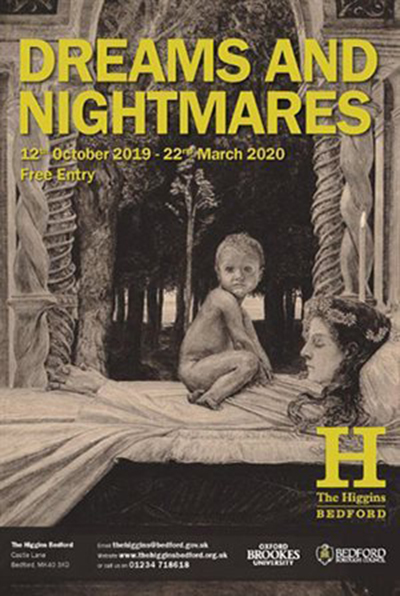
Exhibition catalogue: Christiana Payne and Victoria Partridge. Dreams and Nightmares. Bedford: The Higgins, 2019.
This exhibition showcased a selection of works from the collection of The Higgins. One month after the end of Fire: Flashes to Ashes in British Art, 1692–2019, Blake’s The Good and Evil Angels (c. 1793–94) returned to its home to reappear in the different context of dreams and nightmares, structured around manifestations of unconscious fears, nightmares, and the supernatural, but also romantic dreams, daydreams, and dreamscapes. The catalogue places Blake’s work in a section dedicated to “Sublime and Spiritual Visions,” next to “Creation of the Universe” (c. 1893) by Paul Gauguin and Henry Moore’s Death of the Suitors, “The Odyssey” (1944). But the work’s title and iconography shift when placed against other areas of the exhibition, since the child-snatching theme resonates with an earlier section on witches, which featured Richard Westall’s Macbeth and the Witches (c. 1797), John Anster Fitzgerald’s Fairy Lovers in a Bird’s Nest Watching a White Mouse (c. 1860), Richard Doyle’s The Altar Cup of Aagerup (1883) and Riding through the Air, and Arthur Rackham’s Moonlight, Pixies in the Wood. Blake’s connection with some of these works might have been mediated by Henry Fuseli’s The Nightmare (1781), which is certainly an iconographic source for Max Klinger’s “Dead Mother” (1898), the arresting etching reproduced on the exhibition poster. Blake’s late miniature wood engravings “Sabrina’s Silvery Flood” and “Colinet’s Fond Desire Strange Lands to Know” for Robert Thornton’s Pastorals of Virgil featured alongside Samuel Palmer’s etching “The Early Ploughman” (c. 1861), Palmer’s watercolor with body color The Bellman (from Il penseroso) (1881), and Graham Sutherland’s etching “The Village” (1925), reflecting the experience of nature “transfigured by effects of light and by the selection and careful delineation of detail, like a particularly vivid dream.”Christiana Payne, catalogue p. 67. These dreamscapes concluded the exhibition.
The Good and Evil Angels (c. 1793–94). Butlin #257.
The Higgins, Bedford, P.272.
Illustrations to Robert Thornton’s Pastorals of Virgil (c. 1821), “Sabrina’s Silvery Flood.”
The Higgins, Bedford, P.603.
Illustrations to Robert Thornton’s Pastorals of Virgil (c. 1821), “Colinet’s Fond Desire Strange Lands to Know.”
The Higgins, Bedford, P.604.
21 November 2019–8 March 2020
British Museum, London
Troy: Myth and Reality
Exhibition catalogue: Alexandra Villing, J. Lesley Fitton, Victoria Donnellan, and Andrew Shapland. Troy: Myth and Reality. London: Thames & Hudson, 2019.
The British Museum offered a multimedia review of the story of Troy, which presented each episode through a proliferation of narrative versions and variations. Blake’s watercolor was part of the final section, showcasing the reception of Troy in history, including modern retellings, translations, and pictorial representations.
The Judgment of Paris (c. 1806–17). Butlin #675.
British Museum, 1949,1112.4.
26 November 2019–26 April 2020 [museum closed 17 March]
Fitzwilliam Museum, Cambridge
Feast and Fast: The Art of Food in Europe, 1500–1800
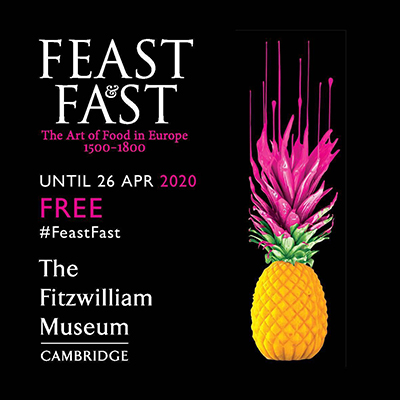
Exhibition catalogue: Victoria Avery and Melissa Calaresu, eds. Feast and Fast: The Art of Food in Europe, 1500–1800. London: Bloomsbury, 2019.
This exhibition explored the iconography, ideology, identity, and history of food through almost 300 objects in different media. The watercolor Christ Refusing the Banquet Offered by Satan, one of twelve illustrations to John Milton’s Paradise Regained (c. 1816–20) owned by John Linnell, documents temptation and abstinence. Featured religious iconography also referenced the temptation of Adam and Eve and food rituals, such as Jan Sadeler’s “Preparation for the Passover” (c. 1585) from Exodus. Abraham Bosse’s “Taste” (c. 1638) suggests the multisensory appeal of food, which the exhibition explored through artifacts ranging from still lifes to landscapes, from Meissen to Staffordshire and Chelsea porcelain figurines and vessels fashioned in the shape of food, from trompe l’oeil plates to edible sugar architectural centerpieces.
Illustrations to John Milton’s Paradise Regained (c. 1816–20), Christ Refusing the Banquet Offered by Satan. Butlin #544.6.
Fitzwilliam Museum, PD.18-1950.