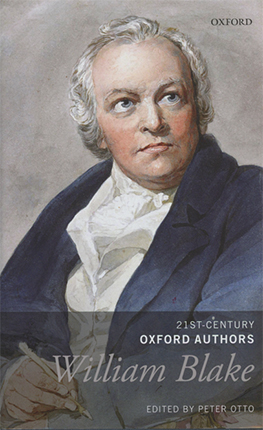
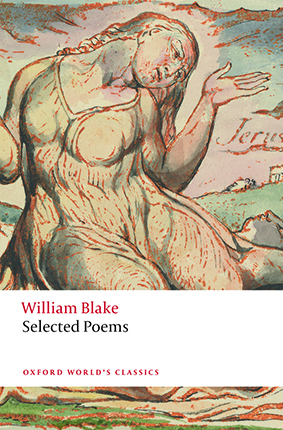
As one expects of Oxford University Press, these two new selected editions of works by Blake are competently and thoughtfully executed. One also expects critical and editorial conservatism from Oxford; although both editors have freshened the introductions and notes and organized the works in original ways, these editions offer few innovations even in comparison with Bentley’s 1978 two-volume Oxford edition.G. E. Bentley, Jr., ed., William Blake’s Writings, 2 vols. (Oxford: Clarendon Press, 1978). Indeed, it could be said that in presenting the visual aspects of Blake’s work the new ones are even less adventurous, in that there appear to be fewer supplementary images of Blake’s actual words and designs in the Otto volume, and except for a detail image of a page on the cover, none at all in Shrimpton’s. This apparent regression may be due to the advent of alternative means of promulgating Blake’s work, which have made clear color images of illuminated pages widely available, especially in the sophisticated and fairly inexpensive Princeton/Blake Trust volumes, single-work facsimile editions, and, even more significantly, in the vast resources of the online William Blake Archive. Given that incorporating monochromatic snippets or even whole pages from illuminated books increases the cost and complexity of publishing, distorts the reader’s experience of the Blakean page, and provides only a small portion of Blake’s visual component, it makes sense for conventional publishers to refer interested readers to the archive or facsimiles rather than trying to convey the full visual aspect of his work in a mostly typographic text. That said, the recent editions of Blake works that combine thorough notes, full-size color images of all pages, and sophisticated transcriptions of the texts are much more satisfactory for most purposes than partially visual editions, and there is reason to wonder whether the world needs another collection that barely acknowledges the visual dimension.
Of the two new editions, Shrimpton’s paperback assortment of mostly complete poems is, at a small fraction of the price of the more comprehensive hardcover-only Otto edition, the more likely to be considered for classroom use. The choice of works will surprise those who order this edition without checking the contents: as a collection of the “Selected Poems,” it omits important works in verse (for instance, The Book of Thel, Tiriel, and Vala/The Four Zoas), omits all prose (except some in Jerusalem), and reduces the Menippean Marriage of Heaven and Hell to its two poems, only one of which is listed in the index by title.
The texts are an eclectic amalgam of what Shrimpton considers to be the “earliest reliable”Both of these editorial criteria are somewhat problematic to apply. Shrimpton argues that the earliest texts are best because “Blake’s revisions further complicated what were already complex poems” (xxxvi). source texts combined with ostensibly authorial punctuation. They have “in practice, been made by removing the modernizing editorial interventions from the text established by Geoffrey Keynes in 1957 …” (xxxvii), restoring Blake’s spelling and capitalization, then supplying punctuation based on several sources (but not, as far as I can tell, by examining actual copies of Blake books). Shrimpton’s illuminated texts resemble those of recent editors who follow one particular Blakean source or another, but the punctuation marks don’t correspond to those in any specific existing or theoretically reconstructed authorial text. These edited texts aren’t seriously misleading or unreadable, but I don’t believe they represent Blake’s intentions at any identifiable stage.
Annotating any text for classroom use requires both learning and discretion. Most publishers suggest that editors should provide information not easily available in reference books and perhaps indicate where one might begin further research, but not do all the interpretive work for readers or trample on subtle ambiguities. Even if one doesn’t explain everything, a few judiciously selected notes can indicate how readers can figure similar things out for themselves. Many of Shrimpton’s notes address matters that aren’t in a dictionary, such as explaining who “Tom Cooke” was (377; unfortunately, Shrimpton follows Blake’s misspelling of Cook). But other notes seem to be provided only because the editor has spotted an unrecognized potential allusion or similar reference, one that may or may not be useful. For instance, rather than discussing greensickness in reference to the line “My face turns green and pale” in “Nurse’s Song” of Experience, Shrimpton’s note quotes Iago on the “green-ey’d monster” Jealousy, which is (I hope) a novel connection but is at most obliquely relevant. Similarly, the very next note, the only one on “The Sick Rose,” cites an obscure and barely germane passage from Edward Young:
The image [of a rose infected by an unseen worm] is taken from the account of Philander’s tuberculosis in Young’s Night Thoughts (1.355): “Death’s subtle seed … beckon’d the worm to riot on that rose so red.” Like tigers, malign bacteria are difficult to reconcile with the concept of a loving God. (356-57)
The passage, though surely known to Blake, is no more relevant than familiar references to cankerworms, buds, and roses in Shakespeare, and far less interestingly resonant with “The Sick Rose” than my favorite intertext for this poem, Matthew Prior’s toxic jibe “A True Maid,” which captures the themes of sexual secrecy and hypocrisy and would also have been familiar to Blake and many in his adult audience:
No, no; for my virginity,
When I lose that, says Rose, I’ll die:
Behind the elms, last night, cried Dick,
Rose, were you not extremely sick?
Having Prior’s poem in one’s head isn’t essential to reading “The Sick Rose,” and I’m not sure it belongs in the notes of a general edition, since its woman is literal and its flower is metaphorical, but I can’t see how the Night Thoughts quotation or Shrimpton’s remark about “malign bacteria” (which are in Young, not Blake) would clarify anything at all to innocent or experienced readers.
Because the paradoxical logic of many of the “Auguries of Innocence” (77-81) is virtually enthymemic, requiring readers to supply additional information, the poem is a good place to measure an annotator’s performance. Shrimpton’s guidance is uneven at best. In the two-part opening augury, he does not explain (or need to) that a robin caged against its will is an offense against heaven, or that by contrast a pigeon or dove eagerly enters a dovehouse, but most students could use help to see why the dovehouse “Shudders Hell.” An appropriate note might be “Shudders Hell: Causes an earthquake like the one associated with the Harrowing of Hell,” which would give readers a start without spilling all the beans. Shrimpton recognizes and helpfully untangles a few such allusions, but his note on “The Game Cock clipd & armd for fight / Does the Rising Sun affright” (78) reports unhelpfully that “cockfighting was legal in England and Wales until 1835 (and Scotland until 1895)” (369). He does not mention that the gamecock’s wings were clipped so it couldn’t fly away and its talons augmented with steel blades, nor that in civilian life the gamecock would be a rooster, herald to the rising sun. For the couplet “He who torments the Chafers sprite / Weaves a Bower in endless Night,” Shrimpton glosses “Chafers” as “beetles” (369), which is true but actually interferes with understanding the poem. “Beetles” not only makes a nominative plural of what is clearly a possessive singular, but it blurs the chafer into generic insectitude, discouraging further investigation. In Blake, species matter: a little research shows that chafers (cockchafers) spend a long larval period underground before emerging as adults, at which stage they are famously attracted to lights at night; the torturer would atone in the prophetic dimension by enacting the chafer’s phototropic life cycle in reverse.
Through much of the epics Milton and Jerusalem (these are printed in full), the notes are comparatively plentiful and helpful, though there are still long stretches in which the editor seems to have wandered off to annotate some other text and left readers to their own devices. And yet, bacteria and chafers notwithstanding, when Shrimpton is at his best he is an alert (if rather quirky) reader and explainer of Blake; I suspect that those who don’t need his notes will find them more interesting than those who do. That is also true of his “Chronology of William Blake,” which is more thorough than most in placing Blake and his works (including omitted ones) in the context of culture and politics of his time, but does not indicate to beginners which juxtapositions are significant or why.
I wouldn’t use Shrimpton’s edition to teach an introductory course on Blake because I couldn’t do without The Book of Thel, Vala/The Four Zoas, or The Marriage of Heaven and Hell, and even students in an advanced class focusing on Milton and Jerusalem would need to refer to these missing works. For other reasons, most notably price, I am also unlikely to choose Peter Otto’s much larger edition of Blake’s writings, though it has virtues: its apparatus is more extensive and it is much more attentive to the visual aspects of Blake’s work, in that the typographic text is supplemented by monochrome images of many important marginal illuminations, images of whole illuminated pages, and additional images, such as a close-up picture of the only remaining fragment of a Blake relief plate. Further, the notes discuss many of Blake’s illuminations in considerable detail. Whereas it is possible to read through all of Shrimpton’s notes and headnotes at a single long sitting, Otto’s edition offers 160 pages of scholarly elaboration in tiny type. Even so, the explanations of potentially puzzling details are strangely fitful, often not much more thorough than those in Shrimpton and sometimes less so. For instance, the farce known as “An Island in the Moon” has very thorough notes about allusions to contemporary events and persons, but those visionary couplets of “Auguries of Innocence” (480-83) are afforded a single note that identifies a parallel passage but clarifies very little (753). Far from handing us the ends of Blake’s golden strings, many of the annotations merely identify similar echoes and allusions, an empty simulacrum of scholarly assistance. Further, the availability of a note is not signaled within the text, so readers must check the back of the book regularly to see if they are missing something. On the other hand, Otto’s headnotes are often expansive and broadly interpretive, including not only longstanding consensus readings but also summaries of selected recent scholarship on particular works, representing an assortment of critical approaches of variable recentness, usefulness, and quality. All told, Otto’s commentary is more helpful than Harold Bloom’s interpretive notes in the Erdman editions ever were, but much of the discussion of recent material will seem very dated in a few years, and some already does.
Unlike Shrimpton, who organizes his edition in such arbitrary categories as “Narrative Poems,” “Brief Epic,” and “Diffuse Epic,” Otto arranges the texts semi-chronologically, lining up clusters of work from a given time period. I haven’t tried using this edition in a class, and probably won’t, but the arrangement has some appeal as a strategy for presenting Blake to students, in that one can better appreciate Blake’s various and ironic stances when one considers, say, Songs of Innocence, The Marriage of Heaven and Hell, and the annotations to Swedenborg together. But who reads a poetry textbook through in page order? For me the chronological organization is more confusing than edifying, and in an edition that omits so much it seems wasteful to print the Songs of Innocence once in the context of the late 1780s and then again a hundred pages later in conjunction with Experience. It is always possible to construct a chronological presentation of texts by having students read them together (or apart), so the pedagogical advantages of this arrangement can be approximated without ordering the edition itself that way.
Otto’s texts of both the illuminated books and other textual categories are essentially touched-up versions of David V. Erdman’s E. For illuminated books, Otto appears to have extended Erdman’s “largest printed mark” eclectic reconstruction of the text and punctuation that Blake wrote backward on the plate, finding larger printed marks (or reading the same marks as larger). As a result, Otto’s versions are more conventionally punctuated than those in E, with more commas and fewer full stops in mid-sentence. Paradoxically, it seems that Otto’s text, by following a reconstructed version of Blake’s most deliberate punctuation, is easier to read in places than Shrimpton’s more aggressively interventional text.
Although Otto’s edition is much longer, it is by no means complete; many short works are omitted altogether, it abridges Jerusalem, “A Vision of the Last Judgment,” and Vala, among others, and it includes only a few of Blake’s letters and limited annotations of other authors. “The Mental Traveller” is present, while “Blakes apology for his Catalogue,” like much of his other pungent doggerel, is not (or at least I think it is not—as a result of chronological ordering, this edition is difficult to navigate or survey in categorical terms). I have never tried to teach the parts of Jerusalem or “A Vision of the Last Judgment” omitted here, so I miss them less than the omitted works in Shrimpton, but many of the abridgments could have been restored if the book were even fifty pages longer. Perhaps those additional pages would have raised the price of the hardcover from exorbitant to ridiculous, but I wonder how many people will want to pay the current high price for a book that leaves out so much.