Maurice Sendak studied Blake’s art and poetry,I would like to thank Robert N. Essick and Justin G. Schiller for fielding my queries about the fall 2018 exhibition of Sendak drawings at the Society of Illustrators in New York City. Any inaccuracies are entirely my own. and collected drawings, watercolors, illuminated books, and prints. In interviews, he frequently professed his adoration of Blake, stating in 2001, “I love Blake; I have all my life.”Philip Nel, “‘Don’t assume anything’: A Conversation with Maurice Sendak,” Conversations with Maurice Sendak, ed. Peter C. Kunze (Jackson: University Press of Mississippi, 2016) 120. The experimental synthesis of the verbal and visual in much of Sendak’s work is self-consciously Blakean, a deliberate evocation of the composite art of the illuminated books that is perhaps seen most forcefully in his final work, My Brother’s Book, completed before Sendak’s death in May 2012 but published posthumously.See Mark Crosby, “Sendak, Blake, and the Image of Childhood,” William Blake and the Age of Aquarius, ed. Stephen F. Eisenman (Princeton: Princeton University Press, 2017) 185-97. In a much earlier work, a 1967 Christmas keepsake published by Bodley Head, we find Sendak engaging directly with the man whom he described in a 1970 interview as “my teacher in all things.”Maurice Sendak, “The Coming Together of All My Various Worlds: Maurice Sendak on Receiving the Hans Christian Andersen Illustrator’s Medal,” Top of the News 26 (1970): 368.
After recovering from a major heart attack during a 1967 promotional tour in northern England, and grateful to Judy Taylor, his editor at Bodley Head, for whisking him to hospital, Sendak created seven pen-and-ink drawings illustrating seven poems from Songs of Innocence. John Ryder, art director at Bodley Head, subsequently commissioned the Christmas keepsake, Poems from William Blake’s “Songs of Innocence,” which reproduces the text of Blake’s poems with Sendak’s interlinear, headpiece, and tailpiece illustrations. This slim volume had a print run of only 275 copies, which were given to friends of the publishing house. In 1968, Sendak gave Taylor his original drawings with a copy that contains a dedication: “My Sketches—my original Blake pictures” as “sufficient example … of my devotion—affection—for you.”Sendak and Blake Illustrating “Songs of Innocence,” fig. 2. The drawings, according to the antiquarian bookdealer Justin G. Schiller, “hung on her wall at home for half a century.”E-mail correspondence with Mark Crosby, 13 December 2019.
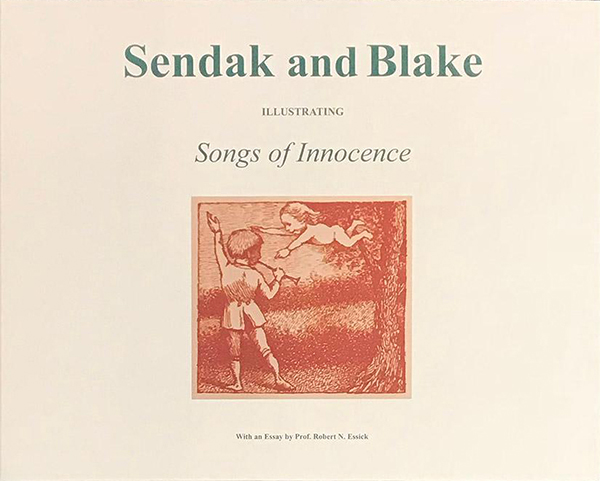
Between 23 October and 3 November 2018, the Society of Illustrators in New York exhibited Sendak’s seven original pen-and-ink drawings and twenty-two pencil preparatory studies. To accompany the exhibition, Battledore Ltd. published a lavishly illustrated catalogue reproducing Sendak’s published illustrations, the pen-and-ink drawings, pencil studies, and a selection of related plates from Songs of Innocence, along with a short introductory essay and commentaries on Sendak’s drawings and Blake’s plates by Robert N. Essick. According to Schiller, the pen-and-ink drawings and preparatory studies constitute the only complete set of artwork for a Sendak title “still in private hands.”E-mail correspondence with Mark Crosby, 13 December 2019. The exhibition and its catalogue were the first public appearance of these drawings.
Sendak and Blake Illustrating “Songs of Innocence” opens with Essick’s essay discussing some of the similarities between Blake’s and Sendak’s respective approaches to illustration. It is pitched at a nonspecialist audience, adroitly summarizing the accepted view that for Blake illustration was, as Essick puts it, “a mode of critical commentary,” where pictorial motifs operate in a variety of ways to create meaning, such as de/emphasizing particular themes and emotions, or operating antithetically to broaden “the range of reference and allusion beyond words.”Quotations are from Essick’s introductory essay and commentaries. There are no page numbers in this publication. Sendak’s seven published illustrations evince some of these qualities as they respond to Blake’s poetry and designs. Essick notes that Sendak was certainly aware of the composite art of Blake’s illuminated books, possibly via the Trianon edition of Songs of Innocence, though he never sought to imitate the aesthetic.As noted in the catalogue, Sendak purchased copy J of Songs of Innocence in 2001, thirty-four years after he created these drawings. Indeed, one of the key features distinguishing his pictures from other attempts to illustrate Blake’s work is that they are “a matter of inspiration and innovative borrowings, never slavish imitation.” In terms of format, Sendak’s illustrations in the Bodley Head edition, unlike the relief-etched designs in Songs of Innocence, where text and design frequently intertwine, are afforded a distinct visual presence on the page, separate from the text of Blake’s poems.
Essick’s commentaries on Blake’s original plates, Sendak’s published illustrations, the pen-and-ink drawings, and the preparatory pencil studies, alongside color and black-and-white reproductions, account for the bulk of the catalogue. Anyone familiar with Essick’s edition of Songs of Innocence and of Experience (2008), described by Alexander Gourlay as “an intellectual and critical gem,” will recognize and certainly be rewarded by the commentaries here.Alexander S. Gourlay, rev. of Robert N. Essick, ed., William Blake, “Songs of Innocence and of Experience” (San Marino: Huntington Library, 2008), Blake 46.1 (summer 2012): par. 1. They follow the order of Blake’s poems and Sendak’s illustrations in the Bodley Head Christmas keepsake, beginning with Sendak’s illustration of the “Introduction,” followed by “A Dream,” “The Lamb,” “The Ecchoing Green,” “Night,” “The Little Boy Lost,” and “The Little Boy Found.” Visually, the catalogue displays the color reproductions on the initial spread for each poem, beginning with Sendak’s published illustration in sepia ink, Blake’s corresponding plate from Songs of Innocence, and Sendak’s pen-and-ink design. The following spread presents black-and-white reproductions of the preparatory studies. The fifty-four reproductions in the catalogue are not facsimiles; nevertheless, the images of Sendak’s published illustrations and the corresponding pen-and-ink drawings are, on the whole, quite sharp. The reproductions of the pencil studies are less crisp, and some “minute particulars” can be difficult to discern.
In his commentaries, Essick discusses how Sendak’s illustrations, drawings, and studies respond to Blake’s poems and designs. Like the introductory essay, the commentaries are intended for a general audience and helpfully guide the reader through Sendak’s process of “thinking on paper.” For several designs, Sendak begins with a compositional arrangement of figures that is similar to Blake’s originals. For example, the illustration of the “Introduction” depicts, like Blake’s frontispiece to Songs of Innocence, a (child) piper below a hovering infant in a rural setting. Sendak refined this composition through four pencil studies that work out the vegetation, alter the clothing of the child piper, and amend the postures and gestures of piper and infant. While not strictly examples of pentimenti, the preparatory studies do show Sendak changing his mind during the process of composition over three or four sketches. He also gave himself textual reminders of changes for future iterations; for instance, on a preparatory sketch for the “Introduction” that depicts the hovering infant touching the piper’s head, he offers the following instruction: “Don’t actually touch the head or pipes!” As Essick notes, it was clearly important for Sendak that the hovering infant inspire and direct “but … not physically engage, the boy and his pipe.” The preparatory studies reveal another similarity with Blake, a concern with gestures. One of the three studies for the illustration of “A Dream” is an enlarged sketch of the arms and hands of a weeping child. The larger scale allowed Sendak, as Essick observes, to “work out the details of the finger positions” before reducing the scale in the pen-and-ink drawing.
One of the most striking and, for anyone familiar with Sendak’s Where the Wild Things Are (1963), most recognizable images is the giant, watchful lion that commands the illustration of “Night.” The dominating presence of this motif was at the forefront of Sendak’s thinking about this illustration, as the preparatory studies reveal, and is a direct response to the text of Blake’s poem rather than the design.The pen-and-ink drawings and preparatory studies also reveal a multitude of details difficult to discern in the published illustrations. For example, in my discussion of the interlinear illustration on the title page of the 1967 Christmas keepsake, I suggest that the seated, robed, and bearded figure watching the children play is holding an “oversized compass” (see Crosby, “Sendak, Blake, and the Image of Childhood” 190). A high-resolution digital image of the corresponding pen-and-ink drawing, once enlarged, shows that Sendak has depicted a walking stick. I would like to thank Robert N. Essick for supplying me with the high-resolution image of the pen-and-ink drawing illustrating “The Ecchoing Green.” We may also detect visual echoes in Sendak’s lion, with its slightly anthropomorphized features, of the wild things that Max encounters, as well as perhaps a nod to Blake’s depiction of a seemingly benign tiger in Songs of Experience. In terms of scholarly contribution, Sendak and Blake Illustrating “Songs of Innocence” makes public for the first time a body of art that offers an enlightening glimpse into the development of Sendak’s ideas about innocence and childhood as he responds to Blake’s own configuration of innocence.
At the end of his commentaries, Essick offers an apposite personal anecdote recalling Sendak’s love of “everything by Blake connected with childhood.” An important conceit of Songs of Innocence, which can be traced through much of Sendak’s published work, is that innocence is verbally and visually represented by childhood, where spontaneity and play are crucial for exercising imaginative freedom. It seems entirely fitting, then, that upon his recovery from what he believed was a near-death experience, he chose to engage directly with his “teacher in all things” by illustrating seven poems that in various ways present childhood as a period of puissant imagination.
Editors’ note: Battledore Ltd. is offering a promotion. If you mention this review, postage for the catalogue will be free within the US and at a $10 discount elsewhere.