James Blake of Rotherhithe, Timber Merchant
Wayne C. Ripley (wripley@winona.edu) is a professor of English at Winona State University in Minnesota. He is working on a project regarding Blake’s Broad Street family, friends, and neighbors.
TheI’d like to thank my colleague Andrew Higl for his assistance. identity of William Blake’s paternal grandfather, James Blake I,As this formulation suggests, I refer in this note to Blake’s grandfather as James Blake I and his father as James Blake II. rests on two documents associated with Blake’s father: first, James Blake II’s apprenticeship indenture with the linen draper Francis Smith, where James Blake I is identified as “James Blake of Rotherhithe in the County of Surrey Gentleman,”G. E. Bentley, Jr., Blake Records, 2nd ed. (New Haven: Yale University Press, 2004) 2-3. Hereafter abbreviated BR(2). and, second, the duty paid on the apprenticeship, where James Blake I is named “James Blake of Rotherhith.”Board of Stamps, Apprenticeship Books, series IR1, piece 15 (National Archives, via UK, Register of Duties Paid for Apprentices’ Indentures, 1710–1811, ancestry.com). Given both James Blake I’s residence in Rotherhithe and James Blake II’s probable age at the time of his apprenticeship, G. E. Bentley, Jr., identifies the “James ye S[on] of James & Eliz: Blake” who was christened at St. Mary, Rotherhithe, on 12 April 1722, as William Blake’s father.BR(2) 2, 848n3 (to “Prelude” section). Church of England Parish Registers, 1538–1812 (London Metropolitan Archives, via London, England, Church of England Baptisms, Marriages, and Burials, 1538–1812, ancestry.com). Bentley, then, associates this couple with the James Blake and Elizabeth Baker who were married, “p[e]r Banns,” at St. Olave, Southwark, on 30 April 1721.BR(2) 2. Church of England Parish Registers, 1538–1812 (London Metropolitan Archives, via London, England, Church of England Baptisms, Marriages, and Burials, 1538–1812, ancestry.com).
Beyond this chain of evidence, Bentley also raises the possibility that Blake’s grandfather could be identified with James Blake, a timber merchant who died in Ratcliff, Middlesex, in 1754. He bases this “tempting” speculation on the proximity of Ratcliff and Rotherhithe, and on the fact that this man’s will refers to several people who share names with members of Blake’s extended family.BR(2) xxxi. James Blake of Ratcliff had a son and a grandson named James (like Blake’s father and brother), a wife named Elizabeth (like Blake’s paternal grandmother and the middle name of his sister), a brother named John (like Blake’s brothers—one of whom died before the other was born),Bentley’s claim that James Blake II had a brother named John is not supported by any documentary evidence. As he concedes, “The evidence that John Blake was related to the poet’s father the hosier consists simply in the fact that they lived in the same house” (BR[2] 735). But if the equation of James Blake of Rotherhithe and James Blake of Ratcliff holds, it seems more likely that the “Jno Blake” (BR[2] 734n) who was listed in the 1743 watch rate book for the Glasshouse residence a quarter before James Blake II entered was, instead, the uncle of James Blake II. In addition to the explicit reference to James Blake of Ratcliff’s brother in the 1754 will, James Blake II himself turned only twenty-one in April 1743, meaning that a younger brother would not yet have been of age. and a daughter-in-law named Ann (a possible nickname for Catherine, though one not previously associated with Blake’s mother).BR(2) xxxi-ii.
I have now uncovered what I believe to be James Blake II’s admission paper for the Freedom of the City of London, which includes new information that seems to validate Bentley’s suspicion.
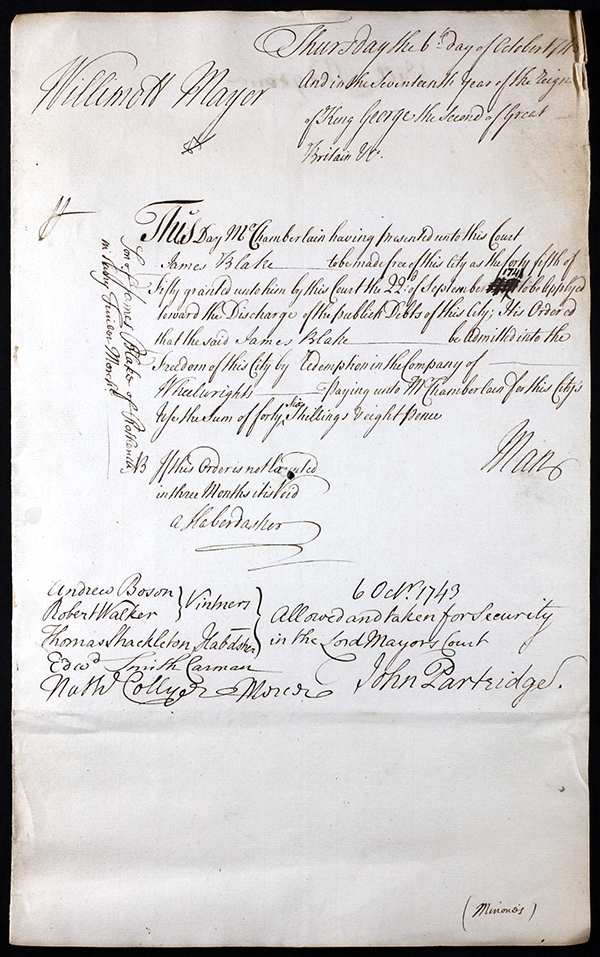
And in the Seventeenth Year of the reign
of King George the Second of Great
Britain &c.
James Blake____to be made free of this City as the forty fifth of
toward the Discharge of the publick Debts of this City; It is Ordered
that the said James Blake__________be Admitted into the
Freedom of this City by Redemption in the Company of _______
Wheelwrights________paying unto Mr Chamberlain for this City’s
Use the Sum of forty^Six Shillings & eight pence
in three Months it is Void
a Haberdasher
Robert Walker
Edwd Smith Carman
Nath Collyer[e] Mercer [?]
Whatever the answer to this and other questions it raises, the document identifies James Blake II’s father as “James Blake of Rotherhith / in Surrey Timber Merch.t” The shared professions of this “James Blake of Rotherhith” and James Blake of Ratcliff make it a near certainty that Bentley’s association of the two men is correct. Beyond the coincidence of family names in the 1754 will, there is now the coincidence of both apprenticeship and Freedom of the City documents with fathers from Rotherhithe named James Blake, with the son in both cases having the same name and the same profession of haberdasher. It seems safe to assert as fact, then, that James Blake I was a timber merchant who must have moved from Rotherhithe to Ratcliff sometime between 1743 and 1754, where he died three years before William was born.