Interpreting Blake’s The Magdalene at the Sepulchre
G. A. Rosso (rossoga1@gmail.com) has written and co-edited a number of books and essays on Blake, including most recently The Religion of Empire: Political Theology in Blake’s Prophetic Symbolism (2016), a study of Blake’s three long poems. His essay “The Lamb’s New Song: Apocalypse in Early British Hymnody” is forthcoming from Religion & Literature.
| The Imagination. that is God himself | } | עשי Jesus |
| The Divine Body | ||
| It manifests itself in his Works of Art |
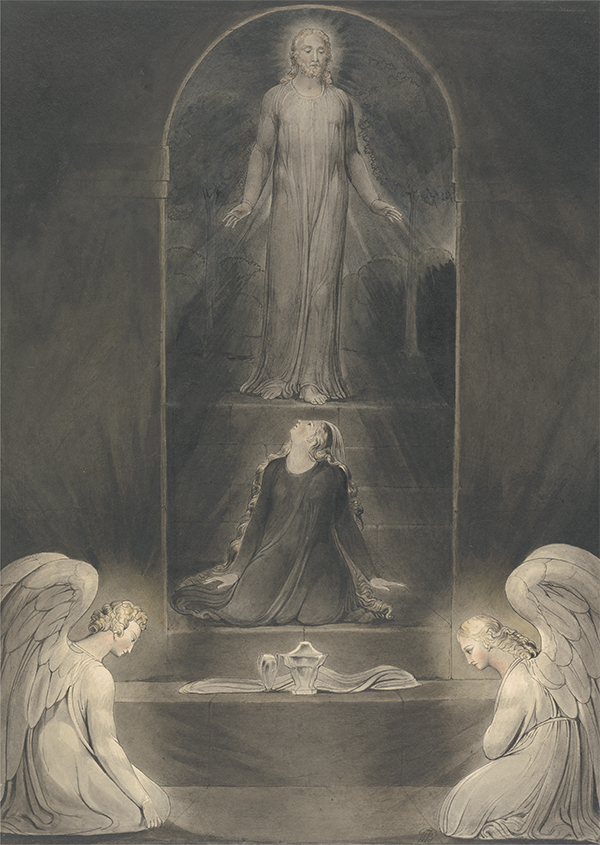
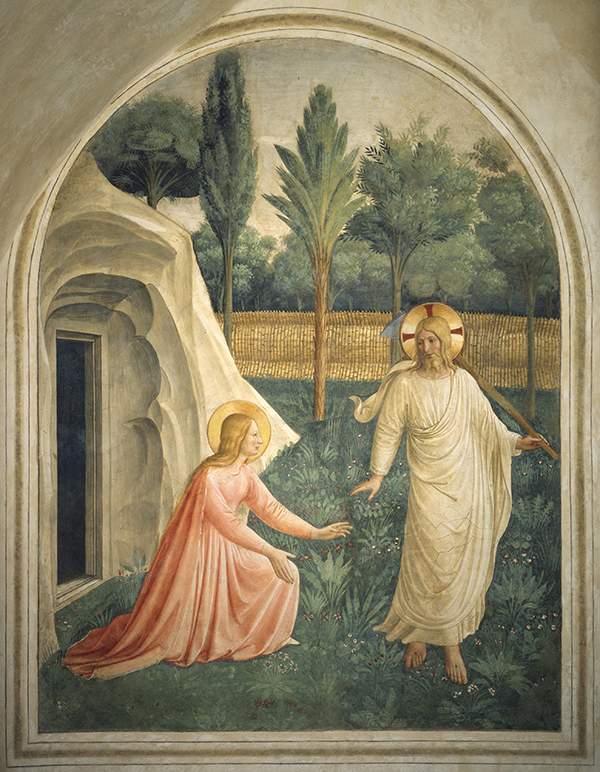
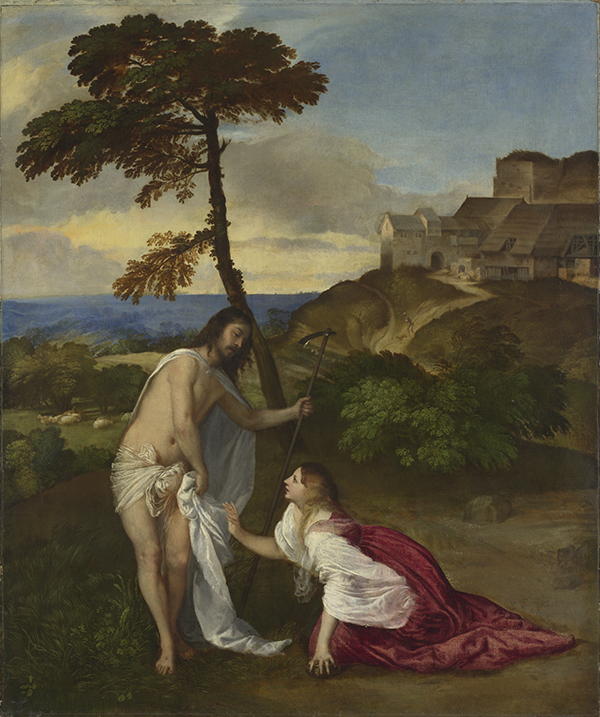
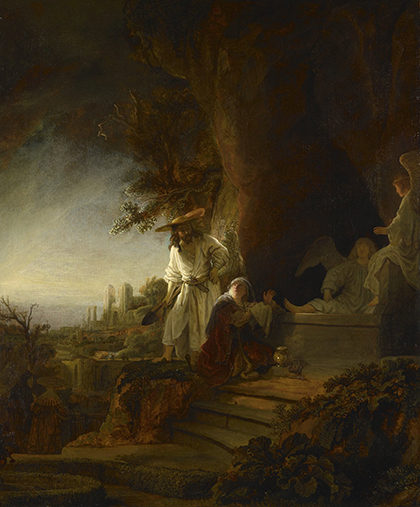
In 1805, Blake painted the beautiful, solemn watercolor The Magdalene at the Sepulchre for his friend and patron Thomas Butts (illus. 1). It illustrates a scene from the resurrection narrative in the gospel of John, capturing the moment before Mary recognizes that the figure who appears to her, outside the tomb, is the risen Jesus: But Mary stood without at the sepulchre weeping: and as she wept, she stooped down, and looked into the sepulchre, And seeth two angels in white sitting, the one at the head, and the other at the feet, where the body of Jesus had lain. And they say unto her, Woman, why weepest thou? She saith unto them, Because they have taken away my Lord, and I know not where they have laid him. And when she had thus said, she turned herself back, and saw Jesus standing, and knew not that it was Jesus. (20.11-14)All quotations from the Bible are from the King James Version, unless otherwise noted. The scene continues with an exchange between Mary and Jesus in which she at first mistakes him for the gardener and then recognizes him as her teacher (“Rabboni”) once he calls her name. Jesus tells her not to touch him because he has not yet ascended, then commissions her to inform the disciples of his resurrection and imminent ascent (20.15-18). This dialogue serves as the source of an extensive iconographic tradition in Western art, the Noli me tangere (“Touch me not”), treated by Giotto, Fra Angelico, Dürer, Titian, Correggio, Michelangelo, and Rembrandt, among others (see illus. 2-4).Nancy lists over forty paintings (103-05). The Noli me tangere imagery traces back to illuminated manuscripts, altarpieces, and wall paintings in the ninth to tenth centuries (Benay and Rafanelli 20, 149).
The painting was composed at a moment of transformation for Blake, following a period of personal, poetic, and artistic crises at Felpham under William Hayley’s patronage (1800–03). It thus bears scrutiny in relation to other works he was undertaking at this time. Of special interest are two related subgroups of biblical illustrations he painted for Butts: one features “Mary” designs—Mary Magdalene, Mary the mother of Jesus, and Mary of Bethany—and the other depicts the entombment and resurrection.“Mary” paintings include The Woman Taken in Adultery (Butlin #486), The Raising of Lazarus (#487), Mary Magdalene Washing Christ’s Feet (#488), Christ in the House of Martha and Mary (#489), The Crucifixion: “Behold Thy Mother” (#497), The Three Maries at the Sepulchre (#503), and The Assumption of the Virgin (#513). Entombment scenes appear in The Entombment (#498), Christ in the Sepulchre, Guarded by Angels (#500), The Angel Rolling the Stone away from the Sepulchre (#501), and The Resurrection (#502). Numbers refer to entries in Butlin’s catalogue. Images of most are available at the William Blake Archive under “Drawings and Paintings,” “Water Color Drawings Illustrating the Bible”: <http://www.blakearchive.org/work/biblicalwc>. These works were executed when Blake also was revising Vala or The Four Zoas, adding an account of the trial, crucifixion, burial, and resurrection of Jesus (c. 1802–07). Considered together, they provide a valuable perspective on Blake’s evolving aesthetic, opening several points of contact between his poetry, his theory of art, and his religious beliefs. In particular, they offer insight into Blake’s signature equation of Jesus and the imagination, which reaches its fullest expression in Jerusalem, the Job engravings, and the יה & His Two Sons print, published in the 1820s.
In The Magdalene at the Sepulchre, Blake presents Jesus in a fairly traditional manner. He wears a seamless gown, has long, curly hair and a beard, and a nimbus or halo emanates from his body. Blake places him at the top center of the design, standing on a wall outside the tomb above and behind Mary, facing forward and looking down toward her. His left foot, imprinted with a stigma, steps toward the edge of the wall, and stigmata are slightly visible on his hands. Perhaps the most intriguing feature is the gesture he makes with his hands, which deviates from tradition by not seeking to elude or ward off the Magdalene. His palms face downward but are slightly open, perhaps showing his wounds. Below the Magdalene, on a ledge inside the tomb, are a white cloth, perhaps the linen clothes Jesus has put off, and two vessels—an urn and a jar. Two angels, kneeling in rapt devotion, stare solemnly at the ground where Jesus had lain, their winged bodies giving off intense light and their necks and faces flushed with a rosy hue.Like the angels in the frontispiece to Blake’s illustrations for Young’s Night Thoughts, the angels avert their gaze from the risen Jesus, in contrast to the Magdalene. Mary kneels on the step leading into the tomb and wears a black gown; a veil partly covers her long, curly hair and her arms are at her side, palms down. Most strikingly, she turns and stretches her neck and head up and to the right to look at Jesus, her lips pale with surprise and bewilderment (illus. 5). Blake has chosen to illustrate the most suspenseful moment in John’s resurrection scene (20.14).
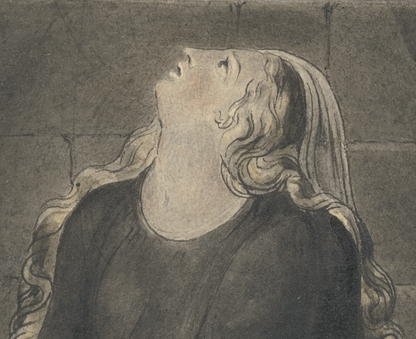
Several other elements are important for understanding the painting and the way Blake interprets John, inventing details that diverge from the text and from the main iconographic tradition. First, in terms of the pictorial setting, Mary and Jesus have switched places: he is now outside the tomb and she occupies the place where he had lain before his resurrection (Billingsley 120). Second, his facial expression and the gesture of his hands seem to beckon or call her to rise from the tomb, exhorting her to overcome her grief and confusion. This reading can be supported by comparing Mary’s look of astonishment and hand gesture with the similar gesture and facial expression of Lazarus in The Raising of Lazarus (illus. 6). The hands of both figures seem to suggest levitation.
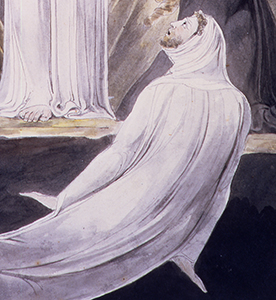
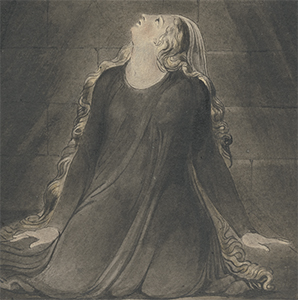
Image of The Raising of Lazarus (c. 1805) © Aberdeen City Council (Art Gallery & Museums Collection). Watercolor, 40.7 x 29.6 cm. ABDAG002369.
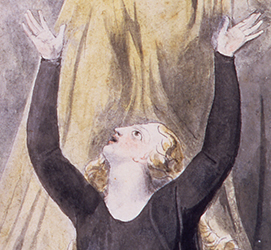
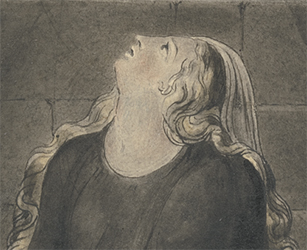
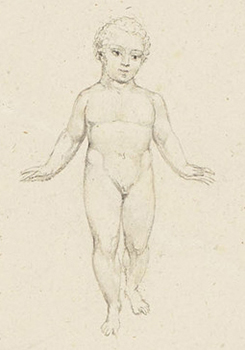
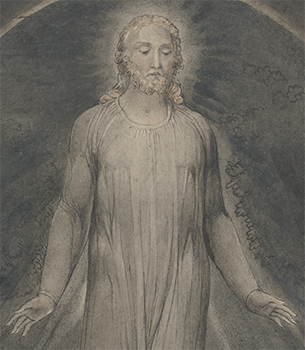
Image of The Assumption of the Virgin (1806) courtesy of the Royal Collection Trust/© Her Majesty Queen Elizabeth II, 2020. Watercolor, 40.2 x 26.7 cm. RCIN 913379.
A further observation about the composition of the design can open other dimensions of meaning that go to the heart of Blake’s Christology and aesthetics. The scene within and outside the tomb is suffused with radiance, illuminating the darkness with remarkable yet subtle power. Light emanates from Jesus’s head and from his chest and hands. It also is visible through the arched doorway, appearing in the sky behind him and softly brushing the outline of the bushes (or tombstones), suggesting the arrival of the new dawn. Traditionally Jesus is the source of light, visually and metaphorically, although here a conceptual disruption occurs. It is striking how much light comes from within the tomb. It shines most vividly on or from the two angelic bodies, especially their heads and arms, and gleams off the walls, moving upward to illuminate the Magdalene’s face, neck, and hands. As Morton Paley suggests, the radiance “cannot come from a single external light source but must be inner and spiritual.”Paley also states that Blake’s treatment is “a spiritual counterpart” or contrary “to Rembrandt’s chiaroscuro” Christ and St. Mary Magdalene at the Tomb (illus. 4), in which Jesus and the Magdalene are illumined by natural light (56). Yet Rembrandt anticipates Blake in depicting Mary’s inner struggle, her “state of startled confusion” (Dykema 255). In related terms, W. J. T. Mitchell states that for Blake, pictorial space exists as an “extension of the consciousness of the human figures it contains” (38). In this sense, the angels fulfill a traditional function as divine messengers and represent an aspect of Mary’s experience. Exegetically, Blake follows John in associating the angels with Mary, not with Peter and the “beloved” disciple, who are the first to enter the sepulchre but do not see the angels. The angels’ question—“Woman, why weepest thou?”—registers her inner struggle, her fear and grief at finding the tomb empty. It also triggers the impulse that leads Mary to turn toward Jesus. As they are placed prominently in the design and reflect the brightest light issuing from the tomb, they help highlight the revelation that emerges in Mary’s exchange with the risen Jesus.
But Blake delays this exchange to focus attention on Mary’s struggle at the tomb, a place that seemed to preoccupy his imagination at this pivotal stage of his life. In addition to his entombment-resurrection designs for Butts, he was commissioned in 1805 to produce a set of drawings from Robert Blair’s The Grave (1743), with similar eschatological themes and overlapping subjects for illustration.Several of the engravings include images of a grave or tomb. In “Christ Descending into the Grave,” the portrayal of Jesus bears a close resemblance to the one in The Magdalene at the Sepulchre (see William Blake Archive, “Commercial Book Illustrations,” The Grave, object 3). He also was reminiscing about his Gothic apprenticeship days to Benjamin Heath Malkin, whose A Father’s Memoirs of His Child (1806) contains an account of Blake’s formative experiences among the sepulchral monuments of Westminster Abbey. In letters of this time, Blake recalls his early days as a visionary engraver and history painter, claiming that his vocational struggles at Felpham led to a “restoration to the light of Art” (E 756). As David Bindman comments, Blake’s renewed sense of the Gothic provides “a link between [his] youth and his present regenerate state,” which is associated with the “Divine radiance and visionary clarity” expressed in his watercolor drawings (141). But this positive view must be placed alongside the more problematic focus on the tomb or sepulchre that Blake brings to his revisions of Vala. One of the most stimulating points of convergence in Blake’s work at this moment is his preoccupation with the tomb as the site of an epochal struggle over the history and meaning of Christianity.
2
The empty tomb is the most common feature shared by the gospel resurrection narratives, and one in which women play a primary role, a fact Blake incorporates into both his watercolor series and his Vala revisions.Johnson suggests that Blake’s gospel designs featuring women may have been commissioned to adorn the walls of a girls’ school managed by Butts’s first wife, Elizabeth (“The Death and Assumption of Blake’s Mary” 148). In Night VIII especially, the tomb is at the center of the poem’s proliferating narratives and is a key to the ultimate fate of the manuscript.Pierce provides a helpful account of the narrative complexities and stages of the manuscript (39-62). The scenes at the tomb give rise to two contrasting modes of Christianity: the true visionary religion of Jesus that Blake associates with the figure of Jerusalem, and its false institutional simulacrum, or state religion, which he names Rahab. The imbrication of these figures, which is a major theme of Blake’s long poems, emerges in the space between crucifixion and resurrection, the moment captured in The Magdalene at the Sepulchre. Unlike the watercolor, however, in Vala the female character at the tomb (Jerusalem) is overcome with fear and doubt and does not embrace the resurrection faith. To account for the difference between the poem and the entombment-resurrection watercolors we must delve briefly into the thicket of revisions to Vala, where Mary Magdalene makes two fleeting but revealing appearances. Blake initially conflates Mary Magdalene and Rahab to suggest that Mary becomes part of the development of the false church, but he later backs off this move in other revisions that distinguish the two characters.
The closest parallels between the painting and the poem occur in the drama at the tomb following Rahab’s crucifixion of Jesus, especially on page 106, one of the most important and heavily revised pages in the manuscript.In an earlier draft the page directly linked the crucifixion (lines 1-6) with the merger and transformation of Rahab-Urizen (lines 17-48), the first and second portions of page 106 in Erdman’s edition (E 379, 381-82). Blake added the burial passage and instructions to “turn back 3 leaves”—that is, to the bottom half of page 113, followed by pages 114-16 (E 379-81), containing three consecutive designs of the risen Jesus. See Pierce (127-39) and Rosso (72-82) for discussion. This page contains the first of two entombment scenes in the manuscript, a ten-line marginal passage (106.7-16, E 379) in which Los and Jerusalem remove the body of Jesus from the cross and Jerusalem makes the fateful proposal: “Let us build / A Sepulcher & worship Death in fear … / … / And Let all Nations of the Earth worship at the Sepulcher.” The scene is repeated nearly verbatim at the end of the Night, just prior to Rahab’s triumph over Jerusalem, though Blake adds a historical reference, saying that “Jerusalem wept over the Sepulcher two thousand Years” (110.30-33, E 385). More significantly for my purposes, the second burial account replaces and follows a deleted passage in which Jerusalem is identified with Rahab through an allusion to Mary Magdalene:
But Rahab [hewd] a Sepulcher in the Rock of Eternity
And placing in the Sepulcher the body which she had taken
From the divine Lamb wept over the Sepulcher weaving
Her web of Religion around the Sepulcher times after times beside Jerusalems Gate
But as she wove behold the bottom of the Sepulcher
Rent & a door was opend thro the bottom of the Sepulcher
Into Eternity And as she wove she heard a Voice behind her calling her
She turnd & saw the Divine Vision & her (E 843)
Blake identifies Rahab with Jerusalem by saying that she weaves her religion “times after times beside Jerusalems Gate,” a temporal reference he associates with the two-thousand-year era of Christendom in the revised passage. But along with the identification of Rahab and Jerusalem, the deleted passage implicates Mary Magdalene in creating the web of religion, for as Rahab weaves she hears “a Voice behind her calling her / She turnd & saw the Divine Vision & her.” Blake abandons this version for the one involving Los and Jerusalem, but his allusion to the Magdalene’s encounter with the risen Jesus invites comparison with the watercolor.
Blake’s decision to break off the passage mid-sentence suggests ambivalence toward the figure of Mary in the late revisions. He focuses on the same scene from John’s gospel in both The Magdalene at the Sepulchre and Vala, but for Rahab he chooses the moment after Jesus calls Mary’s name and “she turned herself” a second time, recognizing him and reaching to touch him (20.16-17). Blake avoids the moment of recognition in the watercolor and forecloses it in the poem. John Pierce shows that Blake’s reason for canceling the lines before completing them is that he decides to place the revelation of Rahab nearer to the crucifixion and to create a narrative connection between her exposure (113.38-43, E 379-80) and Los’s long speech to her (113.46-116.6, E 380-81). The lines describing Rahab’s revelation are taken from one of the few extant draft pages (145.20-23):
But when Rahab had cut off the Mantle of Luvah from
The Lamb of God it rolld apart, revealing to all in heaven
And all on Earth the Temple & the Synagogue of Satan & Mystery
Even Rahab in all her turpitude …. (113.38-41, E 379-80)
And Rahab stripd off Luvahs robes from off the lamb of God
Then first she saw his glory & her harlot form appeard
In all its turpitude beneath the divine light & of Luvahs robes
She made herself a Mantle (145.20-23, E 842)
In both passages Rahab weaves a “Mantle” out of Jesus’s mortal body, thus creating a church or temple in which to worship his death. Blake brilliantly enacts this exposure of Rahab’s temple form (her religion) simultaneously with the revelation of Jesus’s immortal body. But in the draft passage, Blake explicitly references Rahab’s “harlot form” in the moment that she sees Jesus “beneath the divine light,” the same moment that Rahab turns to see the divine vision in the deleted passage on page 110. In effect, the lines from page 145 can serve to complete the canceled passage on page 110: “She turnd & saw the Divine Vision & her [harlot form appeard].” Blake is thus very close to identifying Rahab and Mary Magdalene, but he chooses not to make this potential link a part of the poem—that is, he chooses not to identify Mary Magdalene with the false Christian church that worships a dead Christ at the holy sepulchre. He reserves that role for Jerusalem, though her fate in the narrative is left undecided. At the opening of Night IX, she still worships at the empty tomb, yet midway through the Night she becomes the New Jerusalem (122.1-20); how this comes about remains a mystery. Without an articulated path from the tomb to the apocalypse, the poem lacks narrative coherence, which is one reason Blake left it in manuscript form.
3
In addition to the watercolors and Vala, Blake engages with the figure of Mary Magdalene in two late works that present his most profound treatments of Christianity, especially in relation to sexuality and the biblical idea of holiness. In the section “Was Jesus Chaste” from The Everlasting Gospel (c. 1818) and on plates 60-62 of Jerusalem (1820), he develops the positive portrayal of the Magdalene from the watercolors while addressing the issue of doubt and despair that shadows her (and Jerusalem) in the Vala revisions. These texts differ from Vala and The Magdalene at the Sepulchre in presenting their scenes through dialogue between Jesus and the female characters and, more importantly, by adding the concept of chastity as the main target of critique. The women, like those in Vala and the watercolors, are composite figures, though in the texts their dialogues with Jesus involve painful self-reflections that bring intellectual and spiritual breakthroughs. The texts offer a creative response to the gospel depictions of Mary Magdalene, affirming the essential role of imaginative vision in the resurrection. They also exhibit what Christopher Hobson describes as a “regendering” of “theological authority” (par. 31), an issue at the heart of current feminist scholarship on Mary Magdalene and her role in early Christianity.Johnson lists several key Magdalene studies in her bibliography to “Blake’s Mary and Martha” (107-08). I have drawn especially on the work of D’Angelo, de Boer, and Schaberg.
The “Was Jesus Chaste” section of The Everlasting Gospel contains the only explicit treatment of Mary Magdalene outside the watercolor series. As in The Magdalene at the Sepulchre—but unlike Vala or Jerusalem—she is the main character, although she is conflated with the woman taken in adultery (John 8.3-11) and, more obliquely, with Jesus’s mother.Lines from a canceled draft section, “Was Jesus Born of a Virgin Pure,” state: “If he intended to take on Sin / The Mother should an Harlot been / Just such a one as Magdalen / With seven devils in her Pen” (E 877). Blake follows tradition in regarding the Magdalene as a reformed prostitute. In the dialogue between Jesus and Mary (lines 43-80, E 521-22), the core issue hinges on her willingness to open herself to Jesus and confess her “sin” so that he can forgive it. However, Mary comes to recognize that her sin—the “seven devils” that torment her (Luke 8.2)—is not adultery or harlotry but a “dark pretence to Chastity,” an outward show of morality that veils her desire for love, rendering “that a Lawless thing / On which the Soul Expands its wing.” Her sin is to internalize the view of those who condemn her for selling her body to survive: “That they may call a shame & Sin / Loves Temple that God dwelleth in / And hide in secret hidden Shrine / The Naked Human form divine” (lines 63-66). The juxtaposition of the hidden shrine and human form divine gets to the heart of Blake’s critique of biblical teaching about holiness. As in Jerusalem, the shrine doubles here as the tabernacle holy of holies and female genitalia. In the biblical temple, the inner sanctuary was separated from the rest of the congregation by a veil or partition, designed to protect God’s holiness from violation; at his death, Jesus rends the veil, opening a “new and living way” between earth and heaven, humanity and the divine (Hebrews 10.19-20). The shrine also serves to symbolize “Sexual Religion,” a phrase Blake uses to convey how patriarchal control of women’s sexuality is secured by the code of chastity (Jerusalem 44 [30].11, E 193). Mary struggles to overturn this code’s hold on her by redefining adultery and harlotry not as sins against moral law but as blasphemy against Jesus himself—an unforgivable act in his teaching (Mark 3.29). Her intellectual and spiritual advance comes when she questions the finality of this judgment.In “Blake, Paul, and Sexual Antinomianism,” Hobson argues that Mary’s redefinition leads to her breakthrough in lines 75-80 (par. 27). She realizes that even the unforgivable act can be forgiven, an insight achieved by experiencing Jesus’s redemptive death as her own: “And canst thou Die that I may live / And canst thou Pity & forgive” (lines 79-80). Mary’s insight concludes the dialogue and her question is answered affirmatively, as it triggers the section’s denouement in the crucifixion: “Then Rolld the shadowy Man away / From the Limbs of Jesus to make them his prey” (lines 81-82). This image mirrors the moment in Vala when Rahab strips the mantle from Jesus and “it rolld apart,” exposing her as the false church. Though the text is not explicit, we can assume, as Christopher Rowland argues, that Mary’s “appropriation of Christ’s experience on the cross” leads to her redemption, to her “rediscovering” the human form divine within (Blake and the Bible 135, 190). But as in Vala, the resurrection is not portrayed explicitly in the text. Only in Jerusalem does Blake fully address the issue he leaves unresolved in Vala, returning also to the moment he visualizes in The Magdalene at the Sepulchre.
On plates 60-62 of Jerusalem, in his closest textual analogue to the Butts painting, Blake associates his titular heroine with both Mary the mother of Jesus and Mary Magdalene. The depth and complexity of his pictorial treatment of the Magdalene are given poetic voice. As in The Everlasting Gospel, Jesus—or alternately here “the Lamb of God” or “the Divine Voice”—initiates the exchange.Though Blake does not use the name Jesus on these plates, he refers to the speaker as “the Divine Lamb,” “the Divine Voice,” and “the Lamb of God” (60.50, 60.65, 62.30, E 211, 213), phrases he often uses to designate Jesus. He asks a series of questions that address the causes of Jerusalem’s exile in Babylon, challenging her complicity in being taken captive, the same situation she finds herself in at the end of Night VIII. Similarly, the narrator tells us that Vala has invaded Jerusalem’s character and consciousness and “triumphs in pride of holiness” (60.45, E 210). As with the Mary figure in “Was Jesus Chaste,” Jerusalem has internalized the code of chastity that condemns her as a harlot, though the conditions of her oppression here are much more devastating and difficult to overcome. Imprisoned in a Babylonian dungeon, she is beaten, tortured, and degraded to the point that “she raves upon the winds hoarse, inarticulate” (60.44). And while she still can see “the lineaments Divine” and hear “the Voice” of Jesus, she remains confused, expressing the same bewilderment as Jerusalem in the first Vala entombment scene: “Art thou alive! & livest thou for-evermore? or art thou / Not: but a delusive shadow, a thought that liveth not” (60.54-55, E 211). Despite her abject state, Jerusalem insists that she knows Jesus and affirms his presence “even in this dungeon,” saying “altho I sin & blaspheme thy holy name, thou pitiest me” (60.58-62), echoing Mary’s insight in The Everlasting Gospel. Yet unlike Mary, who seems better able to resist the code that labels her an adulterer, Jerusalem has become more deeply “deluded” into accepting the harlot label (60.63-64). In response, Jesus offers Jerusalem a vision to comfort her, an account of the Mary-Joseph story from Matthew that inverts its orthodox meaning and undermines the equation of holiness and virginity.
This justly celebrated retelling of Matthew’s infancy narrative too often is read in isolation from the larger context of Jesus and Jerusalem’s exchange, which situates the story in a broader, richer web of biblical allusions and traditions. The most relevant of these are biblical treatments of Jerusalem’s fall and exile in Babylon and the covenant marriage metaphor, especially the harlot image that the prophets use to denounce her sins and justify her fallen condition.As Baumann shows, in “prophetic marriage imagery” adultery and harlotry are equivalent terms, especially in relation to Israel and Jerusalem (figured as female), whose “idolatry” violates the covenant relation with God (1, 43). Blake attaches this imagery to Joseph, who responds in anger to Mary’s “illegitimate” pregnancy, exclaiming “Should I / Marry a Harlot & an Adulteress?” (61.5-6, E 211). Blake also departs from Matthew by having Mary speak on her own behalf, standing up to Joseph and rejecting the demand for remorse and purification as inadequate to the covenant of forgiveness. After an angel convinces Joseph to accept Mary’s “impure” state, she breaks into a song of joy that contains a complex series of voices interweaving her story and identity with Jerusalem’s.
In the song, Jerusalem’s voice emerges in a passage that disrupts the celebration of Mary’s reunion with Joseph: “And I heard the voice … / … Saying, Am I Jerusalem the lost Adulteress? or am I / Babylon come up to Jerusalem?” The questions recall Jerusalem’s identity crisis in Night VIII, although here a second voice directly follows the first with another set of questions, echoing Mary’s insight: “Does the voice of my Lord call me again? am I pure thro his Mercy / And Pity” (61.33-37, E 212). Jerusalem struggles to internalize Mary’s voice against her own shame and despair, entrapped by the judgments of her “idolatrous” and traumatic history. But she restores her sense of integrity and her relationship to God by redefining his holiness as forgiveness and compassion, thus envisioning his divine humanity (61.37-46). The song then appears to end positively, with Jerusalem alluding to Isaiah’s uniquely empathic use of the marriage metaphor: “Fear not; for thou shalt not be ashamed …. Thy Maker … hath called thee as a woman forsaken …. For a small moment have I forsaken thee; but with great mercies will I gather thee” (Isaiah 54.4-7).In Isaiah, God looks upon the exile as caused by his abandonment of Jerusalem, taking responsibility for the marriage crisis in what Baumann regards as “an astonishing pose of self-renunciation toward his wife” (185). But Jerusalem’s identification with Mary remains problematic. Jesus follows the song with an account of his own birth in which Jerusalem serves as midwife in the establishment of Western Christendom:
Mary leaned her side against Jerusalem, Jerusalem recieved
The Infant into her hands in the Visions of Jehovah. Times passed on
Jerusalem fainted over the Cross & Sepulcher She heard the voice
Wilt thou make Rome thy Patriarch … & the Kings of Europe his
Horsemen? (61.47-51, E 212)
We have returned to the moment of Jerusalem’s capitulation at the sepulchre in Vala. This development now serves, however, as a catalyst for her spiritual evolution. In her final speech in the dialogue, a response to Jesus’s call to repose on him “till the morning of the Grave” (62.1), Jerusalem transforms her fallen perspective at the tomb in Vala and attains a revelation that augments Mary’s radical stance and awareness in the infancy narrative.
On plate 62, she at first reiterates Mary’s insight that it is because of her impurity and sinfulness that she is forgiven and reconciled to Jesus, who becomes her “Husband” in spite of her “Harlot” status (62.4-6, E 212-13). But she goes further in recognizing the flaws in the concepts of chastity and genealogy that inform the virgin birth. Indeed, Jerusalem achieves two major revelations in her speech. In the first, she says, “I see the Maternal Line, I behold the Seed of the Woman!” and she traces the line from Genesis all the way to Mary, whom she includes among “the Daughters of Vala, Mother of the Body of death” (62.8-13). This critical statement echoes both the proposal to worship “the Body dead upon the Cross” in Night VIII (E 379) and the equally critical statement at the end of the Bard’s Song in Milton: “The Body of Death was perfected in hypocritic holiness, / Around the Lamb, a Female Tabernacle” (13 [14].25, E 107). Uniquely in Jerusalem, this revelation leads directly to a second one of even greater magnitude:
But I thy Magdalen behold thy Spiritual Risen Body
Shall Albion arise? I know he shall arise at the Last Day!
I know that in my flesh I shall see God …. (62.14-16)In John, after Jesus tells Mary to announce his ascension to the others, the narrator states: “Mary Magdalene came and told the disciples that she had seen the Lord” [or “I have seen the Lord” (NRSV)] (20.18).
Despite her oppressed state, Jerusalem achieves a level of consciousness matched only by Albion’s visions of Jesus later in the poem—visually on plate 76 and textually on plate 96.The text reads: “Jesus replied Fear not Albion unless I die thou canst not live / But if I die I shall arise again & thou with me” (96.14-15, E 255). Interlacing references to the gospel of John and the book of Job, Blake presents Jerusalem-Magdalene not as a penitent prostitute but as a visionary and a prophet. Jerusalem combines Martha’s response to Jesus about raising Lazarus—“I know that he shall rise again in the resurrection at the last day” (John 11.24)—with Job’s passionate response to his friend Bildad—“I know that my redeemer liveth, and that he shall stand at the latter day upon the earth: And … in my flesh shall I see God” (Job 19.25-26). This creative exegesis enables Jerusalem to surpass Martha by imagining herself as the Magdalene beholding the risen Christ at the sepulchre. She sees beyond the body of death to the eschatological future, which Blake’s Jesus—again quoting John (11.25)—assures her is available in the present moment: “I am the Resurrection & the Life. / I Die & pass the limits of possibility” (62.18-19). Jerusalem’s vision of Jesus’s spiritual body marks a stunning intellectual leap, one that offers an apt interpretive gloss on Mary’s experience in The Magdalene at the Sepulchre.
4
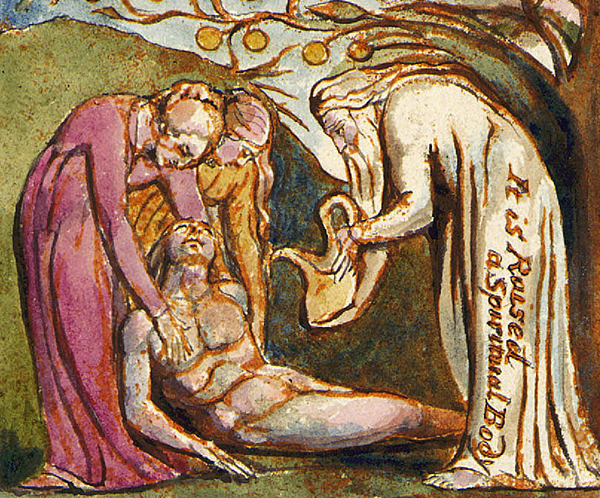
Blake’s concept of a spiritual body derives of course from Paul, but he develops the idea in unique ways, combining Paul with John to create a new theological and aesthetic perspective. He first uses the phrase in “To Tirzah” (Songs of Experience) to counteract the power of generation he names Tirzah and associates with Mary, mother of Jesus’s “Mortal part.” Claiming that Jesus’s death has set him free, the speaker asks rhetorically, “Then what have I to do with thee?” (line 16), quoting Jesus’s brusque words to Mary in John 2.4. Below this line, written on the garment of the aged figure, is the verse from Paul: “It is Raised a Spiritual Body” (1 Corinthians 15.44) (illus. 9).Spector observes that Tirzah takes on a more (ironically) redemptive role in Vala: as “the means through which the incarnation can be achieved” (180), she enables Jesus to give “his vegetated body / To be cut off & separated that the Spiritual body may be Reveald” (104.37-38, E 378).
Simon Jarvis comments that while Blake develops Paul’s concept, he alters its meaning: the spiritual body in Paul is raised after the death of the natural body, while for Blake “the spiritual body is the real one, now and eternally” (13). Jarvis does not refer to John, but he suggests that Blake adopts the more immediate or “realized” eschatology of John instead of Paul’s focus on temporal sequence.It should be noted that in Romans (6.9) and Colossians (3.1), Paul expresses a view similar to John’s in saying that followers are “raised from the dead” through the experience of baptism. These conceptions are in tension in Paul’s work. In John, Jesus announces that the “hour is coming, and now is, when the dead shall hear the voice of the Son of God: and they that hear shall live” (5.25, emphasis added). In his visual exegesis of these texts, Blake is focused not on the nature or status of Jesus’s risen body but on the centrality of transformation, coming to a different intellectual and ethical understanding of life through visionary perception.
In discussing Blake’s annotations to Berkeley’s Siris, Jarvis makes another point about the spiritual body applicable to John’s Magdalene. Responding to Blake’s notation “The Natural Body is an Obstruction to the Soul or Spiritual Body” (E 664), he writes that the natural body is “a mistake of our thinking, a self-misrecognition which our spiritual body makes” (13). Again, however, Jarvis does not reference John, whose Mary initially seeks Jesus’s natural body and at first misrecognizes his spiritual risen one, a mistake at the center of Noli me tangere iconography. As we have seen, Blake resists this move, focusing instead on Mary’s turn away from the dead Jesus and the sepulchral religion that typifies the church. Blake also quotes John in an annotation that identifies the spiritual body with Jesus manifesting himself as the divine imagination: “Jesus considerd Imagination to be the Real Man & says I will not leave you Orphanned and I will manifest myself to you he says also the Spiritual Body or Angel as little Children always behold the Face of the Heavenly Father” (E 663). The text in John is one of the chief sources for Blake’s theology and ethics: I will not leave you comfortless: I will come to you. Yet a little while, and the world seeth me no more; but ye see me: because I live, ye shall live also. At that day ye shall know that I am in my Father, and ye in me, and I in you. … He that loveth me shall be loved of my Father, and I will love him, and will manifest myself to him. (14.18-21)The KJV reads “I will not leave you comfortless,” but “orphans” is used in multiple translations of the Greek text available to Blake; see Wesley’s Explanatory Notes (256-57) and Wakefield’s New Testament (185). Jesus’s prophetic statement, which is fulfilled when he appears to the Magdalene at the tomb, is concerned less with the Son’s relation to the Father and more with how the divine presence is constituted by those whose love enables them to “see” Jesus.Adams makes a similar point in his analysis of the Berkeley annotations, saying that Jesus’s appearance to the Magdalene and the other disciples is “an example of the imaginative power of those who saw” (156-57). The passage goes to the core of Blake’s Christian aesthetics, his emphasis on the transformative power of a faith informed by visionary experience, as his reuse of this statement in the Job engravings affirms.
Blake’s reference to Jesus manifesting himself comes from the farewell discourse in John (14-17), a major theological address that scholars view as a key for interpreting the Magdalene’s encounter with Jesus.See Brown (1012) and de Boer (172-76). Rowland comments on the importance of this discourse to Blake’s Job engravings, plate 17 in particular, citing an inscription on the theme of mutual indwelling from the scroll in the lower margin: “At that day ye shall know that I am in / my Father & you in me & I in you” (Blake and the Bible 60). Rowland emphasizes that the visual appearance of God/Christ to Job and his wife dominates the design of the plate, though the lower portion includes a medley of verses from John 14 that insist on the need for visionary experience in realizing this theme. The medley is headed by the caption for the central image, “I have heard thee with the hearing of the Ear but now my Eye seeth thee” (Job 42.5), indicating the verse’s dual visual and thematic importance to the plate (illus. 10).
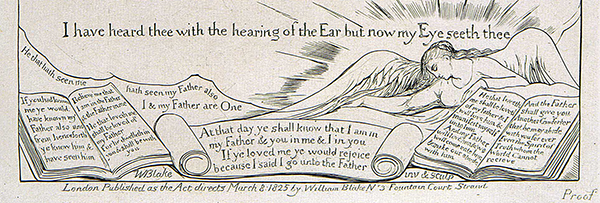
An emphasis on the Magdalene’s visionary experience also underpins the feminist recuperation of her in our time.D’Angelo, Schaberg, Chilton, and de Boer all emphasize the visionary element in the biblical and gnostic material on the Magdalene. Feminist scholarship challenges both the patristic devaluation of Mary as a prostitute and modern subordination of her to the male disciples in the resurrection stories. Scholars focus on the gospel of John because it gives the fullest and sharpest depiction of the Magdalene as the primary witness and messenger of the Easter faith, though traditional commentary argues that she did not grasp the full significance of her experience. Jane Schaberg contends that, until recently, the “protophany,” or first appearance of Jesus to Mary, has been regarded as “a minor, private … or unofficial encounter” in which a female follower is consoled by Jesus before his public declaration (298). She argues that in the two scenes framing the encounter, the Magdalene is “upstaged by the Beloved Disciple” (who is the first to “believe”) and by Jesus’s response to Thomas: “Because thou hast seen me, thou hast believed: blessed are they that have not seen, and yet have believed” (John 20.8, 20.29). John’s emphasis in these scenes on belief over seeing diverts attention from Mary’s role and “downgrade[s] the importance of her visionary experience” (337). On the other hand, Esther de Boer reads Mary’s anguish and Jesus’s consoling appearance to her as fulfillment of his prophecy in the farewell discourse: “Let not your heart be troubled …. Ye have heard how I said unto you, I go away, and come again unto you. If ye loved me, ye would rejoice, because I said, I go unto the Father” (John 14.27-28).Part of verse 28 appears on the scroll at the bottom of Illustrations of the Book of Job plate 17, just below the lines on mutual indwelling. When Jesus calls her name, Mary recognizes that, despite her grief and bewilderment, she has not been orphaned, that Jesus has manifested himself to her (173). Further, Jesus commissions her to proclaim his final message to the male disciples: “Say unto them, I ascend unto my Father, and your Father; and to my God, and your God” (John 20.17). As de Boer states (176-77), when Mary delivers the message to the disciples, “I have seen the Lord,” she establishes her prophetic and apostolic authority in the same manner as Paul (Acts 9.3-18; see illus. 11).
With these comments in mind, we can turn to an important set of questions posed by Mary Lynn Johnson about Blake’s biblical watercolors: By choosing subjects or emphasising details passed over by other artists … does Blake unsettle viewers’ expectations, defamiliarise well-known (perhaps too well-known) Gospel stories of women, and open both texts and their associated iconographic traditions to interpretative possibilities that engage feminist biblical scholars of our time? (“Blake’s Mary and Martha” 100) Regarding The Magdalene at the Sepulchre, the answer is yes to each. Blake’s choice to illustrate the moment that precedes Mary’s recognition of Jesus preempts a traditional iconographic treatment of the scene. He shifts focus away from Jesus’s rebuff of Mary, obviating the need to correct her or illustrate her ignorance and sensuality. He also avoids the tendency to represent Mary as she “reaches toward the groin of Jesus, and he recoils,” as Schaberg puts it (330-31). Susan Haskins records the “transmutation of Mary Magdalene into a Venus-figure,” beginning in the sixteenth century with naturalistic portrayals of her by Titian and Correggio: “Correggio’s penitent in her grotto,” she writes, “had an extraordinary career which took her into the realms of eighteenth- and nineteenth-century erotica” (236).Haskins includes an array of images depicting Mary’s erotic sanctity, culminating in the Magdalene “craze” of the eighteenth century; see especially chapter 8, “Vanitas,” for Blake’s context. Haskins attributes this change partly to the aesthetic shift in these centuries toward a more realistic style of drawing and partly to the Counter-Reformation, which oversaw the emergence of a sensual but chaste Magdalene as “a symbol of Church Triumphant, of the true faith” (252). Against this historical tradition, which he associates with Rahab, Blake reasserts the primacy of the Florentine style, especially that of Fra Angelico and Michelangelo. Jean Hagstrum suggests that in his Noli me tangere (illus. 2), Fra Angelico showed Blake “how to paint a resurrected body,” or “how to etherealize it without robbing it of substance” (144-45). He also provided a model for Michelangelo and others to counter the trend that eroticized the Magdalene in the guise of piety. Analyzing Michelangelo’s Noli me tangere drawing, Christian Kleinbub argues that he deliberately toned down Titian’s “sensual, even romantic, undertones” to focus attention on Mary’s “astonishment before the image” (91-92, 122), a comment that applies to Blake’s painting as well.Kleinbub suggests that the gesture of Michelangelo’s Jesus touching Mary’s right breast “served as an inverted sign for incorporeal sensations,” symbolizing the act of “planting … the seed of faith in [her] heart” (82, 117). Yet despite indebtedness to them, Blake’s portrayal of the Magdalene as a spiritual seeker in an austere, Gothic setting is even more devoid of naturalistic detail than the Florentines’.
In The History of Our Lord as Exemplified in Works of Art, the Victorian art historian Anna Jameson takes Fra Angelico to task for introducing what she deems the “wretched conceit” of portraying Jesus as a gardener and the “miserable absurdity of commemorating [Mary’s] momentary mistake” in reaching to touch him (2.281-82). While Blake avoids both these features, as well as the convention of dressing Mary in red to signify her sinfulness, Angelico’s treatment remains important to him for other reasons. The French art theorist Georges Didi-Huberman argues that the friar subscribed to an incarnational theology that enabled him to express the “mystery in bodies beyond bodies,” to embody “the supernatural in the visible or familiar aspect of things” (6). He finds a “pictorial equivalent” to this doctrine in the concept of “dissemblance,” an idea based on the medieval distinction between divine and phenomenal reality, which he says Angelico uses in Noli me tangere to disrupt the mimetic surface of the design. He points to the flowers on the ground between Mary and Jesus, showing that Angelico applies red splotches of paint to create a mimesis of flowers that are, in fact, not like flowers at all, but a “displacement” of the stigmata on Jesus’s feet, “a repetition of the same pictorial sign” (20). Thus, Angelico overlays the visible aspect of the image with “a visual operation” that seeks to “draw the gaze beyond the eye, the visible beyond itself, into the regions of the imaginary” (4). Blake’s compositional strategies move in a similar direction. He focuses attention on the impact of Jesus’s appearance to Mary, tracing the experience as it imprints itself on her body. The sublime astonishment that Blake conveys via the Magdalene’s face—especially her blanched lips and widened eyes—attests to the impact that the risen Jesus has upon her. But it is her intellectual struggle that opens this manifestation and her transformative experience that is dramatized in the painting.
The Magdalene at the Sepulchre is a consummate example of Blake’s incarnational aesthetic and a striking visualization of his interpretive approach to scripture. By choosing to illustrate this specific episode from John’s gospel, he invokes the illustrious Noli me tangere tradition while departing from it, or, more accurately, by refusing to enter it at all. In his book on this tradition, Jean-Luc Nancy provides insight into Blake’s dual iconographic and exegetical strategy. He observes that painters are drawn to this scene from John “because it puts into play a particularly delicate and complex exercise of vision” (21). Jesus appears in a transitional state: John portrays him as entering a dimension “from which alone comes glory,” a glory whose radiance can be seen “only insofar as it is received and transmitted” (17). Mary Magdalene is the first to receive and to transmit this glory, and in the language of Paul, she is “changed into the same image from glory to glory” (2 Corinthians 3.18). She too appears in a transitional state, on the cusp of a profound personal transformation that is at the same time a momentous historical one. At the threshold of moving from an earthly to a spiritual intimacy with Jesus, she struggles to distinguish his divine body from his natural one, compelled to enter a new relationship with him that is not dependent on physical contact. Mary’s experience is thus symbolic of Christianity at the crossroads of the pre- and post-Easter eras. Like Jesus, she cannot stay at the tomb: she must rise to report her revelation to the other followers and inaugurate a new stage of the faith. But Blake does not illustrate this end to the story, choosing to dwell on the uncanny inception of the Magdalene’s vision before it can be contained within a church or reduced to a moral tale. It is Mary’s imagination that enables her to pass the limits of possibility and, like Paul on the road to Damascus, to manifest the divine body—as Blake does in this work of art.
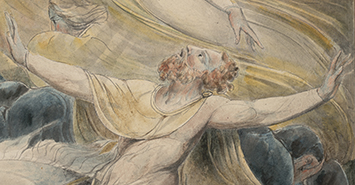
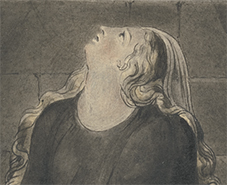
Image of The Conversion of Saul (c. 1800) © courtesy of the Huntington Art Museum, San Marino, California. Watercolor, 40.9 x 35.8 cm. 000.29.
Works Cited/Bibliography
Adams, Hazard. Blake’s Margins: An Interpretive Study of the Annotations. Jefferson, NC: McFarland, 2009.
Baumann, Gerlinde. Love and Violence: Marriage as Metaphor for the Relationship between YHWH and Israel in the Prophetic Books. Trans. Linda M. Maloney. Collegeville, MN: Liturgical Press, 2003.
Benay, Erin E., and Lisa M. Rafanelli. Faith, Gender and the Senses in Italian Renaissance and Baroque Art: Interpreting the Noli me tangere and Doubting Thomas. Abingdon: Routledge, 2016.
Billingsley, Naomi. The Visionary Art of William Blake: Christianity, Romanticism and the Pictorial Imagination. London: I. B. Tauris, 2018.
Bindman, David. Blake as an Artist. Oxford: Phaidon, 1977.
Brown, Raymond E. The Gospel according to John. Introduction, translation, and notes. 2 vols. Garden City, NY: Doubleday, 1966–70.
Butlin, Martin. The Paintings and Drawings of William Blake. 2 vols. New Haven: Yale University Press, 1981.
Chilton, Bruce. Mary Magdalene: A Biography. New York: Doubleday, 2005.
Connolly, Tristanne J. William Blake and the Body. Basingstoke: Palgrave Macmillan, 2002.
D’Angelo, Mary Rose. “Reconstructing ‘Real’ Women in Gospel Literature: The Case of Mary Magdalene.” Women and Christian Origins. Ed. Ross Shepard Kraemer and Mary Rose D’Angelo. Oxford: Oxford University Press, 1999. 105-28.
de Boer, Esther A. The Gospel of Mary: Beyond a Gnostic and a Biblical Mary Magdalene. London: T. & T. Clark, 2004.
Didi-Huberman, Georges. Fra Angelico: Dissemblance and Figuration. Trans. Jane Marie Todd. Chicago: University of Chicago Press, 1995.
Dykema, Bobbi. “Woman, Why Weepest Thou? Rembrandt’s 1638 Noli me tangere as a Dutch Calvinist Visual Typology.” Mary Magdalene: Iconographic Studies from the Middle Ages to the Baroque. Ed. Michelle A. Erhardt and Amy M. Morris. Leiden: Brill, 2012. 249-66.
Hagstrum, Jean H. “Christ’s Body.” William Blake: Essays in Honour of Sir Geoffrey Keynes. Ed. Morton D. Paley and Michael Phillips. Oxford: Clarendon Press, 1973. 129-56.
Haskins, Susan. Mary Magdalen: Myth and Metaphor. London: HarperCollins, 1993.
Hobson, Christopher Z. “Blake, Paul, and Sexual Antinomianism.” Blake 52.3 (winter 2018–19): 37 pars.
Jameson, Anna. The History of Our Lord as Exemplified in Works of Art. 2 vols. New ed. London: Longmans, Green, and Co., 1892.
Jarvis, Simon. “Blake’s Spiritual Body.” The Meaning of “Life” in Romantic Poetry and Poetics. Ed. Ross Wilson. New York: Routledge, 2009. 13-32.
Johnson, Mary Lynn. “Blake’s Mary and Martha on the Mount of Olives: Questions on the Watercolour Illustrations of the Gospels.” Women Reading William Blake. Ed. Helen P. Bruder. Basingstoke: Palgrave Macmillan, 2007. 100-08.
———. “The Death and Assumption of Blake’s Mary: Anomalous Subjects in the Biblical Watercolour Series for Thomas Butts.” Re-Envisioning Blake. Ed. Mark Crosby, Troy Patenaude, and Angus Whitehead. Basingstoke: Palgrave Macmillan, 2012. 144-59.
Kleinbub, Christian K. “To Sow the Heart: Touch, Spiritual Anatomy, and Image Theory in Michelangelo’s Noli me tangere.” Renaissance Quarterly 66.1 (spring 2013): 81-129.
Mitchell, W. J. T. Blake’s Composite Art: A Study of the Illuminated Poetry. Princeton: Princeton University Press, 1978.
Nancy, Jean-Luc. Noli me tangere: On the Raising of the Body. Trans. Sarah Clift, Pascale-Anne Brault, and Michael Naas. New York: Fordham University Press, 2008.
Paley, Morton D. William Blake. Oxford: Phaidon, 1978.
Pierce, John B. Flexible Design: Revisionary Poetics in Blake’s “Vala” or “ The Four Zoas.” Montreal: McGill-Queen’s University Press, 1998.
Rosso, G. A. The Religion of Empire: Political Theology in Blake’s Prophetic Symbolism. Columbus: Ohio State University Press, 2016.
Rowland, Christopher. Blake and the Bible. New Haven: Yale University Press, 2010.
———. “‘Intimations of Apocalyptic’: The Perspective of the History of Interpretation.” John’s Gospel and Intimations of Apocalyptic. Ed. Catrin H. Williams and Christopher Rowland. London: T. & T. Clark, 2013. 128-43.
Schaberg, Jane. The Resurrection of Mary Magdalene: Legends, Apocrypha, and the Christian Testament. New York: Continuum, 2004.
Spector, Sheila A. “Sources and Etymologies of Blake’s ‘Tirzah.’” Blake 23.4 (spring 1990): 176-82.
Tannenbaum, Leslie. Biblical Tradition in Blake’s Early Prophecies: The Great Code of Art. Princeton: Princeton University Press, 1982.
Wakefield, Gilbert. A Translation of the New Testament. Cambridge: Cambridge University Press, 1820.
Wesley, John. Explanatory Notes upon the New Testament. 12th ed. New York: Carlton & Porter, c. 1856.