Violence, Death, and Autoeroticism:
The Alternative Self-Annihilation in Visions of the Daughters of Albion
Kang-Po Chen (kpchen@ntut.edu.tw) is an assistant professor in the Department of English, National Taipei University of Technology, Taiwan. He holds a PhD in English literature from the University of Edinburgh and has published several articles on Shelley and Keats. He is currently working on the cultural image of prostitutes in the eighteenth century and its representation in Blake’s works.
In Blake’s system,Parts of this article are from a chapter of the author’s doctoral thesis, “Rethinking the Concept of Obscenity: The Erotic Subject and Self-Annihilation in the Works of Blake, Shelley, and Keats” (University of Edinburgh, 2019). They were also presented at Romantic Improvement, the British Association for Romantic Studies Biennial International Conference in July 2017 at the University of York. the Self or Selfhood denotes the Satanic/Urizenic facet of the human psyche. It represents an alienated masculine persona, what Blake terms the Spectre, and an evil tendency to abstract and rationalize the outer world perceived by the senses. Ensnared by the Selfhood, human beings fall into self-righteousness, jealousy, and tyranny based on the Moral Laws and the Ten Commandments. The aggrandizement of the Selfhood obstructs the poetic imagination and disintegrates the Universal Man, creating a fallen world of oppression. Self-annihilation, therefore, is a key process that humans must undergo in order to restore the primary divinity—that is, to regain the paradise, a state that reintegrates both the masculine and the feminine, “sexless in the sense that it is undivided” (Tayler, “Say First!” 250). On the title page of Milton, Blake depicts his greatest precursor recognizing his Selfhood as Satan/Urizen and striving to annihilate it by breaking his name and by descending to eternal death, where he will reconcile with his feminine aspect, “his Sixfold Emanation scatter’d thro’ the deep / In torment!” (2.19-20, E 96). In Jerusalem, Jesus’s sacrifice epitomizes the concept of self-annihilation; it is a “redemption through death and the annihilation of the righteous selfhood” and “a voluntary death of the old man and a waking of the new” (McGann 10, 18), ideally replacing the notion of atonement—that Christ’s death is a ransom for the sin of humanity to alleviate God’s anger (Ryan 49). In short, the process of Blakean self-annihilation is a synthesis of religious epiphany, poetic inspiration, and harmonious reunion between the sexes.
Yet in Blake’s representations of the erotic interactions between men and women, both textual and visual, the concept of self-annihilation does not always adhere to a unilaterally positive tenet of selfless sacrifice, one “that is echoed in every kindness any man performs for another” (Doskow 164). I argue, therefore, that aside from being a central factor in Blake’s revisionist Christian system of the “human form divine,” self-annihilation is a major source of eroticism in his portrayal of unconventional sexual experiences. Self-annihilation as an erotic phenomenon is empowered by the violent alteration of human subjectivity and the dissolution of social and biological preexisting identity. Blake’s designs of Oothoon and Theotormon in Visions exemplify this alternative aspect, as this essay attempts to demonstrate.
Visions is regarded in Blake studies as an allegorical critique of plantation slavery and the institution of marriage from a historicist point of view.For early criticism concerning Blake’s allusions to the contemporary abolitionist movement and marriage, see Erdman, Prophet against Empire 235-42, Frye 241, and Damon 438. For feminist readings that focus on Oothoon’s victimization as reflecting the predicament of eighteenth-century Englishwomen, see Mellor 369, Tayler, “The Woman Scaly” 75, Fox 513, and Bruder 57, 82. As a psychological observation of the consequences of rape, which severely impact the male violator, the female victim, and the victim’s male partner, the poem also shows the possible route to liberation from these consequences.For discussion of the characters’ psychological states and possible routes of liberation for Oothoon, see Punter 484-85, Linkin 185, and, more recently, Stevens 150. Departing from these two major readings, I explore the potential unconventional sexual activities embedded in Blake’s designs in Visions, with a particular focus on death, violence, and autoeroticism. As Karen Harvey points out in Reading Sex in the Eighteenth Century, the Enlightenment witnessed a shift from a mind-centered subordination of the flesh to a “materialist philosophy” that “transformed the hierarchical mind-body pairing” (199). Thus, “the status of the corporeal” (199) was increased by an emphasis on sensual experience. Although Blake believes that imagination and Poetic Genius cannot be limited by the bodily senses—“Mans perceptions are not bounded by organs of perception. he percieves more than sense (tho’ ever so acute) can discover” (There is No Natural Religion, E 2)—he nevertheless pores over the possibilities of the human body in terms of sexual desire. From this perspective, the essay also highlights possible influences of the contemporary sexual discourse in light of the theory of autoeroticism advanced by Freud, whose relevance to Blake’s works has already been established.The most extensive discussion juxtaposing Blake and Freud is Diana Hume George’s 1980 monograph. While arguing that Blake’s exploration of psychic processes not only predates Freud’s but also clarifies the parts of Freudian psychoanalysis that need expansion and revision, George notes that both Freud and Blake are aware of the conflict between human sexual instinct and the establishment of social norms. In Visions, this conflict results in misery in the marriage of Theotormon and Oothoon, which is exposed by the rape: “jealousy and aggression in the male, resentment and frigidity in the female” (George 131). Other studies include Jerry Caris Godard, Mental Forms Creating: William Blake Anticipates Freud, Jung and Rank (Lanham: University Press of America, 1985) and Morris Dickstein, “The Price of Experience: Blake’s Reading of Freud,” The Literary Freud: Mechanisms of Defense and the Poetic Will, Psychiatry and the Humanities vol. 4, ed. Joseph H. Smith (New Haven: Yale University Press, 1980). As I argue, Blake draws upon Erasmus Darwin’s botanic poetics in The Loves of the Plants (1789) to depict Oothoon’s plucking of the Marygold as a potentially polyamorous sexual experience that entails violence and approximates death. Oothoon’s pursuit of erotic comfort through the plucking indicates her dissatisfaction with Theotormon’s sexual conservatism. Theotormon’s repressive attitude—reflective of eighteenth-century society—leads, as Blake highlights, to the self-annihilating complex of autoeroticism. Blake also engages with contemporary discourse on masturbation as found in Tissot’s On Onanism and Rousseau’s Confessions, illustrating the mechanism of autoeroticism that emerges from the seemingly passive status of Oothoon and Theotormon as the victims of the rape. He connects autoeroticism with poetic imagination to foreground a heterogeneous form of sexual pleasure that derives from the disintegration of identity and subjectivity.
At the outset of the poem, Oothoon’s psychological state, inherently unsettled even before the rape, is the remote cause of her and her lover’s self-annihilating autoeroticism. In the Argument, she confesses her perception of love: “I loved Theotormon / And I was not ashamed” (iii.1-2, E 45), a radical declaration in a cultural milieu that often prohibited female expression of sexual desire (Bruder 74). Even though she courageously articulates her love for Theotormon, she trembles in “virgin fears” and conceals herself “in Leutha’s vale” (iii.3-4). Oothoon’s nameless virgin fears soon become “woe,” in which she wanders “along the vales of Leutha seeking flowers to comfort her” (1.3-4).For the division between sighs and woes in the context of late eighteenth-century abolitionist poetry, see Stevens. That woe, corresponding to Blake’s use of the word in other poems (for example, “When early morn walks forth in sober grey” in Poetical Sketches and “The Angel” in Songs of Experience), connotes the repression of sexual desire and the consequent emotions of negativity. Woe thus represents the heroine’s sexual frustration—her virgin fears. It is the consequence of contemporary conservative attitudes that derive from the Christian ideology that, even in marriage, the sole purpose of sex is not pleasure but procreation.This sentiment is indicated in Lady Sarah Cowper’s diary, in which she considers “[her] Self a Mirror of Chastity, Even beyond the most intact virgin, for to Conceive four Children without knowing what it is to have an unchaste thought or Sensual pleasure” (quoted in Kugler 313). In opposition to the prizing of chastity in orthodox Christianity, Blake does not consider virginity a passive status quo that needs to be preserved; for him, it is an active state in which the virgin aspires to embrace sexual desire in myriad forms.
Driven by her virgin fears and woe, Oothoon converses with and plucks “the bright Marygold of Leutha’s vale” (1.5). Critics commonly interpret this episode as the awakening of her sexual desire. George views the encounter as a representation of Oothoon’s “conscious decision to become a sexual being” (127). Anne K. Mellor reads the Marygold as Oothoon’s female genitals, with which she equips herself to offer “her blossomlike clitoris and her fertile womb to her lover” (366). For Nancy Moore Goslee, the plucking is a forecast of the rape because “the marigold seems an exuberant smaller version of [Oothoon] herself” (106). In Bruder’s view, the plucking is Oothoon’s self-deflowering, a form of female masturbation that enables “her own potential for multiple and recurrent orgasm” and points to Blake’s “validation of a woman’s right to pleasure herself” (75). Taking a queer perspective, Caroline Jackson-Houlston values the plucking as Blake’s positive depiction of mutually consensual lesbian love.
The sexual dynamic here is reminiscent of Darwin. Scholars have noted his influence on Blake; Erdman, for example, recognizes that The Book of Thel is “pictorially and metaphorically … a counterpart” of The Loves of the Plants (The Illuminated Blake 33). Under the cover of botanic science, Darwin shows a “fascination with hybridity” and “illicit loves” (Connolly 604), indicating the potential for sexual relations that are free from the confines demanded by Christianity. He discusses flowers’ reproductive activities, but of course these are analogous to humans’ engaging in illicit and unorthodox sexual acts. Darwin’s humanization of plants and their sexuality provides a highly imaginative model for Blake: as Desmond King-Hele observes, Blake’s depiction of the Marygold in Visions reproduces Darwin’s description of the flower that radiates sparks. The anthropomorphic form of the Marygold also resembles “Darwin’s viewing of the amorous antics of the plants” (45).
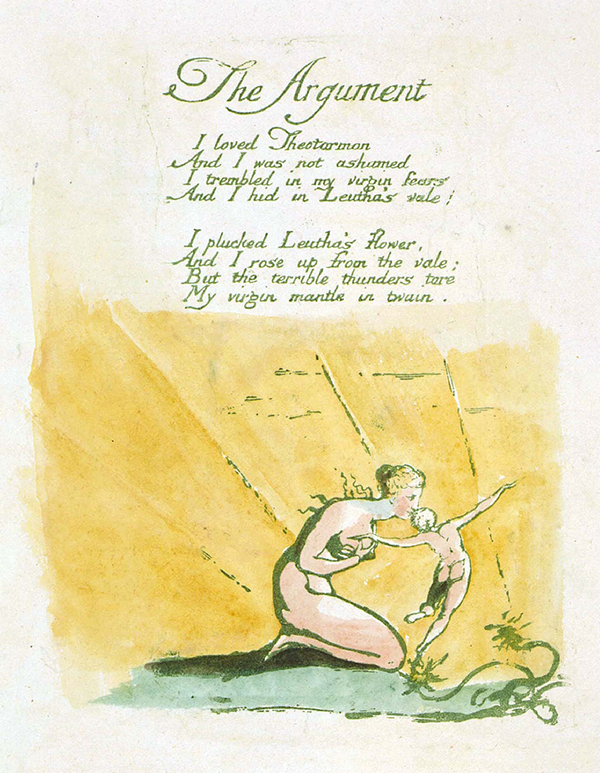
The design of plate iii shows Oothoon kneeling with her hands around her breasts, as the leaping nymph outstretches her arms. The light emitted from the Marygold is delineated by four lines that radiate across the shining background. In Blake’s image we can see striking similarities with Darwin:
[Hygeia] Saw the sad Nymph uplift her dewy eyes,
Spread her white arms, and breathe her fervid sigh;
Call’d to her fair associates, Youth, and Joy,
And shot all-radiant through the glittering sky. (The Loves of the Plants 2.375-78)
Darwin describes plants whose flowers seem to emit light, including marigold, garden nasturtium, orange lily, and the Indian pink. In his view, certain electronic activities in the plants cause the shining, especially when a pistil is impregnated. He presents the tropaeolum with an erotic interaction between its eight stamens and one pistil:
The chaste Tropæo leaves her secret bed;
A saint-like glory trembles round her head;
Eight watchful swains along the lawns of night
With amorous steps pursue the virgin light;
O’er her fair form the electric lustre plays …. (4.45-49)
In line with the tropaeolum, the shining Marygold that Oothoon encounters has an innate sexuality that generates the glorious light illuminating plate iii. In a subversion of the institution of monogamy, Darwin shows the tropaeolum’s sexual quality as polyandrous: the female has sexual encounters with several males. Tristanne Connolly proposes that Darwin frequently italicizes numbers not only because they are significant in taxonomy, but also because they produce erotic thrills (606). The emphasis on numbers promotes sexual pleasure that is not limited by a one man-one woman relationship. In Visions, Blake recreates such Darwinian sexual multiplicity in Oothoon’s fantasy at the end of the poem, where Theotormon makes love with “girls of mild silver, or of furious gold” in “wanton play” and “lovely copulation” (7.24-26, E 50). Oothoon’s aspiration for Theotormon’s promiscuous pleasure is often dismissed as Blake’s sexist assimilation of the female into male-centered desire—Oothoon’s “slip-sliding away” into “an energetically ensnaring procuress” for men’s “harem fantasy” (Bruder 82). On the other hand, Saree Makdisi reads this passage as a manifestation of Oothoon’s freedom from being “confined, objectified, and turned into a productive mechanism” and from “the confines of unitary selfhood, the pressures of jealousy and possession” (96-97). As Faramerz Dabhoiwala points out in The Origins of Sex, the discourse on polygamy flourished in the eighteenth century with the emergent fundamentalist exegesis of the Bible (that justifies concubinage),Critics such as Marsha Keith Schuchard and Humberto Garcia have paid attention to Blake’s wish to have concubines. Schuchard attributes it to his early adherence to the doctrines of the Moravian Church (234). Garcia, on the other hand, argues for the influence of the English translation of the Qur’ān (36). In addition to these religious influences, Darwin’s poetics of plants might have inspired Blake to explore concubinage and represent unconventional sexual orientations in Visions. the promotion of sexual freedom as part of the natural law, and the newly developed theory of demography. Reflecting this cultural debate, Blake adopts the polyandrous anatomy of the flower in Darwin’s work to implant unconventional sexual desire in the Marygold and Oothoon. Such desire is not only free from monogamy (and additionally, the form of monogamy that aims solely at legitimate reproduction), but also makes room for the possibility of a woman’s having multiple husbands, an option absent from the eighteenth-century debate on polygamy, in which only one man taking multiple wives is considered.Swedenborg’s discussion of polygamy and concubinage in The Delights of Wisdom Pertaining to Conjugial Love (1768) condemns these institutions as lascivious and unlawful, except for legitimate causes (for example, the wife commits adultery or theft). In this respect, the Marygold signifies a form of sexual love that rebels against the confines of Oothoon’s restricted relationship with Theotormon, who symbolizes obstructed desire that is “filld with care” (Milton 24 [26].12, E 119)—sexual conservatism necessitated by religious and moral repression. This is the reason that Oothoon seeks inspiration from the Marygold, who, with its polyamory resonant with The Loves of the Plants—a particularly woman-centered sexuality—provides the heroine the comfort that Theotormon is unable to offer.
The plucking of the Marygold is often interpreted as the prelude to the rape, as “pluck,” like the more specific “deflower,” culturally indicates a woman’s loss of virginity by a male violator. Yet, as Jackson-Houlston argues, Oothoon’s plucking also emblematizes positive lesbian love between her and the Marygold, a stark contrast to the subsequent heterosexual violence. Even though Oothoon’s action seems to be based on mutual consent, potential danger to the Marygold is hinted at by her hesitation: “I dare not pluck thee from thy dewy bed!” (1.7, E 46). The nymph’s reply—“Pluck thou my flower Oothoon the mild / Another flower shall spring” (1.8-9)—indicates that the action entails the death of the flower, so that a new flower can be born. This conversation implies that sexual love, regardless of the form, causes violent alterations of the participants’ mental and physical states. In other words, violence is the nature of eroticism, whose outcome is a simulative experience of death, la petite mort.Before Visions, Blake had linked sex with death in The Book of Thel. When Thel inquires about the Cloud’s ephemeral life—“Why thou complainest not when in one hour thou fade away” (3.2, E 4)—the Cloud answers, “When I pass away, / It is to tenfold life, to love, to peace, and raptures holy” (3.10-11). In this line, Blake correlates erotic ecstasy and its approximation to death with religious sacredness. Such an experience leads to the enrichment of new lives: the Marygold’s new flower and the Cloud’s “tenfold life.”
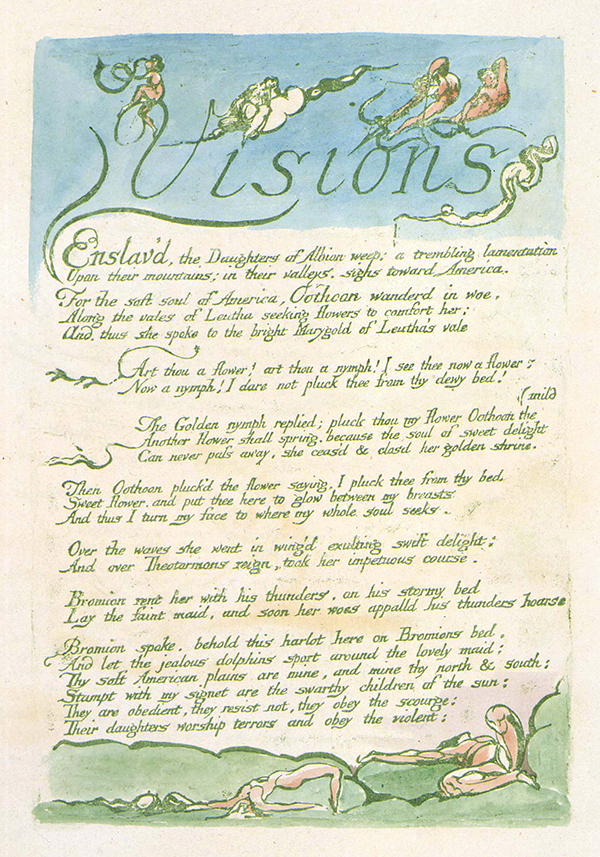
Blake describes the rape with only two lines: “Bromion rent her with his thunders. on his stormy bed / Lay the faint maid, and soon her woes appalld his thunders hoarse” (1.16-17, E 46). The designs present only its aftermath at the bottom of plate 1, where the violator and the victim lie together.Some critics do not regard these figures as Oothoon and Bromion. Philippa Simpson, for instance, sees the figure on the right also as a woman, who opens her thighs to show her vulva, “splayed in a way commonly associated with the hardcore pussy shot” (215). Simpson takes this figure as an example of Blake’s representation of “sexy amputation” that attests to the pornographic propensity of Visions.
After the rape, Theotormon appears and folds “his black jealous waters round the adulterate pair / Bound back to back in Bromions caves terror & meekness dwell” (2.4-5, E 46), the scene displayed on the frontispiece.
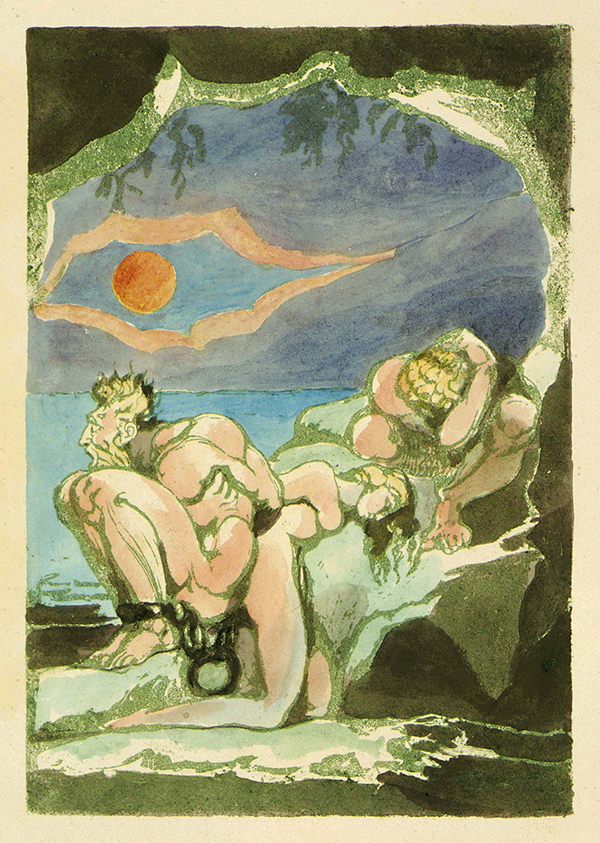
If the image of legs spread in a triangular shape represents a post-orgasmic state, Bromion’s open posture suggests that he is sexually interacting with others, projecting his desire outward. The image of Theotormon has the same post-orgasmic undertone, but his enclosed upper body is the opposite of Bromion’s open one, denoting an inward self-projection through which he directs his desire back to himself. Thus, Theotormon’s posture can be conceived as a representation of autoeroticism. In this respect, Freud’s theory of mourning and melancholia is particularly useful. Theotormon’s self-enclosed image consists, in Freud’s terms, of the subject’s withdrawal of his libido-cathexis from the exterior world and its concentration on the subject’s own self and body (“On the Introduction of Narcissism” 5). The withdrawal of sexual desire from others to self is caused by extreme mental distress, which Freud categorizes as melancholia: “Melancholia is mentally characterized by a profoundly painful depression, a loss of interest in the outside world, the loss of the ability to love, the inhibition of any kind of performance and a reduction in the sense of self, expressed in self-recrimination and self-directed insults, intensifying into the delusory expectation of punishment” (“Mourning and Melancholia” 204). In the aftermath of his lover’s rape, Theotormon’s static image on the frontispiece comprises the enclosed upper body of libido withdrawal and the triangular lower body of autoerotic self-projection. The passage on plate 2 following the binding of “the adulterate pair” also presents his mental state: the line describing how “Theotormon sits wearing the threshold hard” (2.6) reinforces the sense of his “inhibition … of performance” and the phrase “secret tears” (2.7) emphasizes the unnamable nature of his distress. Furthermore, his imagined self-flagellation in the design on plate 6 anticipates “the delusory expectation of punishment” in the symptoms of Freudian melancholia.
Theotormon’s form of self-annihilation can be further illustrated through Freud’s division between normal mourning and pathological melancholia. Although both conditions are caused by the loss of the love object, in mourning this sense of loss is conscious/presentable, while in melancholia it is unconscious/unpresentable. This distinction brings forth the key element of melancholia, “an extraordinary reduction in self-esteem, a great impoverishment of the ego” (“Mourning and Melancholia” 205). In Theotormon’s case, he cannot undergo the normal process of mourning and regain his ability to interact with the outside world because what he truly loses is not Oothoon as a love object, but his sense of self and social identity as a heterosexual lover/husband. As noted, Theotormon’s sexual conservatism in his relationship with Oothoon results in her early “woes” and, indirectly, her rape by Bromion. This point is worth raising again because the loss of self-esteem and positive identity as a result of sexual inability is, for Theotormon, unnamable, especially when he notices Oothoon’s problematic arousal by her violation; this is the reason for his immobilization and self-enclosure. In this state of withdrawal, he can only channel his libido, “the burning fires / Of lust” (2.9-10, E 46), into his own autoerotic lower body by emulating Bromion’s post-orgasmic posture on plate 1—that is, after recognizing Oothoon’s possible pleasure in the rape, he attempts to identify with Bromion’s sexual potency and violence, further disintegrating his identity as a loving husband in this autoerotic experience of self-annihilation.
In previous discussions of Blake’s view of autoeroticism in Visions, critics have generally focused on Oothoon’s later denouncement of such behavior as an unhealthy outcome of sexual repression by religious doctrines—“the rewards of continence” and “the self enjoyings of self denial” (7.8-9, E 50). Highlighting Freud’s notion that masturbation provides only “substitute gratification,” George proposes that it is “an anti-act for Blake, one accomplished in the dark, in silence, in the presence of an absence” (136). Similarly, Richard Sha foregrounds the conflict between Blake’s view of masturbation and his ideal of mutual affection in sexual interactions between individuals (204-05). In contrast, Christopher Hobson maintains that Blake regards masturbation as an unconventional sexual behavior that stands for liberation (36). Yet Blake’s autoerotic design of Theotormon on the frontispiece, which emulates Bromion’s posture on plate 1, has not attracted much attention.
From the perspective of the contemporary discourse on masturbation, the design of Theotormon resonates with Samuel-Auguste Tissot’s treatise On Onanism (1760), which shaped the negative view in following decades. With two English translations in 1766, it was popular in Blake’s time (Jordanova 70), and he may well have known of or read it. Tissot’s account is based on a central idea of “animal economy” that generally consists of the processes of “waste” and “reparation,” which are actualized by the generation, circulation, and consumption of humors. In his hierarchy of humors, milk is much more dispensable than blood, and semen is crucial: “The loss of an ounce of this humour would weaken more than that of forty ounces of blood” (10). If this loss occurs in an “unnatural” way, the ill consequences are even more severe. For example, Tissot maintains that seminal issue that results from conjugal intercourse does less damage to the body than that from sexual intercourse with prostitutes; likewise, nocturnal emission is less harmful than masturbation because the former happens without the subject’s knowledge, while the latter is a deliberate act of unrestrained lasciviousness. Hence, it is obvious that Tissot’s apparently scientific treatise is infused with moral sensibility as well. These moral sentiments are common in the eighteenth century, as reflected in John Armstrong’s popular 1736 poetic essay The Oeconomy of Love, where masturbation is dismissed as an “ungenerous, selfish, solitary Joy” and “unhallow’d Pastime”—“To shed thy Blossoms thro’ the desert air, / And sow thy perish’d Off-spring in the winds” (lines 106, 122, 120-21). As one of the most unnatural ways to lose semen, masturbation not only damages the body—weakened sight, pimples, weight loss, and fatigue—but also causes the masturbator to experience mental catastrophe, diminishing “all the bodily senses and all the faculties of the soul” and resulting in the loss of imagination and memory; and imbecility, contempt, shame, ignominy …; the humiliating character of being an useless load upon earth; … a distaste for all decent pleasures; lassitude, an aversion for others, and at length for self; life appears horrible; the dread which every moment starts at suicide; anguish worse than pain; remorse, which daily increases … and serves perhaps for eternal punishment—a fire that is never extinguished. (Tissot 126, emphasis added) In Tissot’s view, masturbation signifies the utter loss of one’s sense of identity as a social being, causing one to become “an useless load upon earth.” Ludmilla Jordanova points out that his description has a secondary effect; it “suggests an element of pleasure derived from the recounting of pain and misery in others” (75). In other words, Tissot’s style of writing invites readers to imagine the masturbator’s situation—the lust he indulges himself in, and the dreadful consequences he has to suffer—and take pleasure in this process of imagination. His description renders masturbation, frequently called “the feats” in the treatise, not only frightening but also perversely attractive. Apart from this mixture of fear and attraction, the physical pleasure of masturbation is also underlined by contemporary botanist Bellenden Ker, who claims that “there is more pleasure in frigging one’s self, considered in merely a sensual way” than in having sex with women (quoted in Dabhoiwala 178).
In Tissot, the mental mechanism involved in masturbation is the self-annihilating process of forsaking one’s social identity and its function and purposefulness. The masturbator belittles himself in humiliation and shame, feelings that are blended with the experience of bodily pleasure. Despite listing meticulously the fearful pathological damages on the body masturbation causes, Tissot’s writing, perhaps unconsciously, indicates that such unnatural behavior grants the doer a unique pleasure that cannot be achieved through natural sexual intercourse. The potential autoeroticism of Theotormon in Visions reflects this description, as it also emerges in a humiliating situation where the social identities of Theotormon as a husband, lover, and heterosexual man are breached. The autoerotic pleasure is begot, therefore, by the drastic alteration of subjectivity, which takes him out of his socially functioning role and renders him “an useless load upon earth.” In Visions, Blake not only reflects Tissot’s observation of the negative effects of masturbation when he has Oothoon call it “the self enjoyings of self denial,” but also acknowledges the intense pleasure of this unnatural sexual act. Blake takes his idea of autoeroticism further in Oothoon’s calling for self-punishment. Diverging from Tissot’s assertion that autoeroticism—a passive behavior of torpidity—results in “the loss of imagination,” he regards it as an active process of poetic imagination.
Oothoon responds to Theotormon’s masturbatory status with her own autoerotic fantasy of self-punishment, “calling Theotormons Eagles to prey upon her flesh”:
I call with holy voice! kings of the sounding air,
Rend away this defiled bosom that I may reflect.
The image of Theotormon on my pure transparent breast. (2.14-16, E 46)
Her desire for mutilation as a rape victim reminds us of the eponymous heroine in James Macpherson’s poem Oithona, one of the most prominent sources for Visions. After being raped by Dunromath, Oithona condemns herself in shame in front of her lover, Gaul: “Why comest thou over the dark-blue wave, to Nuäth’s mournful daughter? Why did I not pass away in secret …?” She then plunges into despair: “I vanish in my youth; my name shall not be heard. Or it will be heard with grief; the tears of Nuäth must fall” (Macpherson 107-08). Oithona’s reaction to her rape is entirely passive: she denies her physical existence and social identity and wishes to be absent in her lover’s presence. Following Oothoon’s counterpart in Oithona, Blake seems to recreate the self-accusation of the rape victim in Visions. As Welch points out, the victim’s impulse for self-punishment is not uncommon, since it was usually the violated woman rather than the male violator who was condemned in the late eighteenth century (121). Oothoon’s call for self-mutilation, though more or less reflective of this tradition, is a subtle manifestation of poetic imagination. Like Theotormon, she is also undergoing a process of autoerotic fantasy by imagining herself willingly being violated again. The image of an eagle rending its victim’s breast is an obvious allusion to Prometheus, a symbol of rebellion and self-sacrifice.
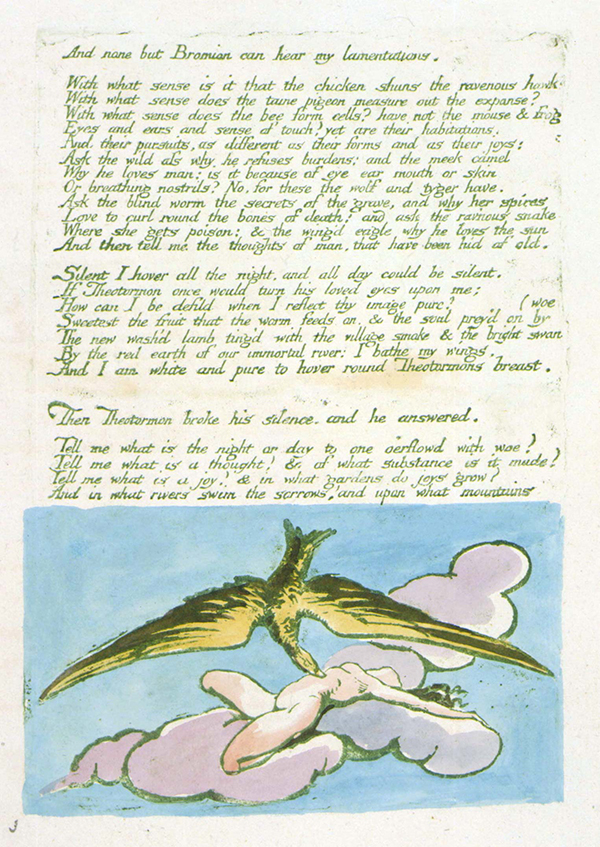
The disintegration of the self and the recasting of subjectivity in autoeroticism also appear in Jean-Jacques Rousseau’s Confessions, a work Blake was very familiar with.In Blake’s earlier prophetic books, Rousseau and Voltaire are depicted as the positive momentum of the French Revolution. But Blake does not share their deistic view of religion; in Jerusalem, Rousseau, along with Voltaire, Gibbon, and Hume, is accused of hypocrisy: “The Book written by Rousseau calld his Confessions is an apology & cloke for his sin & not a confession” (E 201). See also Damon 351-52. In terms of sexuality, both writers explore the mentality of autoeroticism. As Harvey’s study shows, eighteenth-century thinkers, especially those from France, aligned their philosophies “with a veritable unleashing of sexual desires” (200). Among them is Rousseau, who is particularly concerned with the sexual relationships between men and women in larger social and political contexts. According to Joel Schwartz, Rousseau believes that male sexual desire for women constitutes the mutual dependence between the sexes, which is a positive drive that ameliorates society and accomplishes “the political betterment of mankind” (3). Autoeroticism—the withdrawal of sexual desire from the external world—therefore hinders such social improvement. For instance, in Emile, Rousseau dismisses masturbation so that a mature man can “enter society … to find there a companion worthy of him” (quoted in Schwartz 105). Despite this characterization of autoeroticism as an anti-social complex, Rousseau still indulges himself in the seductive “feat”—in Tissot’s word—of masturbation. Schwartz distinguishes Rousseau’s romantic relationship with Thérèse Levasseur, portrayed as a common and illiterate woman in The Confessions, from Emile’s relationship with Sophie in Emile. He points out that while the latter is based on mutual affection, the former originates entirely in corporeal desire. Rousseau refers to his relationship with Thérèse as a “supplement,” a word he also uses to describe his masturbation (Schwartz 104-05). Both are substitutes for his ideal love object, who is always absent. But the two substitutes are in essence different, because unlike the sex with Thérèse, masturbation is not only a supplement, but also “ce dangereux supplément.” In book 3 of The Confessions, Rousseau gives a personal account of “this dangerous supplement which diverts the course of nature”: This vice, which shame and timidity find so convenient, has, besides, great enticements for lively imaginations; that is, to dispose, in a manner, at will, of the whole sex, and to make the beauties which tempt them serve their pleasures without the necessity of obtaining their consent. (1783 Dublin ed., 1: 164, emphasis added) And in book 9, in a distress of longing without a real woman’s presence, he admits his “vice” in a suggestive way: The impossibility of attaining real beings threw me into the regions of chimera, and seeing nothing in existence worthy of my delirium, I sought food for it in the ideal world, which my imagination quickly peopled with beings after my own heart. … In my continual extacy I intoxicated my mind with the most delicious sentiments that ever entered the heart of man. (1790 London ed., 1: 342, emphasis added) In these passages, Rousseau aestheticizes his experience of masturbation by accentuating its artistic quality of “lively imagination” in order to create images that generate utmost pleasure in his mind. Because the object of desire is absent, he has to enter “the regions of chimera”—a phrase that denotes the splitting of subjectivity. In an autoerotic ecstasy, where the subject imagines his love object, his subjectivity must be divided to assume several identities, like the chimera who is at the same time a lion, a goat, and a serpent. It is also a process of dissolving the conventional boundary of gender roles; Schwartz notes that Rousseau’s experiences in reading and imagination make him “both female and male, which is to say that he transcends the differentiation between the sexes, and is a human whole, not merely a sexual part” (107). This androgynous mentality corresponds to Blake’s ideal of the Universal Man, a primary state of humanity and Poetic Genius that reunites the masculine Spectre and feminine Emanation. Though Blake deems The Confessions a work of hypocrisy, there is a subtle resonance between Blake and Rousseau in terms of sexual experience (especially autoeroticism), which is analogous to artistic imagination. In her autoerotic fantasy illustrated on plate 3 of Visions, Oothoon also activates her “lively imagination” to split her subjectivity and form a scene in which the dominant image is erotic violence. This is exactly Rousseau’s access to the masturbatory “regions of chimera” and his “ideal world, which my imagination quickly peopled with beings after my own heart.” With the potency of imagination, Oothoon calls for Theotormon’s violence on herself. As both a victim and a masochist, she paradoxically exerts the power of powerlessness and shows the activeness of passivity. By urging Theotormon to mutilate her “defiled bosom,” Oothoon actually takes control of the imperative language in this masochistic play. She is, as Susan Sontag would put it, “profoundly active in her passivity” (99).
Welch underscores the distinction between “this defiled bosom” and “my pure transparent breast” (emphasis added), arguing that Oothoon’s call for self-mutilation is an assertion of her untainted essence, to “distinguish between her true self and her unwillingly defiled exterior” (121). But more than defending her essential innocence, with the self-disintegrating imagination of autoeroticism she is actually denouncing Theotormon’s sexual impotence and conservatism—which indirectly cause her, unwillingly, bodily arousal during the rape—and his later inactivity and self-victimization. With the typical emotional withdrawal and enclosure of Freudian melancholia—“She cannot weep! her tears are locked up” (2.11, E 46)—Oothoon’s lamentations are intrinsically accusations: “They [melancholics] are not ashamed, they do not conceal themselves, because everything disparaging that they express about themselves is basically being said about someone else” (Freud, “Mourning and Melancholia” 208). What Oothoon says later in plate 2 about her dire state being limited by five senses is truly an indication of Theotormon’s inability to see through her polluted exterior (“this defiled bosom”) and acknowledge her intact interior (“my pure transparent breast”). Aggravatingly, he is unable to act like a real husband/lover by bringing justice upon the rapist and asserting his unchanged love for her, perhaps as the hero in Oithona does.Gaul, the counterpart of Theotormon, declares: “Thou [Oithona] art to me the beam of the east, rising in a land unknown. But thou coverest thy face with sadness, daughter of car-borne Nuäth! Is the foe of Oithona near? My soul burns to meet him in fight. The sword trembles by the side of Gaul, and longs to glitter in his hand” (Macpherson 107). The themes of reunion with a damsel in distress and restoration of order permeate Macpherson’s narrative. In Visions, these themes that solidify masculine identity are entirely absent. Conversely, Blake’s poem shows the breakdown of Theotormon’s masculine identity through self-annihilating autoeroticism. Instead, Theotormon’s selfhood based on the identity of husband/lover has already been annihilated in his autoerotic emulation of Bromion’s sexual violence, an abject situation that Oothoon discloses with the pronouncement “all from life I was obliterated and erased” (2.34, E 47).
Theotormon fails to understand the profound meaning of Oothoon’s call for self-mutilation: “Theotormon hears me not! to him the night and morn / Are both alike” (2.37-38); what he sees now is only a picture of autoerotic and masochistic fantasy. Consequently, he undergoes further drastic alterations of his subjectivity. He perceives Oothoon’s autoerotic imagination and “severely smiles. her soul reflects the smile; / As the clear spring mudded with feet of beasts grows pure & smiles” (2.18-19). Here he is not only a humiliated husband but also a thrilled spectator of the erotic violence that Oothoon presents through her “lively imagination.” His smile upon “the clear spring mudded with feet of beasts”—a recapitulation of Oothoon’s rape by Bromion—corresponds to his emulation of and identification with the rapist’s sexual violence on the frontispiece. In his discussion of spectacular violence in Romantic imagination, Ian Haywood points out that in the triangular relationship among a victimizer, a victim, and a spectator, there is a certain “configuration of multiple points of view” that “breaks down the binary opposition of self and Other which is implied in the simplistic viewer-victim model” (6). Oothoon’s eagle-rent image on plate 3 and Theotormon’s erotic reaction as a spectator exemplify such a “triangular vignette,” in which both characters alter their identities in a drastic manner, as Oothoon becomes simultaneously victim and victimizer and Theotormon forsakes his social identity as a husband/lover (who is at least obliged to comfort Oothoon, if not fully avenge her rape) to take pleasure in her second violation.Plate 3 also reminds us of Blake’s illustrations to John Gabriel Stedman’s Narrative. His engravings of tortured slaves, based on Stedman’s drawings, seem to evoke sympathy and abolitionist sentiments. The representation is problematic, however, for his erotic way of portraying afflicted human bodies. The extent to which Blake approves of such eroticization of suffering requires further exploration. Nevertheless, Oothoon’s autoerotic fantasy and Theotormon’s reaction seem to correspond to the images of the tortured slaves and suggest “the trans-historical nature of aesthetics, torture, the fetish, and pornography” (Wood 94).
To conclude, I turn to Bromion’s lines on plate 4. Though allegorically Bromion represents plantation slavery and patriarchal oppression, this antagonist articulates the nature of eroticism for Blake. After the lengthy and abstract conversation between Oothoon and Theotormon about the restriction of human perception, Bromion urges Theotormon to “gratify senses unknown”:
Thou knowest that the ancient trees seen by thine eyes have fruit;
But knowest thou that trees and fruits flourish upon the earth
To gratify senses unknown? trees beasts and birds unknown:
Unknown, not unpercievd, spread in the infinite microscope,
In places yet unvisited by the voyager. and in worlds
Over another kind of seas, and in atmospheres unknown. (4.13-18, E 48)
Stevens proposes that the “senses unknown” allude to “a less conventional sexuality” (149), a queer interpretation that Theotormon is both mentally and physically raped by Bromion, who in this passage is suggesting homosexual anal sex as an unspeakable but tempting pleasure. Certainly, Bromion is referring to a wider scope of sexuality that is free from the institution of marriage and heteronormativity in Blake’s time. In addition, with the repeated stress on the word “unknown” and the phrase “not unpercievd,” Bromion promotes a kind of sexual experience that values sensual perception over knowledge, on which human subjectivity and selfhood are constructed. In Visions, eroticism encompasses heterogeneous aspects of sex, including violence against the self and the other. This alternative form of eroticism is actualized in Oothoon’s plucking of the Marygold, which represents polyamorous sex and erotic approximation to death, in the rape itself as a violent embodiment of sex, and in the autoerotic fantasy that entails the disintegration of selfhood and subjectivity. Oothoon and Theotormon annihilate their previous social identities in the erotic experiences precipitated by the extreme conditions of violence and loss of love object. It might not be plausible to say that Blake advocates sexual violence and self-denying autoeroticism in Visions, which, as many critics have demonstrated, bears a social/political message criticizing slavery and religious oppression. But these sexual negativities do empower his poetic imagination and there does emerge the irresistible pleasure of “the self enjoyings of self denial”—Tissot’s “feats,” Rousseau’s “most delicious sentiments,” and Blake’s “sweetest … fruit” blighted by the worm—that somehow outweighs “normal” erotic love between individuals based on positive mutual affection. Indeed, as the most prominent motif in Milton and Jerusalem, self-annihilation is a ceaseless “Mental Fight” that envisions a political/religious paradise in “Englands green & pleasant Land” (Milton 1 [i], E 95-96) with the harmonious reunion of men and women. Yet an alternative aspect of self-annihilation is embodied by the restless “Sword … in my hand,” a sexual euphemism since Shakespeare. Apart from being “Forgiveness of Sins” (Jerusalem 98.23, E 257) and the key to reestablishing the genderless Universal Man in the later epics, the phenomenon of self-annihilation emerges in Visions in the forms of sexual violence and autoeroticism, which generate unacknowledged pleasure by decentralizing subjectivity and disintegrating preexisting identity.
Works Cited
Armstrong, John. The Oeconomy of Love: A Poetical Essay. New ed. London, 1745. [Accessed in Eighteenth Century Collections Online (hereafter ECCO), 28 June 2019.]
Blake, William. The Complete Poetry and Prose of William Blake. Ed. David V. Erdman. Newly rev. ed. New York: Anchor-Random House, 1988. [Abbreviated as E.]
Bruder, Helen P. William Blake and the Daughters of Albion. London: Macmillan, 1997.
Clark, Anna. Women’s Silence, Men’s Violence: Sexual Assault in England, 1770–1845. London: Pandora, 1987.
Connolly, Tristanne. “Flowery Porn: Form and Desire in Erasmus Darwin’s The Loves of the Plants.” Literature Compass 13.10 (2016): 604-16.
Dabhoiwala, Faramerz. The Origins of Sex: A History of the First Sexual Revolution. Oxford: Oxford University Press, 2012.
Damon, S. Foster. A Blake Dictionary. With a new index by Morris Eaves. London: Thames and Hudson, 1979.
Darwin, Erasmus. The Botanic Garden. Part II. Containing The Loves of the Plants. A Poem. 2nd ed. London: J. Nichols, 1790. [Accessed in ECCO, 27 June 2019.]
Doskow, Minna. William Blake’s “Jerusalem”: Structure and Meaning in Poetry and Picture. Rutherford: Fairleigh Dickinson University Press, 1982.
Erdman, David V. Blake: Prophet against Empire. 3rd ed. Princeton: Princeton University Press, 1977.
———. The Illuminated Blake. Oxford: Oxford University Press, 1975.
Fox, Susan. “The Female as Metaphor in William Blake’s Poetry.” Critical Inquiry 3.3 (1977): 507-19.
Freud, Sigmund. “Mourning and Melancholia.” On Murder, Mourning and Melancholia. Trans. Shaun Whiteside. London: Penguin, 2005. 201-18.
———. “On the Introduction of Narcissism.” “Beyond the Pleasure Principle” and Other Writings. Trans. John Reddick. London: Penguin, 2003. 1-30.
Frye, Northrop. Fearful Symmetry: A Study of William Blake. Princeton: Princeton University Press, 1947.
Garcia, Humberto. “Blake, Swedenborg, and Muhammad: The Prophetic Tradition, Revisited.” Religion & Literature 44.2 (2012): 35-65.
George, Diana Hume. Blake and Freud. Ithaca: Cornell University Press, 1980.
Goslee, Nancy Moore. “Slavery and Sexual Character: Questioning the Master Trope in Blake’s Visions of the Daughters of Albion.” ELH 57.1 (1990): 101-28.
Harvey, Karen. Reading Sex in the Eighteenth Century: Bodies and Gender in English Erotic Culture. Cambridge: Cambridge University Press, 2004.
Haywood, Ian. Bloody Romanticism: Spectacular Violence and the Politics of Representation, 1776–1832. Basingstoke: Palgrave Macmillan, 2006.
Hobson, Christopher Z. Blake and Homosexuality. New York: Palgrave, 2000.
Jackson-Houlston, Caroline. “‘The lineaments of … desire’: Blake’s Visions of the Daughters of Albion and Romantic Literary Treatments of Rape.” Queer Blake. Ed. Helen P. Bruder and Tristanne Connolly. Basingstoke: Palgrave Macmillan, 2010. 153-62.
Jordanova, Ludmilla. “The Popularization of Medicine: Tissot on Onanism.” Textual Practice 1.1 (1987): 68-79.
King-Hele, Desmond. Erasmus Darwin and the Romantic Poets. Basingstoke: Macmillan, 1986.
Kugler, Anne. “Constructing Wifely Identity: Prescription and Practice in the Life of Lady Sarah Cowper.” Journal of British Studies 40.3 (2001): 291-323.
Linkin, Harriet Kramer. “Revisioning Blake’s Oothoon.” Blake 23.4 (spring 1990): 184-93.
Macpherson, James. The Poems of Ossian. 2 vols. London, 1796. [Accessed in ECCO, 21 July 2016.]
Makdisi, Saree. William Blake and the Impossible History of the 1790s. Chicago: University of Chicago Press, 2003.
McGann, Jerome J. “The Aim of Blake’s Prophecies and the Uses of Blake Criticism.” Blake’s Sublime Allegory. Ed. Stuart Curran and Joseph Anthony Wittreich, Jr. Madison: University of Wisconsin Press, 1973. 3-21.
Mellor, Anne K. “Sex, Violence, and Slavery: Blake and Wollstonecraft.” Huntington Library Quarterly 58.3/4 (1995): 345-70.
Punter, David. “Blake, Trauma and the Female.” New Literary History 15.3 (1984): 475-90.
Rousseau, Jean-Jacques. The Confessions of J. J. Rousseau …. Part the Second. 3 vols. London, 1790. [Accessed in ECCO, 19 Nov. 2018.]
———. The Confessions of J. J. Rousseau: With the Reveries of the Solitary Walker. 2 vols. Dublin, 1783. [Accessed in ECCO, 8 Dec. 2020.]
Ryan, Robert M. The Romantic Reformation: Religious Politics in English Literature, 1789–1824. Cambridge: Cambridge University Press, 1997.
Schuchard, Marsha Keith. Why Mrs. Blake Cried: William Blake and the Sexual Basis of Spiritual Vision. London: Century-Random House, 2006.
Schwartz, Joel. The Sexual Politics of Jean-Jacques Rousseau. Chicago: Chicago University Press, 1984.
Sha, Richard C. Perverse Romanticism: Aesthetics and Sexuality in Britain, 1750–1832. Baltimore: Johns Hopkins University Press, 2009.
Simpson, Philippa. “Blake and Porn.” Sexy Blake. Ed. Helen P. Bruder and Tristanne Connolly. Basingstoke: Palgrave Macmillan, 2013. 211-18.
Sontag, Susan. “The Pornographic Imagination.” Story of the Eye, by Georges Bataille. London: Penguin, 2001. 83-118.
Stevens, Bethan. “‘Woes & … sighs’: Fantasies of Slavery in Visions of the Daughters of Albion.” Queer Blake. Ed. Helen P. Bruder and Tristanne Connolly. Basingstoke: Palgrave Macmillan, 2010. 140-52.
Tayler, Irene. “Say First! What Mov’d Blake? Blake’s Comus Designs and Milton.” Blake’s Sublime Allegory. Ed. Stuart Curran and Joseph Anthony Wittreich, Jr. Madison: University of Wisconsin Press, 1973. 233-58.
———. “The Woman Scaly.” Bulletin of the Midwest Modern Language Association 6.1 (1973): 74-87.
Tissot, Samuel-Auguste. Three Essays …. Third, On Onanism: or, A Treatise upon the Disorders Produced by Masturbation: or, The Effects of Secret and Excessive Venery. Dublin, 1772. [Accessed in ECCO, 27 July 2016.]
Welch, Dennis M. “Essence, Gender, Race: William Blake’s Visions of the Daughters of Albion.” Studies in Romanticism 49.1 (2010): 105-31.
Wood, Marcus. Slavery, Empathy and Pornography. Oxford: Oxford University Press, 2002.