“If you want to learn the secrets, close your eyes”: Bruce Dickinson’s “Gates of Urizen” as Contrary Version of The [First] Book of Urizen
Katharina Hagen (katharina.hagen@ruhr-uni-bochum.de), MA, is a PhD student of English literary and cultural studies at the University of Saarland. Her research interests are intertextuality and intermediality with a strong focus on popular culture. She is also a guest author for Zoamorphosis, the Blake 2.0 Blog—William Blake in Art, Music, Film, and Literature.
Urizen, the protagonist of William Blake’s The [First] Book of Urizen (1794), is a dark character who represents tyranny, suppression, and reason. While Urizen retells events in the form of a book, depicting an unchangeable past, Bruce Dickinson’s song “Gates of Urizen” (The Chemical Wedding, 1998) concentrates on enlightenment and the escape from Urizenic restrictions. Both focus on contrasts—imagination and reason, open space and enclosure, mind and body, mobility and fixture, success and failure. Whereas the separation of contraries Los and Urizen leads to misery and chaos in Urizen, it produces positive results in “Gates”: Dickinson’s adaptation changes the outcome of Urizen and turns the plot into practical advice on how to pass the gates of Urizen. By comparing metaphors of imprisonment and freedom in both texts, such as impaired vision and prophetic sight or the contrast between being earthbound and airborne, I shed light on how “Gates” turns a dystopic mythology into a philosophy of life.
The Mysticism of Blake: Dickinson’s Concept Album
The Chemical Wedding is a concept album governed by two major themes and their interrelation, the work of Blake and the occult. As Dickinson explains in What Does This Button Do? An Autobiography: Most of the album was heavily influenced by Blake—not just in a literal sense, but in a spiritual one. Blake was almost certainly an alchemist or a member of a group relating to the occult or magical philosophy. At the same time, I was struck by his two characters “Los” and “Urizen.” Los (or Sol backwards) was creative and doomed forever to have his head buried in a bucket of fire, symbolising the torture of the endlessly creative soul. Urizen was the cold repository of logic, chained to a rock, dismal and brooding. To me they seemed like characters in Blake’s subconscious, acting out the drama in his soul, expressed as art and poetry. I had some inkling of what it felt like to love the creativity but be held back by the grim realities of the commercial and the fear of change. I could relate to Blake. (269) Although this essay shows that Dickinson clearly dismantles this popular yet simplified characterization of Urizen, the dichotomy between Los and Urizen is still a major theme of the album, which not only retells their narratives but also uses their characters as archetypes representing the inner struggle of the artist. Los and Urizen as embodiments of creativity and commerce represent a dilemma that questions, in the long run, the very nature of art.
The use of Blakean references and ideas inspired by Blake, combined with occultist thought, results in a complex conglomerate of allusions. The album is thus not a simple musical adaptation of Blake’s work. As one might expect, it features “Jerusalem”—the best known and most frequently set to music of Blake’s poemsWhittaker’s recent discography mentions 406 recordings/scores.—but Dickinson has added lyrics to expose, as he says, “the pagan-alchemical verse I thought represented its true meaning” (What Does This Button Do? 269), and slightly changed the Blakean lines.
References to the occult are numerous and various, covering fictional representations as well as occultist knowledge itself. “Book,” for instance, quotes one of the witches from Shakespeare’s Macbeth, “Return of the King” evokes Arthurian legend by mentioning Uther Pendragon, hinting at mystic (or druid) Britain, and “The Tower” incorporates tarot imagery into the lyrics: the chorus enumerates archetypes of the Major Arcana, such as the Tower, the Lovers, and the Moon.The Major Arcana are the twenty-two mostly numbered archetypes in a tarot deck, in contrast to the Minor Arcana, which are organized like ordinary playing cards. For more detail on how a tarot deck fit for divination is structured, see “Tarot” in the Encyclopedia Britannica, <https://www.britannica.com/topic/tarot>. The Blakean references are thus firmly embedded in a framework of occultist thought.
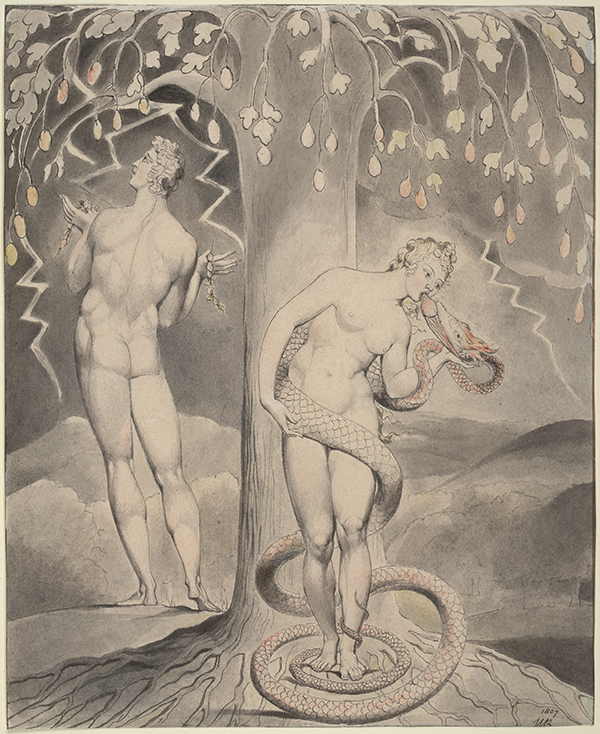
Strengthening this connection between Blake’s work and the occult, the album is linked to several schools of mysticism. The title, The Chemical Wedding, refers to one of the manifestos of the Rosicrucian Order, Chymische Hochzeit Christiani Rosencreutz anno 1459 (1616; The Chymical Wedding of Christian Rosenkreutz),Dickinson explains that his script for the film Chemical Wedding (2008) was inspired by the manifesto and that he used the same title for this album (What Does This Button Do? 268). Thus, by logical extension, the album too was inspired by the manifesto. a text strongly rooted in alchemy.The maiden who accompanies the guests during the wedding preparations and ceremonies is called Alchemia (Andreae, notes, 175). See also Steiner. The title is also reminiscent of practices of sex magic as proclaimed by several groups seeking spiritual enlightenment that Blake was familiar with (such as the Moravians), Emanuel Swedenborg’s teachings about the enhancement of spiritual vision by the means of what he calls conjugial love, and Blake’s own infusion of his poetry and art with references to sex magic (see Schuchard). One such example is the sketch Eve Tempted by the Serpent (Schuchard 63), one of the works that apparently served as inspiration for “Book.” In sum, by combining allusions to the occult, the album traces different schools of mysticism at whose center sit Blake’s prophetic sight and understanding of religion.
The Song
“Gates” is an open text that contains references to several of Blake’s works and brings them into relation with each other, thereby forming a new and independent narrative. It retells the beginning of Urizen, but later parts way with the hypotext.
As above, so below
All things come from the one
Now you are the victim
Carried by the wind, rooted in the ground
If you want to learn the secrets
Close your eyes
The ladder falls away
At the gates of Urizen
Fallen eagles blaze
At the gates of Urizen
Eternal twins are damned
At the gates of Urizen
Separate lives begin
In every woman is a man
From the moon come silver ghosts
Spectres of the blood
From my spirit comes the darkness
From the void, the crimson fortress rises
At the gates of Urizen
The ladder falls away
At the gates of Urizen
Fallen eagles blaze
At the gates of Urizen
Eternal twins are damned
At the gates of Urizen
Separate lives begin
At the gates of Urizen
The ladder falls away
At the gates of Urizen
Fallen eagles blaze
At the gates of Urizen
Eternal twins are damned
At the gates of Urizen
Separate lives begin
At the gates of Urizen
The gates of Urizen
The gates of Urizen
At the gatesThe lyrics reflect the recorded versions. Those in the booklet (The Chemical Wedding, expanded ed., 2005) differ slightly: “Gathered by the wind” for “Carried by the wind”; “then rooted in the ground” for “rooted in the ground”; and, in the first use of the line, “Separate lives began” for “Separate lives begin.”
Words and music by Paul Dickinson and Roger Ramirez.
© Copyright 1998 Rumba Zealous Music/Duellist Enterprises Ltd.
BMG Rights Management (UK) Ltd., a BMG Company.
All rights reserved. International copyright secured.
Used by permission of Hal Leonard Europe Limited.
Dickinson’s Reinterpretation of Urizen: “The dark power hid”
Dickinson introduces this suppressive character as a threat. He begins his narrative with a direct quotation from Urizen, but shapes his version by the choice and placement of the quotation. “Gates” is preceded by a spoken introduction on the previous track, “Book of Thel” (or, in the case of the live album Scream for Me Brazil [1999], “Chemical Wedding”), which is taken from the first chapter of Urizen: “What Demon / Hath form’d this abominable void / This soul-shudd’ring vacuum? Some / said / ‘It is Urizen’, But unknown, abstracted / Brooding secret, the dark power hid” (object 3, lines 5-10).All quotations from Blake are taken from the William Blake Archive. Quotations from Urizen are from its latest realization, copy G. Urizen is introduced as a “dark power” that has hidden in obscurity, a lurking threat. “Gates” mirrors this disappearance by placing the introduction not as part of the track itself, but at the end of the track before, so that Urizen is concealed for the moment a CD or MP3 player skips from one to the next. He hides even more if the listener separates the titles, be it by shuffling or picking songs. In the age of streaming and download purchases, a customer might decide to listen to “Gates” in isolation, a scenario in which the first appearance of the “dark power” would remain “unknown” and “hid[den]” forever.In Scream for Me Brazil, the introduction of Urizen is even more complex. The quotation from chapter 1 at the end of “Chemical Wedding” is preceded by part of the preludium, which appears at the end of “King in Crimson” (which in turn precedes “Chemical Wedding”): “Of the primeval Priests assum’d power, / When Eternals spurnd back his religion; / And gave him a place in the north, / Obscure, shadowy, void, solitary” (object 2, lines 7-10). In this case, the introduction of Urizen is given more detail, and he hides twice before he reappears in “Gates.” The misplacement of Urizen into the wrong track (wrong in the sense that he does not belong in the world of Blake’s Thel or Dickinson’s Thel) adds even more to the eerie atmosphere and anticipated danger created by his sudden appearance/disappearance.
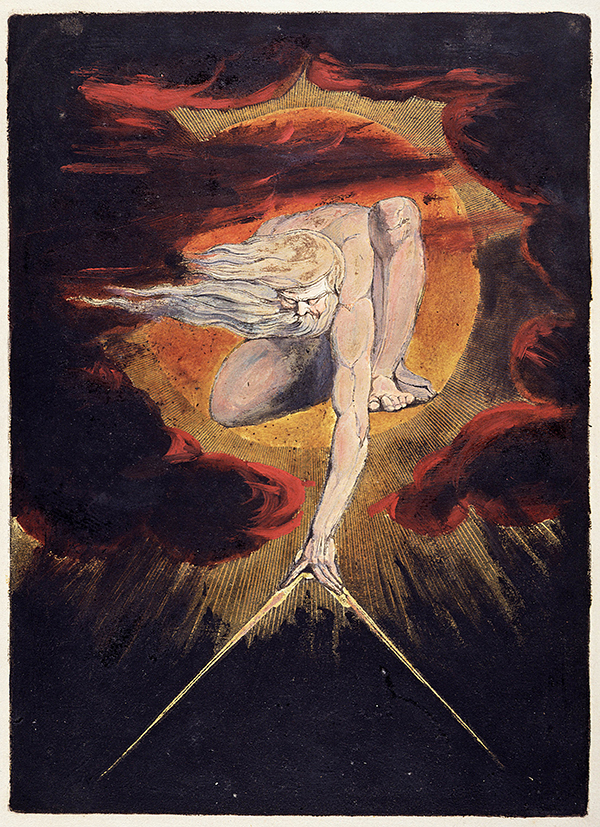
To strengthen his reading of Urizen as a threat, Dickinson pronounces the name to rhyme with “horizon” rather than “reason.”The pronunciation differs in the spoken introduction on the studio album. On the live album Scream for Me Brazil, the introduction corresponds to the song. This choice places more emphasis on Urizen as one who restricts, confines space, creates boundaries, and expects others to submit to his rule(s). Urizen sets up or measures the horizon as a boundary, as can be seen in his depiction as “The Ancient of Days.” As he is a character who imprisons, the “gates of Urizen” are the one element to break his power—passing the gates means entering or escaping his realm and his influence. They are the gates to another world, one not ruled by reason and the bodily senses, and they thus resemble Blake’s “doors of perception,” which enable man to see “every thing … as it is, infinite” (Marriage copy G, object 13, A Memorable Fancy).
Incarceration in a Physical Body, Imperfect Eyesight, and the Ability to See
The gates are the chance to escape the Urizenic world of logic, reason, and impaired vision. Blake’s work deals extensively with the concepts of eyesight and vision, as Sarah Eron argues: Blake’s preoccupation with sight extends beyond his biblical poems. In turning to an analysis of Urizen, we might recall the opening epigraph on the title page of Visions of the Daughters of Albion, “The Eye sees more than the Heart knows.” Here, Blake plays with our concept of vision by destabilizing the traditional association of sight with knowledge. If the language of prophecy is dependent upon foresight, a knowledge that stems from visionary perception, then the eye’s perceptions might dictate the knowledge of the mind or heart. However, in Visions Blake suggests that we see more than we know, or, in other words, we never internalize all of our perceptions. This is a phenomenon that can be explained through the narrative of Urizenic genesis, a myth that seeks to unfold the story of man’s emergence into a world of “narrowing perceptions.” (par. 2, emphasis in original) Blake presents eyesight either as too broad for the mind to understand, as in Visions, or as limited by the body, as in Urizen. Reduction of the visual sense is a central and repeated theme of the poem—Urizen “creates a world of single vision, where reason and the shrunken physical senses become the narrow windows of perception, the ‘narrow chinks’ of man’s ‘cavern’ as Blake puts it in The Marriage of Heaven and Hell ” (Ibata par. 14). But Urizen not only reduces eyesight; physically his eyesight too is reduced. Los, appalled by what has become of him, gives him a physical body, including eyes: “His [Urizen’s] nervous brain shot branches / Round the branches of his heart / On high into two little orbs / And fixed in two little caves” (object 13, lines 13-16). Yet these eyes do not expand Urizen’s vision; they diminish it. He cannot perceive his surroundings, “except what his little orbs / Of sight by degrees unfold” (object 15, lines 35-36).Leonard argues that Urizen has induced his state of reduced (eye)sight by himself. As a consequence, he has very little “optical consciousness,” while “the ‘optical unconscious,’ what he might see if his ‘doors of perception’ were cleansed, rolls like a sea around him” (921-22). While I agree that Urizen refrains from relying on spiritual sight instead of physical sight, I argue that the impaired vision of his physical eyes is caused by Los, who has created Urizen’s body. In another example of the reduction of sight, Urizen creates the Net of Religion, with disastrous results: “The remaining sons of Urizen / Beheld their brethren shrink together / Beneath the Net of Urizen / … / And their eyes could not discern, / Their brethren of other cities” (object 27, lines 14-16, 20-21). Mollyanne Marks illustrates that the effects of the Net on the inhabitants of this world imitate the previous descriptions of the creation (fall) of the world and of Los’s “organization” of Urizen into human form. The shrinking inward, the hardening, the closing off of the senses, are all repeated and extensive verbal echoes appear. (588) The reduction of sight thus happens threefold, firstly by the creation of the world by Urizen, secondly by the creation of Urizen’s body by Los, and thirdly by the creation of the Net of Religion.
In “Gates,” Urizen becomes a prisoner too, confined to his body by Los: “All things come from the one / Now you are the victim.” The one from whom all things come can be either Urizen or Los, as both are creators, but “now you are the victim” can only refer to Urizen, who has become a prisoner himself. The embodiment of horizon, the creator of boundaries and limits, is incarcerated in a body and chained up. The line that follows—“Carried by the wind, rooted in the ground”—reinforces my reading that the song retells the narrative of Urizen at this point, since it hints at the creation process of Urizen’s body. His body parts are repeatedly exposed to wind: “upon the winds” (object 12, line 43), “hiding carefully from the wind” (object 13, line 17), and “hanging upon the wind” (object 13, line 29). The roots in “Gates” may be seen as extensions of the branches in Urizen: “His nervous brain shot branches / Round the branches of his heart” (object 13, lines 13-14). “Rooted in the ground” also describes the full-page design on object 11, which shows Urizen chained, firmly fixed to the ground.
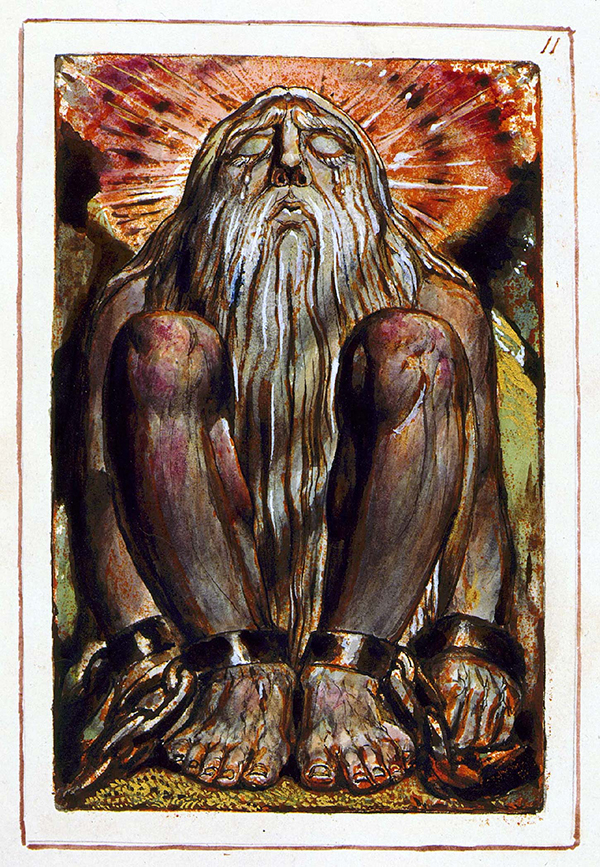
15.6 x 10.1 cm. Library of Congress, Lessing J. Rosenwald Collection. Catalogue number 1807. Image courtesy of the William Blake Archive.
“Rooted in the ground” sums up a central plot element and key idea of Urizen, the binding and fixation of Urizen by Los. Yet Dickinson’s text does not merely describe the plate and retell the event—it also interprets the narrative. Urizen’s fixation is open to two readings, either as mental incarceration or as bodily incarceration. Ibata interprets object 11, the depiction of the chained-up Urizen, as mental incarceration: “This state of closure and petrifaction is heightened by the figure’s closed eyes (from which tears are rolling down in some versions), which suggest that his imprisonment is primarily mental” (par. 22). Harald Kittel’s observation is along the same lines: “According to Urizen’s own report, the ‘fire’ pertaining to Eternals forced him to retreat into his innermost self ” (119). Dickinson’s description of Urizen as “now … the victim / … rooted in the ground” implies, however, that his incarceration is of a physical nature, forced upon him. In the following lines, the narrator offers practical advice on how to escape—“If you want to learn the secrets / Close your eyes”—which may be directed at Urizen, since closing his imperfect, earthbound eyes would give way to the imagination. According to this reading, his predicament is partly caused by his reduced ability to perceive, by the imperfection of his senses. The inadequacy of his eyesight is a major factor of his imprisonment: he is confined by his “little orbs / … fixed in two little caves” as much as the inhabitants are incarcerated by the Net of Religion, which takes away their ability to see and recognize. The loss of the ability to see, which is here identical to the ability to understand, is the true incarceration. This interpretation harks back to the epigraph of Visions, “The Eye sees more than the Heart knows,” in that the branches have connected the “little orbs” to the heart and their perceptions have become one.
Urizen’s eyes are either imperfect or, like the inhabitants, he cannot understand what he sees. On a mental level, he stands for logic and everything that is bound to the body; his eyesight is limited because he cannot see the realms of imagination. Closed eyes do not imprison Urizen—open eyes do. But taking Urizen’s rational character into account, closing his eyes will not open the gates to freedom for him—his very nature does not allow for this solution. As Ibata notes, in some versions of the full-page design where Urizen is chained, his closed eyes produce tears. These are signs of woe, not freedom. Since the song is still close to the hypotext at this point, I argue that the advice given in “Gates” is not aimed at Urizen, but at the recipient. S/he is supposed to close her/his eyes to learn the secrets. As paradoxical as it seems, here closing one’s eyes is the way to perfect sight.This reading is in the same vein as Peter Ackroyd’s observations that Blake may have looked inward instead of outward and that “one of the great emblems of the spiritual life is of course the visionary who sees with closed eyes” (152).
Yet it is exactly this advice that changes the narrative of the song. It recalls another text by Blake, Jerusalem: “I rest not from my great task! / To open the Eternal Worlds, to open the immortal Eyes / Of Man inwards into the Worlds of Thought: into Eternity / Ever expanding in the Bosom of God, the Human Imagination” (copy F, object 5, lines 18-21).Dickinson presented this quotation, as well as excerpts from “Gates,” at the unveiling of Blake’s gravestone on 12 August 2018, thereby relating the two texts (see the video on the Blake Society Facebook page, <https://www.facebook.com/208774852588428/videos/1360006100798625>, from 54′45″). By combining ideas from Urizen and Jerusalem, Dickinson creates a new text, which differs significantly from Urizen: the inclusion of the idea of “immortal Eyes” into his Urizenic narrative makes for a different outcome. In the new narrative, earthbound eyes have to be exchanged for “immortal Eyes,” which can see “inwards into the Worlds of Thought.” While eternity, as described in Jerusalem, is lost at the end of Urizen as the inhabitants become mortal, it is still accessible in the realm of imagination in “Gates”—at least the narrator can advise how to reach it. To achieve it, earthbound eyes must be closed, because all they produce is impaired vision, and immortal eyes must be opened.
Contrast and Separation as Solution: How to Pass the “Gates of Urizen”
Closing earthly eyes and opening immortal eyes means nothing less than separating reason and imagination, as embodied in Urizen and Los respectively. The lines of the chorus “at the gates of Urizen / Separate lives begin” illustrate that the gates force a life-changing decision—two parties will be permanently split. I argue that this separation refers to Urizen and Los, as expressed in “eternal twins are damned.” On the narrative level, both characters are damned because Urizen finds himself trapped in a human body and Los succumbs to a state of madness after the loss of Urizen. If we take them as embodiments of parts of the human mind, however—reason and imagination—this split may be fruitful.
The gates are thus a place of no return. This idea is strengthened by “the ladder falls away,” an action that erases the redeeming way out. They are also a place where the carcasses lie of those who have failed: “Fallen eagles blaze.” The eagle is another Blakean metaphor that has been added to the new narrative. In Blake, it represents genius: “When thou seest an Eagle, thou seest a portion of Genius” (Marriage copy G, object 9, Proverbs of Hell). In the song, the eagle can be seen as a metaphor for the genius and flying represents the power of the imagination. Significantly, these (human) eagles are unable to fly; when the ladder falls away, they can no longer move because of their lack of imagination and instead fall and blaze. The failed eagles plummet to the earthbound state of Urizen, who is not only chained to the ground himself, but also sets up the horizon as a boundary. Crossing the “gates of Urizen” means traversing the borders of reason and the horizon. Dickinson combines both aspects and both interpretations of Urizen. The phrase “carried by the wind” can also be applied to the genius, the eagle. Passing the gates means being “carried by the wind,” passing the earthbound horizon and thus defeating Urizen. The eagles must fly to succeed, fly to cross the horizon, fly to use their imagination.
The genius has to pass through the gates to survive—her/his freedom and well-being are threatened by the boundaries of Urizen. The true genius must enter the realm of imagination; the fallen genius, or fallen artist, goes up in flames. Since Dickinson has interpreted Los and Urizen as embodiments of creativity and commerce, this indicates that the artist is supposed to focus on creativity alone and leave the demands of the art industry aside.
The separation refers not only to the materialistic world of commerce, but also to the mind of the artist. The genius must separate Los from Urizen, keeping them apart as contrary powers. Thus, s/he must decide whether to be “carried by the wind” or “rooted in the ground,” an antagonism that describes the basic natures of Los (the wind that carries the eagles) and Urizen (the roots that bind them to the ground). In other words, the imagination helps the genius to fly, whereas reason will chain her/him to the ground. To be able to fly, the genius must rely on Los alone, parting the “eternal twins” so that “separate lives begin.” The separation of Los and Urizen arguably points to a division of the inner self: from now on, the genius is ruled either by Los or by Urizen, leaving the other part of her/his personality behind.
“If you want to learn the secrets / Close your eyes” sums up the antagonism between incarceration through impaired, physical vision and freedom gained by spiritual sight. The genius, the eagle, has to fly, which means that s/he must loosen both the branches that connect her/him to the ground and those that link the “little orbs” to the heart. As the heart cannot understand what the eye perceives, it is necessary to close the physical eyes and rely on another kind of sight. In other words, the heart cannot gain knowledge by earthly perceptions; it needs to see “Eternity / Ever expanding in the Bosom of God, the Human Imagination.” The genius needs to pass the boundaries of reason and bodily senses and learn to rely on her/his spiritual sight. The reward is something that resides in “the Bosom of God,” true inspiration and true enlightenment. Passing the gates of Urizen thus opens the way to self-development.
Spiritual sight is crucial for cartomancy, obligatory for the context of Chymische Hochzeit, and a constitutive element of a large part of Blakean thought. The spiritual sight described in “Gates” connects the tarot cards mentioned in “Tower” with the Rosicrucian manifesto and Blakean ideas; in the advice offered, occultist teachings and Blakean ideas coincide. Since the contrast between Los and Urizen represents the inner struggle of the artist, the eagle, this advice forms a concise poetic. It describes what an artist ought to do: close the physical eyes and learn the secrets offered by spiritual sight and the imagination.
“Gates of Urizen” is a contrary version of Urizen. The metafictional appeal “close your eyes,” aimed at the listener of the song, serves as guidance on how to pass the gates of the horizon and secure a happy ending or positive outcome. If the adept can find “the Bosom of God,” s/he will be immune to the blinding effect of the Net of Religion. In Urizen, this blindness has dire consequences; the inhabitants are, in Dickinson’s words, “rooted in the ground” and thus become mortal: “No more could they rise at will / In the infinite void, but bound down / To earth by their narrowing perceptions / They lived a period of years / Then left a noisom body” (object 25, lines 52-54; object 27, lines 3-4). They cannot access the “Eternal Worlds” that lie behind the gates, as they have lost the ability to see and to “rise at will”; they are “bound down / To earth” and then leave a “noisom body.” “Gates,” however, proclaims contrast, earthbound Urizen versus airborne Los, and Dickinson provides an alternative ending to Blake’s text. Passing the gates of Urizen leads to the “Eternal Worlds” and disempowers the Net of Religion, reversing the narrative. A dystopia has been turned into a guide on how to achieve enlightenment and move from reason to imagination, enclosure to open space, fixture to mobility, and failure to success.
Sources
Ackroyd, Peter. Blake. London: Vintage Books, 1999.
Andreae, Johann Valentin. Die Chymische Hochzeit des Christian Rosenkreuz Anno 1459. Trans. Walter Weber. Stuttgart: Freies Geistesleben, 1957.
Blake, William. William Blake Archive. Ed. Morris Eaves, Robert N. Essick, and Joseph Viscomi. <http://www.blakearchive.org>.
Butlin, Martin. The Paintings and Drawings of William Blake. 2 vols. New Haven: Yale University Press, 1981.
Dickinson, Bruce [Paul Bruce Dickinson]. What Does This Button Do? An Autobiography. London: HarperCollins, 2018.
Dickinson, Bruce [Paul Bruce Dickinson], and Julian Doyle, screenwriters. The Chemical Wedding. Bill and Ben Productions, Focus Films, 2008.
Dickinson, Bruce [Paul Bruce Dickinson], and Adrian Smith. “Return of the King.” Bruce Dickinson, The Chemical Wedding. Expanded ed. BMG, Sanctuary, 2005. CD.
Dickinson, Bruce [Paul Bruce Dickinson], and Roy Z [Roger Ramirez]. “Chemical Wedding.” Bruce Dickinson, Scream for Me Brazil. BMG, Sanctuary, 1999. MP3.
———. “Chemical Wedding.” Bruce Dickinson, The Chemical Wedding. Expanded ed. BMG, Sanctuary, 2005. CD.
———. “Gates of Urizen.” Bruce Dickinson, Scream for Me Brazil. BMG, Sanctuary, 1999. MP3.
———. “Gates of Urizen.” Bruce Dickinson, The Chemical Wedding. Expanded ed. BMG, Sanctuary, 2005. CD.
———. “Jerusalem.” Bruce Dickinson, The Chemical Wedding. Expanded ed. BMG, Sanctuary, 2005. CD.
———. “King in Crimson.” Bruce Dickinson, Scream for Me Brazil. BMG, Sanctuary, 1999. MP3.
———. “The Tower.” Bruce Dickinson, The Chemical Wedding. Expanded ed. BMG, Sanctuary, 2005. CD.
Dickinson, Bruce [Paul Bruce Dickinson], Roy Z [Roger Ramirez], and Eddie Casillas. “Book of Thel.” Bruce Dickinson, The Chemical Wedding. Expanded ed. BMG, Sanctuary, 2005. CD.
Eron, Sarah. “Bound … by their narrowing perceptions”: Sympathetic Bondage and Perverse Pity in Blake’s The Book of Urizen.” Blake 46.3 (winter 2012–13): 27 pars.
Ibata, Hélène. “Parody, Terror and the Making of Forms: Blake’s Aesthetics of the Sublime in The Book of Urizen.” Romanticism and Victorianism on the Net 59-60 (2011): 52 pars. <https://doi.org/10.7202/1013275ar>.
Kittel, Harald A. “The Book of Urizen and An Essay Concerning Human Understanding.” Interpreting Blake. Ed. Michael Phillips. Cambridge: Cambridge University Press, 1978. 111-44.
Leonard, Garry. “‘Without Contraries There is No Progression’: Cinematic Montage and the Relationship of Illustration to Text in William Blake’s The [First] Book of Urizen.” University of Toronto Quarterly 80.4 (2011): 918-34.
Marks, Mollyanne. “Structure and Irony in Blake’s ‘The Book of Urizen.’” Studies in English Literature, 1500–1900 15.4 (1975): 579-90. <https://doi.org/10.2307/450012>.
Schuchard, Marsha Keith. “Why Mrs. Blake Cried: Swedenborg, Blake, and the Sexual Basis of Spiritual Vision.” Esoterica: The Journal of Esoteric Studies 2 (2000): 45-93.
Steiner, Rudolf. “Die Chymische Hochzeit des Christian Rosenkreuz.” Andreae 135-74.
Whittaker, Jason. “‘Jerusalem’ Set to Music: A Selected Discography.” Blake 52.4 (spring 2019).