“Remarkable both for Genius, & Extravagance”: Amelia Opie and Blake’s Illustrations of
the Book of Job
Shelley King is professor in the Department of English Language and Literature at Queen’s University, Kingston. She is the author of articles on Opie in journals including Romanticism on the Net, Studies in Eighteenth-Century Culture, and Eighteenth-Century Studies.
John B. Pierce is vice-provost (teaching and learning) at Queen’s University, Kingston, and professor in the Department of English Language and Literature. He is the author of Flexible Design: Revisionary Poetics in Blake’s “Vala” or “The Four Zoas” (McGill-Queen’s University Press, 1998) and The Wond’rous Art: William Blake and Writing (Fairleigh Dickinson University Press, 2003), as well as articles on Blake and Shelley.
They are co-editors of The Collected Poems of Amelia Alderson Opie (Oxford University Press, 2009) and of four of Opie’s novels.
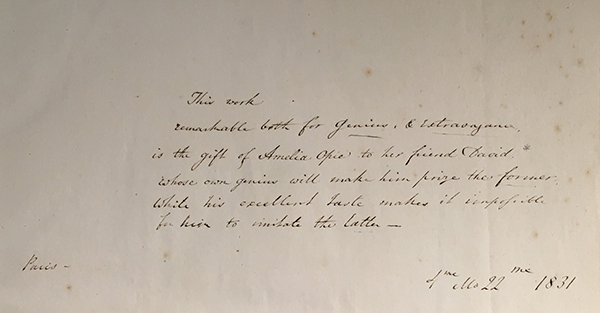
In 1986 William W. Heath announced a most exciting acquisition for the Mead Art Museum at Amherst College, the gift of Dr. and Mrs. K. Frank Austen (class of 1950): a copy of Blake’s Illustrations of the Book of Job (1826) that had been known earlier in the twentieth century but whose location had proved elusive for a number of years. It is readily identifiable by its inscription: “This work remarkable both for Genius, & Extravagance, is the gift of Amelia Opie to her friend David, whose own genius will make him prize the former, while his excellent Taste makes it impossible for him to imitate the latter—Paris—4me Mo 22me 1831” (see illus. 1).Blake’s plates can be viewed online at <https://museums.fivecolleges.edu/detail.php?museum=all&record=0&v=2&s=AC+1983.44&type=all&t=objects>. The location of this copy was unknown to Bentley when he prepared the first edition of Blake Records, though he knew of the inscription through a catalogue description from a clipping in the Mellon collection. His transcription gives the presentation date as “Paris, 14me. Mo. 22me. [i.e. Nov. 22nd?] 1831” (602n3). He corrects the date to 22 April 1831 in the second edition (544 and n74), presumably on the authority of Heath.
In the first edition of Blake Records (1969), G. E. Bentley, Jr., speculates that this copy is among those listed in the Job accounts of John Linnell. He notes with regard to an 1831 entry—“1 copy plain to Miss:—— friend of Mrs Austin”—that “[Sarah Austin’s] friend … may have been Amelia Opie (1769–1853), the novelist, whom she had known from childhood. … This would explain reasonably how Mrs. Opie came into possession of a set of Job at such an early period when she does not appear in the Job accounts” (602n3). In the second edition (2004), he retains Opie as the possible purchaser in his record of Linnell’s general accounts for 1831 (793), but another candidate—Mrs. Anna Brownell Jameson—emerges in the discussion of the Job accounts (803fn¶). While Bentley draws a plausible connection between Opie and this purchase, certain elements remain troubling: by 1831 “the celebrated Mrs. Opie” (our italics), as Dr. Chalmers and others called her,Cecilia Brightwell quotes the Memoirs of Dr. Chalmers: “‘Last of all, I must mention another lady, who dined and spent the night—one who, in early life, was one of the most distinguished of our literary women, whose works, thirty years ago, I read with great delight—no less a person than the celebrated Mrs. Opie, authoress of the most exquisite feminine tales, and for which I used to place her by the side of Miss Edgeworth’” (Brightwell 304). The New Monthly Magazine (1826) notes that “the celebrated Mrs. Opie was a great favourite of Dr. Parr, who highly praised her pathetic tale of ‘The Father and Daughter,’ and delighted in her society” (167). was one of the best-known literary celebrities in Britain and the widow of a key figure in the late eighteenth-century art world of London, and it seems unlikely that Linnell would have noted “Miss ——” as the ultimate recipient of the volume if Sarah Austin had identified her friend as Amelia Opie. Nor is it entirely likely that Opie would have sought anonymity in making the purchase—she continued to cultivate her acquaintances in artistic circles even after she became a member of the Society of Friends in 1825.
Given these complications, it is worth reexamining the narrative of the copy given to David, especially in light of evidence emerging from renewed interest in Opie’s life and works. In transcribing letters from the extensive Opie correspondence held in the Huntington Library, we have located three references to her purchase of a work by Blake as a gift for the French sculptor Pierre-Jean David d’Angers (1788–1856). They suggest that the artist Henry Perronet Briggs (1793–1844), her cousin, is a more likely candidate than her friend Sarah Austin for the role of her agent in this endeavor. Although Briggs does not appear in Linnell’s ledger, according to the accounts copies of Job were also available at select booksellers in London, offering an alternative means of acquiring the work.
Opie had met David, who had been awarded the cross of the Légion d’Honneur in 1825 and elected a member of the Académie des Beaux-Arts the following year, on her visit to Paris in 1829, and the two quickly became friends. She writes to her friend Sarah Rose describing her social circle, and after offering a detailed account of her meeting with Lafayette, continues: My next hero is no General but a sculpteur libéral—the first man of his class here; who before I saw him was desirous of making a medal of me for having made him cry his eyes out by my writing. Malgré moi, he has made me en medaille, me and my petit bonnet which the artists HERE say looks like a Phrygian helmet, and has un air classique; but though young and flattered, the thing is like and David satisfied. (24 July 1829) Opie and David spent time together in Paris, later entering into correspondence, and she subsequently sent him a gift with an accompanying poem, “To a Prism Sent from London to My Friend David.” Her choice was inspired by a glass ornament that she had previously been given by Briggs, and a letter to Eliza Alderson (also a cousin, on her father’s side of the family, who would marry Briggs the following year) expresses the pleasure it gave her: “Tell Henry Briggs his prism is the delight of my eyes! & of all beholders! If David’s does as well, my end is fully answered” (13 November 1829). Further letters confirm that Opie also had a more substantial gift in mind for her friend. David had sent her a number of items as well as the medallion, and she was duly flattered by this homage. In early 1830 she writes to Briggs: “I have had a very nice letter from David—He detains the bust [of Lafayette] to send me a model of his Condé—Canst thou dear Henry procure for me two, or three (if not very dear,) prints, or something of Blake’s queer drawings or sketches? I used to see them & I want them much” (28 April 1830). Eight months later she writes again to Eliza, enumerating a long list of items that she would like sent to her in Paris, reminding her, “I want something of Blake’s if procurable,” but “if not, some print from a picture, or portrait of my husband’s that Henry would chuse” (20 December 1830).
Opie’s familiarity with Blake’s work is perhaps not unexpected, given both her radical connections as a young woman in the 1790s and her ties to London’s art world through her marriage to John Opie (1761–1807) in 1798. One likely site for viewing Blake’s work would have been Joseph Johnson’s bookshop. Keri Davies argues persuasively in “Mrs. Bliss: A Blake Collector of 1794” that Blake’s productions were displayed at the premises of the radical bookseller, quoting a letter dated 13 September 1794 in which Richard Twiss informs his correspondent, Francis Douce, that “you will see several more of Blake’s books at Johnsons in St Ps. Ch. yd.” (216). As the radically inclined Miss Alderson, Opie is likely to have frequented the bookshop in the 1790s, when her friends William Godwin and Mary Wollstonecraft were part of Johnson’s circle. A letter to her friend Susannah Taylor of Norwich confirms her interest in such booksellers and describes an encounter at the shop of Daniel Isaac Eaton: “A very genteel looking young man came in—he examined us and we him, and suspicion being the order of the day, I dared not talk to Mrs. Eaton, till the stranger was engaged in conversation with Boddington—I then told her that curiosity led me to her shop, and that I came from that city of sedition, Norwich” ([26 August] 1794). The stranger, who later engages them in conversation, reveals himself to be Charles Sinclair, one of a group of Scottish and English radicals who had been charged with sedition.One of five charged with sedition in late 1793, Sinclair subsequently emerged as a controversial figure. A December 1794 letter from Godwin to Sinclair outlines John Horne Tooke’s reasons—accepted by Godwin—for believing Sinclair had betrayed his colleagues. Modern historians remain divided, some accepting the accusation that he turned king’s evidence against his colleagues, while others regard him as a steadfast supporter of the Jacobin cause. Jon Mee, Print, Publicity, and Popular Radicalism in the 1790s (Cambridge: Cambridge University Press, 2016) discusses the bookshop episode (58-59) and Sinclair’s politics (96). The young woman who so eagerly made herself at home in Eaton’s shop—“At last we became so fraternized, that Mrs. Eaton shut the shop door, and gave us chairs”—and who was close friends with Godwin and Wollstonecraft would surely have visited Johnson’s shop as well.
Opie’s own ties to Twiss could have provided an avenue through which she “used to see” “Blake’s queer drawings or sketches.” In 1804 she wrote to Samuel Pratt, who had solicited contributions for a benefit, explaining her financial circumstances: But most of what I am able to spare from my own wants to those of others, I have already given to some dear friends of my infancy, who have been latterly reduced from opulence to beggary—amongst these is Mr. Twiss, the traveler, who is at this time soliciting subscriptions to a quarto volume which he is going to publishPresumably the two-volume Miscellanies, published in 1805. & who has claimed and received all the little assistance which my exertions amongst my acquaintance have been able to procure for him. (4 June 1804) As his letter to Douce indicates, Twiss had an awareness of Blake and was a link to early collectors of Blake’s works, and it is not unreasonable to imagine him sharing this interest with Opie. Another potential means of seeing Blake’s designs came through her nine-year marriage to John Opie, a noted creator of both history paintings and portraits. Elected an associate member of the Royal Academy in 1786 and a full member the following year, he promoted art as a public good, advocating in 1800 for the creation of a national gallery; he also delivered the Royal Academy lectures on painting in 1806.In the memoir published in Lectures on Painting … by the Late John Opie (1809), Amelia Opie writes, “He next published a letter in a daily paper [the True Briton] (since re-published in ‘An Inquiry into the requisite Cultivation of the Arts of Design in England,’) in which he proposed a distinct plan for the formation of a National Gallery …” (66). By 1799, the year following his marriage, John Opie would have been aware of Blake’s work as an engraver, as Boydell commissioned Blake to produce a new engraving of Opie’s painting of Romeo and Juliet act 4, scene 5.See Chandler 78n14. This plate, dated 25 March 1799 in the imprint, was published in Boydell’s The Dramatic Works of Shakspeare (1802) and in Boydell’s Graphic Illustrations of the Dramatic Works, of Shakspeare (c. 1803). In addition, as Bentley notes in William Blake: The Critical Heritage, “The Blake designs best known to his contemporaries were those etched by Louis Schiavonetti for Robert Blair’s The Grave” (109), and in 1805 John Opie was one of the distinguished subscribers and patrons listed by Cromek in the prospectuses for that volume. Finally, as the wife of an academician, Amelia Opie would have attended the annual Royal Academy exhibitions, at which she might have encountered Blake’s work.
Amelia Opie was also a correspondent and friend of William Hayley for a number of years. She quoted from Hayley’s The Triumphs of Temper in her novel Temper, or Domestic Scenes (1812): flattered, Hayley reciprocated by revising the reading of Serena, his heroine, in subsequent editions of the poem to include Opie’s novel. Their correspondence until Hayley’s death in 1820 abounds with expressions of affection—he is her “caro padre” and she is his “carissima figlia.” Although there is no mention of Blake in the letters, Opie did visit Hayley in 1814 and could well have seen works by Blake. Whatever the source(s) of her awareness of Blake’s artistry, by 1830 she has a vivid memory of his works. Though she characterizes them as “queer drawings or sketches,” she clearly regards them as suitable gifts for a valued artist friend and places them ahead of a more personal gift of a print based on her husband’s work.
Job makes its next appearance in Opie’s correspondence the following year, when she is in Paris. On 18 April 1831 she writes again to her cousin Eliza, wife of Henry Briggs, “The Job for David is not arrived! tho’ I am told it left London on the 1st. If Henry or Tom or someone could call at Baldwin’s & Craddock, Paternoster Row, to enquire concerning it they would greatly oblige me. It is too precious to be lost.” Invoking the aid of Briggs and another cousin, Tom Alderson, in tracing the shipment suggests that they might also have been her agents in the purchase. Baldwin, Cradock, and Joy had previously been associated with two works for which Blake was an engraver, and as a prominent British publishing house had international connections for distribution.They were among the publishers of Abraham Rees’s Cyclopædia; or, Universal Dictionary of Arts, Sciences, and Literature (1820), for which Blake produced designs and engraved seven plates (see Butlin 1: 488-89 for an account of the drawings). Two years later they published The Works of William Hogarth, from the Original Plates Restored by James Heath … with the Addition of Many Subjects Not Before Collected: To Which Are Prefixed, a Biographical Essay on the Genius and Productions of Hogarth, and Explanations of the Subjects of the Plates, by John Nichols …, which included one plate engraved by Blake. The letter concludes happily, with news of the arrival of Blake’s work: in a sentence partially obscured by the seal Opie writes, “From what I hear Job is arrived at Galignani’s.” Galignani’s was reputed to be the oldest English-language bookstore in Europe, and its reading rooms were a gathering place for English tourists: “In 1801, at 18 rue Vivienne, between the Palais Royale which was crowded with booksellers and the Théâtre Feydeau, [Giovanni Antonio Galignani] opened a bookshop and a reading-room specialized in English books.” He also established a courier service ensuring that the “English daily press arrived at nine o’clock every morning” (Cooper-Richet and Borgeaud), which could have provided a convenient means of transporting the copy of Job from London to Paris. We know that Opie left Paris for Rouen by 10 May (letter to Eliza Briggs, 9 May 1831), so her imminent departure provides some explanation for the urgency of her letter to Eliza. As the inscription records, she presented Blake’s Job to David on 22 April 1831, within a week of its arrival on 18 April and just prior to her departure from the city.
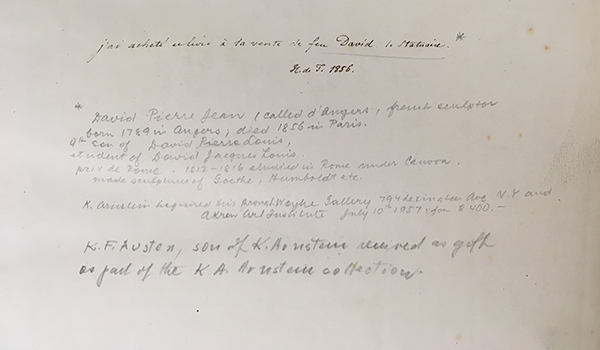
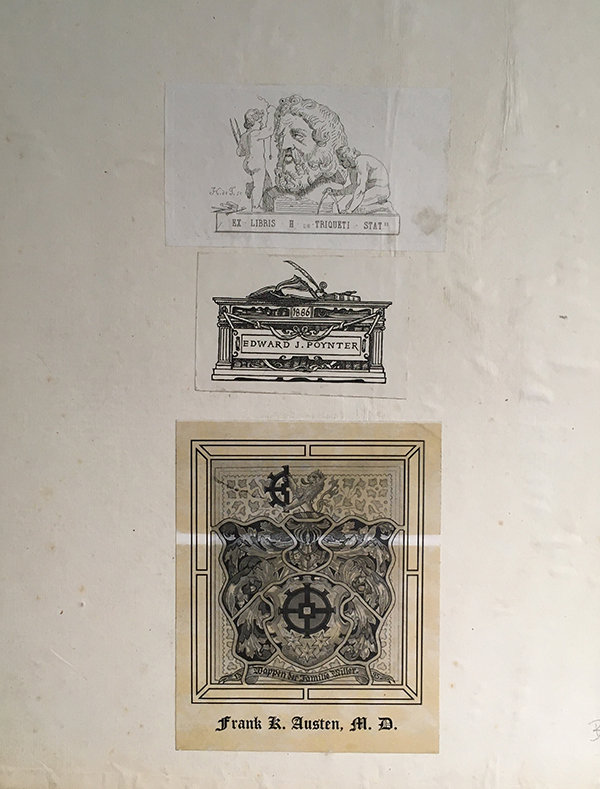
The work is also inscribed “j’ai acheté ce livre à la vente de feu David le Statuaire. H. de T. 1856” and bears the bookplate of H. de Triqueti (see illus. 2-3). Henri, Baron de Triqueti (1803–74), was a sculptor and a contemporary of David; his inscription presumably records a sale that took place following David’s death in January 1856. Both Triqueti and the architect Ambrose Poynter (1796–1886), father of the painter and designer Sir Edward J. Poynter (1836–1919), had married granddaughters of the British sculptor Thomas Banks, the sisters Julia and Emma Forster. The younger Poynter, whose bookplate appears below Triqueti’s (illus. 3), was director of the National Gallery from 1894 to 1904 and president of the Royal Academy from 1896 to 1918. The copy next appears in an Anderson Galleries catalogue of May 1920, Purchases in London and Paris of the Late George D. Smith Sold by Order of His Estate (lot 743, p. 95).Smith, a noted New York rare books dealer who worked closely with Henry Huntington from 1911, died in March 1920 (Thorpe 442). Heath supplements the account of the provenance: “A further inscription indicates that the volume was subsequently purchased (in 1957) from the E. Weyhe Gallery in New York City. Dr. and Mrs. K. Frank Austen ’50 presented it to [Amherst] College in 1983” (59).According to the inscription, Dr. Austen’s father, noted aeronautical engineer and collector Dr. Karl Arnstein (1887–1974), “acquired this through Weyhe Gallery … and Akron Art Institute July 10th 1957 for $400” (see illus. 2).
Thus for almost a century this copy of Blake’s Job retained its strong connection with artists: it was purchased by a celebrated author (the widow of an equally celebrated British artist), who enlisted the aid of a cousin who was also a painter, to present as a gift to a leading French sculptor; it was subsequently purchased by another well-regarded sculptor, then acquired by a painter and designer who would become director of the National Gallery. Four decades after his death it entered the hands of private art collectors before coming to rest in the Mead Art Museum in 1983.
Amelia Opie’s connection with David extended many years after she presented him with Blake’s Job. They remained in correspondence, with letters from 1836 and 1845 suggesting ongoing conversations regarding subjects of mutual concern. Opie also continued to express keen interest in the world of British art. She was delighted when Briggs was elected a full member of the Royal Academy in 1832, and her correspondence with him often touched on gossip from the world of painting. She also traveled to London to attend the annual Royal Academy exhibitions for many years. As Opie’s correspondence illustrates and the inscriptions and bookplates found in this copy of Job confirm, Blake’s works were highly valued by this group of writers and artists, who formed a complex social and commercial network in the nineteenth century.
Bibliography
Bentley, G. E., Jr. Blake Records. Oxford: Clarendon Press, 1969.
———. Blake Records. 2nd ed. New Haven: Yale University Press, 2004.
———, ed. William Blake: The Critical Heritage. London: Routledge, 1975.
Brightwell, Cecilia Lucy. Memorials of the Life of Amelia Opie, Selected and Arranged from Her Letters, Diaries, and Other Manuscripts. Norwich: Fletcher and Alexander; London: Longman, Brown, & Co., 1854.
Butlin, Martin. The Paintings and Drawings of William Blake. 2 vols. New Haven: Yale University Press, 1981.
Chandler, Eric V. “The Anxiety of Production: Blake’s Shift from Collective Hope to Writing Self.” Blake, Politics, and History. Ed. Jackie DiSalvo, G. A. Rosso, and Christopher Z. Hobson. 1998. Abingdon: Routledge, 2016. 53-79.
Cooper-Richet, Diana, and Emily Borgeaud, with an English version by Iain Watson. Galignani. [Paris]: Librairie Galignani, 1999. <http://iframe.galignani.com/assets/livre_galignani.pdf>.
Davies, Keri. “Mrs. Bliss: A Blake Collector of 1794.” Blake in the Nineties. Ed. Steve Clark and David Worrall. Basingstoke: Macmillan, 1999. 212-30.
Farrant, Ann. Amelia Opie: The Quaker Celebrity. Hindringham: JJG Publishing, 2014.
Heath, William W. “William Blake’s Book of Job.” British Art. Ed. Frank Trapp. Amherst: Mead Art Museum Monographs, 1986. 58-59.
Opie, Amelia. Letter, Amelia Alderson [Opie] to Susannah Taylor. [26 August] 1794. The Correspondence of Amelia Alderson Opie: A Digital Archive. Ed. Roxanne Eberle. <http://ameliaopieletters.com/aostletters/AOST1.html#note4>.
———. Letter, Amelia Opie to Samuel Pratt. 4 June 1804. The Amelia Alderson Opie Archive. Ed. Shelley King and John B. Pierce. <https://ameliaopiearchive.com/miscellaneous-letters-king-pierce/amelia-opie-to-pratt-4-june-1804>.
———. Letter, Amelia Opie to Sarah Rose. 24 July 1829. Amelia Alderson Opie Correspondence, 1794–1854. Huntington Library, Art Museum, and Botanical Gardens.
———. Letter, Amelia Opie to Eliza Alderson. 13 November 1829. Amelia Alderson Opie Correspondence, 1794–1854. Huntington Library, Art Museum, and Botanical Gardens.
———. Letter, Amelia Opie to H. P. Briggs. 28 April 1830. Amelia Alderson Opie Correspondence, 1794–1854. Huntington Library, Art Museum, and Botanical Gardens.
———. Letter, Amelia Opie to Eliza Briggs, 20 December 1830. Amelia Alderson Opie Correspondence, 1794–1854. Huntington Library, Art Museum, and Botanical Gardens.
———. Letter, Amelia Opie to Eliza Briggs, 18 April 1831. Amelia Alderson Opie Correspondence, 1794–1854. Huntington Library, Art Museum, and Botanical Gardens.
———. Letter, Amelia Opie to Eliza Briggs, 9 May 1831. Amelia Alderson Opie Correspondence, 1794–1854. Huntington Library, Art Museum, and Botanical Gardens.
———. “To Prince Hoare, Esq.” Lectures on Painting … by the Late John Opie, Esq. Professor in Painting to the Royal Academy. To Which Are Prefixed, a Memoir by Mrs. Opie, and Other Accounts of Mr. Opie’s Talents and Character. London: Longman, Hurst, Rees and Orme, 1809. 1-54.
Purchases in London and Paris of the Late George D. Smith [Part One]. New York: Anderson Galleries, 1920. <https://archive.org/details/bub_gb_ZFHQAAAAMAAJ/page/n111/mode/2up>.
“Recollections of Dr. Parr, by a Pupil—No. II.” New Monthly Magazine and Literary Journal vol. 17, no. 68 (August 1826): 165-72.
Thompson, Lawrance. “The Boydell Shakspeare: An English Monument to Graphic Arts.” Princeton University Library Chronicle 1.2 (February 1940): 17-24.
Thorpe, James. Henry Edwards Huntington: A Biography. Berkeley: University of California Press, 1994.