Diagrammatic Blake: Tracing the Critical Reception
of “The Mental Traveller”
Caroline Anjali Ritchie (car566@york.ac.uk) is a PhD student at Tate Britain and the University of York. Her research relates Blake’s work to the history and theory of mapping.
“The Mental Traveller” I would like to thank Jon Mee for his guidance during my work on this article.is one of Blake’s most notoriously enigmatic poems. The only extant version from Blake’s lifetime appears in the neatly penned Pickering Manuscript;On the dating of the poem, see Bentley, Blake Books 342; on the dating of the manuscript, see also his earlier “The Date of Blake’s Pickering Manuscript.” it consists of twenty-six even quatrains in iambic tetrameter, rhyming ABCB and lacking any annotations or designs. Whatever neat rhyme and reason the poem’s appearance might suggest, there is, however, an unmistakable unruliness to its internal logic that makes it extraordinarily difficult to parse. Summary can hardly do justice to the twists and turns of the narrative, in which a speaker describes the courses taken by a male and a female (or females?) who age and grow young again in a series of peculiar concertina-like arcs, traversing a constantly changing landscape. Spatiotemporally, syntactically, perspectivally, it is profoundly disorientating.
I am certainly not the first to point out the difficulty of interpreting “The Mental Traveller.” Although the earliest commentator, William Michael Rossetti (in Alexander Gilchrist’s 1863 Life of William Blake), confessed no immediate qualms about the challenges,Rossetti was apparently quite comfortable interpreting the poem as symbolizing the life cycle of a “mental phænomenon”: “The mental phænomenon here symbolized seems to be the career of any great Idea or intellectual movement—as, for instance, Christianity, chivalry, art, &c.” (Gilchrist 2: 98). numerous scholars from William Butler Yeats onwards have readily declared their perplexity and, on occasion, have even dismissed the poem as an object of interest altogether.Yeats discussed his difficulty in explaining the poem in A Vision (see Harper and Hood 134). Bernard Blackstone dashed out his view in a mere two sentences, declining to pursue the matter further: “The Mental Traveller is an extremely cryptic poem in quatrains: as to its meaning, one reader’s guess seems as good as another’s. It is based on Blake’s favourite dichotomies of male and female, age and youth, freedom and bondage, and is cyclic in its action” (131). For many scholars, however, an acknowledgement of the poem’s sheer opacity features chiefly as the precursor to a claim to have found a unifying meaning of some kind or other—a way of making it make sense, of pointing to something outside the poem as if to say, this is what Blake really meant. In an astonishingly large number of cases, that meaning is presented in the form of a diagram.
The Diagrammatic Tradition
So common is the tendency to diagram this particular poem that it is possible to speak of a diagrammatic tradition peculiar to scholarship on “The Mental Traveller.” This tradition began with Yeats and enjoyed a life span of over fifty years, no insignificant period in the history of Blake studies. Diagrams were proffered by Yeats (1925), Hazard Adams (1963), Martin K. Nurmi (1964), Donald Ault (1974), James B. Twitchell (1975), and Izak Bouwer and Paul McNally (1978–79). Crucially, Northrop Frye’s theory of the “Orc cycle” (1947) leaned heavily on “The Mental Traveller,” which it sought to reduce to a cyclical model as a schema for a Blakean system. Frye’s cycle was probably the single most influential critical apparatus when later scholars came to visualize the poem as a diagram.
Despite the number of diagrams, the interpretive and epistemological premises of the diagrammatic tradition have not come under sustained scrutiny. Since the 1970s, there seems to have been a substantial shift away from diagrams of “The Mental Traveller,” and I know of no attempts after Bouwer and McNally’s article. This shift occurred silently and without interrogation, and nowadays the poem rarely enjoys more than a glancing mention in studies of Blake’s work. A more critical and explicitly revisionist reading is called for, with a view to dwelling on the poem’s inherent (and, I would argue, deliberate) resistance to codification.
“The Mental Traveller” is by no means the only text or aspect of Blake’s work to have been diagrammed by critics. Though diagrams of it are exceptional in their number, they also participate in a wider and more longstanding tendency in Blake scholarship, which has continued to show up on occasion during the twenty-first century.The diagrammatic and indeed cartographic impulse has had a firm foothold in Blake criticism at large: see, for example, S. Foster Damon’s much-reproduced map of Golgonooza in his Blake Dictionary (163). Susan Fox offers verbally what she later describes as a “standard diagram …, a series of concentric circles beginning at the infinite center point of Eden” (9, 209). Ault, one of the “Mental Traveller” diagrammers, employs a diagram elsewhere in Visionary Physics (37); see also the “List of Charts” (viii) in his monumental Narrative Unbound. Gerda Norvig includes numerous diagrams in her Dark Figures in the Desired Country (144, 147, 166, etc.). Saree Makdisi produces a diagram linking the “Spiritual Fourfold London” with global geography in his Romantic Imperialism (168). Hatsuko Niimi includes two graphics, which she calls diagrams (and which might also be considered tables or charts) in “The Book of Ahania: A Metatext” (52). Still more recently, Russell Prather makes use of numerous diagrams (as well as several tables) in “William Blake and the Problem of Progression” (514, 517, 520, 530). With this in mind, the present revisionist consideration of the “Mental Traveller” diagrams will also speak to some of the fundamental assumptions—and the genealogies of these assumptions—that have guided the methods of Blake scholars. Here I shall focus on three ironies within the “Mental Traveller” diagrammatic tradition. The first inheres in the fact that so many scholars have spoken of the poem as preeminently puzzling and multidimensional and yet, in the moment of criticism, have sought to solve the puzzle using two-dimensional abstract signs. My primary discomfort with this tendency lies in the brevity and superficiality of their justifications of the use of diagrams; by contrast, I advocate serious interrogation of the problems that go hand in hand with diagrammatic criticism when it comes to interpreting Blake’s work. The second irony is that in using diagrams, these critics are acting in a rather unBlakean spirit—as many of them, though briefly, do point out themselves—given Blake’s well-known suspicion of diagrammatic forms (though he does use diagrammatic forms in the illuminated books—a point to which I shall return). Thirdly, it is ironic that the majority of “Mental Traveller” diagrams take the shape of a circle, even though Blake was overtly suspicious of circular and spherical forms alike both in this very poem and elsewhere throughout his oeuvre, as we shall see.
It is not my aim to belittle the achievements of the scholars who have proffered these diagrams. It should be borne in mind that their diagrammatic readings do go some way toward rescuing “The Mental Traveller” from the void of critical capitulation. They demonstrate that there is merit in taking the poem seriously. And, at least at a glance, one can certainly appreciate how a diagram might seem to provide a welcome prophylactic against textual chaos.
In this article it is my contention, however, that diagrammatic interpretations come at the cost of flattening the poem’s radically and fundamentally disruptive logic. Is there a way of living with the internal contradictions without resolving them into such petrific forms? The unruliness of Blake’s work (and this may well be true of any text) is perhaps an inevitable casualty of criticism; the critic cannot fully escape the charges of objectification and reduction. With Blake’s work it is not only a case of making a thick world thin; the world of his poetry and art is disjunctive in a way that criticism—particularly of a diagrammatic bent—struggles to accommodate. This limitation is also guaranteed to a certain extent by the logic of print; every work of criticism potentially risks the kind of abstraction to which Blake famously and frequently objected, separating mind (what we take to be the text’s content or meaning) from matter (the formal makeup of the textual artifact) and placing the former within a new—and usually linear—material context (book, article, thesis). Of course, “The Mental Traveller” itself is known only in its linear, fair-copy state, presumably in preparation for transposition into print. In formal terms the jump to linear print criticism therefore seems less immediately jarring than it does, for instance, in commentary on a manuscript text such as The Four Zoas, which features numerous verbal annotations and struck-out words, as well as graphic components. The primary issue in the case of “Mental Traveller” criticism therefore has to do not so much with the poem’s form as with its content—the syntactic and spatiotemporal obstructions to the kind of smooth linearity that can all too easily appear to be the aspiration of print criticism both formally and rhetorically. Recognizing this issue, recent scholars such as Nicholas M. Williams and especially James Chandler have made great strides back toward the poem’s logic and syntax of resistance, suggesting that there may be ways of allowing its difficulties to participate in and even survive the critical moment, in part by making the difficulties the very theme (or indeed object) of criticism and, as much as possible, resisting the urge to abstract a single, positive meaning from the text.See Williams 2-5 and Chandler chapter 8, especially 275-81. In particular, Chandler’s analysis (a rare twenty-first-century instance of detailed commentary on “The Mental Traveller”) characterizes the poem as disruptive or “inhospitable” to smooth circuits of “sentimental” exchange (277). While I eagerly endorse such approaches, I believe that there is value in retracing our steps to draw out a major strand of Blake scholarship that has not been actively scrutinized, and that embodies many of the twentieth-century critical impulses that have shaped the field.
In what follows, I shall firstly outline the “Mental Traveller” diagrams in chronological order, attempting to trace their genealogical roots and afterlives across the critical tradition and pointing out some of the problems that accompany them from an interpretive point of view. Secondly, I shall connect the diagrammatic impulse with a broader tendency toward completion or transcendence of the Blakean text in the act of criticism. Finally, I shall turn to the tensions between the diagrammatic impulse and Blake’s own lifelong suspicion of diagrammatic and circular forms.
The “Mental Traveller” Diagrams
At the outset, three broad statements can be made to highlight three interpretive problems that accompany the diagrams. Firstly, most focus on the poem’s temporal makeup, making very little or very vague reference to its spatialized landscape. One issue with this is that the bodies are thereby detached from the spaces wherein they do their moving in the poem’s unstable landscapes, and placed instead within the new, seemingly stable, spatial context of the diagram. Another issue is that there are multiple temporalities within the poem. There is the past tense of the opening stanza and the present tense of all that follows. Herein the male and female figures grow alternately old and young again so that time seems continually and simultaneously to unfold and refold itself against the linear thrust of the manuscript page. This separation between time and space can be connected with a broader separation between mind and body, since the presence of physical settings in the poem is central to its elaboration of overlaid mental and corporeal conceptions of journeying. Whereas the title gestures to a privileging of mind over and above the world of the body, the kind of travel mentioned in the first stanza and the various other instances of travel in the poem are of a distinctly bodily nature. As Williams has similarly noted, “What complicates the picture is the fact that what the Mental Traveller sees is a vision of extreme corporeality” (4). Diagrammatic criticism assumes that, as Rossetti proposes in his commentary, “the ‘Mental Traveller’ indicates an explorer of mental phænomena,” as though there were no bodily context at all (Gilchrist 2: 98).The majority of critics affirm this position. Morton D. Paley, for example, seems to echo Rossetti when he writes that the title “tells us that this poem is about ‘mental’ rather than ‘corporeal’ phenomena—internal rather than external, spiritual rather than physical” (97).
Secondly, the critics’ diagrams take for granted that the message of the poem, the bit calling for a diagram, is the narrative constituted by the complementary courses taken by the male and female figures. In fact the poem is far more peopled than this tendency implies: it contains the guests who come to stay at the cottage (line 61, E 485), who may indeed differ from “the Beggar & the Poor / And the way faring Traveller” (lines 38-39), the other male lover of the “Female Babe” (lines 49-50), further lovers wandering in “Labyrinths of wayward Love” (lines 83, 87), the shepherds and inhabitants of the cities (lines 91-92 and stanza 24), and indeed the possibility, repeatedly arising in the poem, that there is in fact more than one female figure (the “Female Babe” born in stanza 11 may differ from the initial “Woman Old” of stanza 3; the same goes for “a Maiden” in line 56 and “a Woman Old” in line 102). It is also important to consider the route taken by the narrator and, relatedly, by the (mind of the) reader. Throughout, the landscape of the poem shifts from rock, to cottage and garden, to desert and labyrinths, to city, and back to rock. It is difficult to ascertain whether the speaker is observing from afar or present every step of the way, and accordingly difficult to assume any stable readerly point of view in spatial terms, since we can never be sure where exactly we stand.
Thirdly, there is a tendency for the diagrams to assimilate “The Mental Traveller” to a wider system—whether biblical, Blakean, or otherwise—supposed to be external and complete. It is true that, at various stages of the poem, the figures of the male and female share traits with members of Blake’s mythology as elaborated in his other works: at one point or another the male figure can be identified with Christ, Orc, Urthona, Tharmas, Urizen, Luvah, Fuzon, etc., and the female with Vala, Enitharmon, Tirzah, Rahab, the daughters of Urizen, etc. The possible correspondences are too many and too convoluted, however, to be summarized by Frye’s typological analysis, or indeed by diagrams like Nurmi’s or Bouwer and McNally’s. John H. Sutherland similarly acknowledges that “there is a violence and inaccuracy in the giving of abstract equivalents for these figures at any of the stages of their developments,” despite proceeding to base his analysis on precisely this kind of schematic approach (145). I shall return to the problems with the supplying of systems throughout my discussion of the diagrams.
All of the critical problems outlined above are epitomized by Yeats’s diagram. In the first edition of A Vision (1925), reflecting on his initial analysis in The Works of William Blake, Yeats readily confesses his earlier discomfort with the poem’s prodigiously challenging nature: When Edwin J. Ellis and I had finished our big book on the philosophy of William Blake, I felt that we had no understanding of this poem: we had explained its details, for they occur elsewhere in his verse or his pictures, but not the poem as a whole, not the myth, the perpetual return to the same thing; not that which certainly moved Blake to write it …. (134) Upon returning to the poem, he claims to have reached an understanding of it “as a whole” via his theory and diagram of double gyres (see illus. 1): “When I had understood the double cones, I understood it also. The woman and the man are two competing gyres growing at one another’s expense.” When Yeats first introduces his diagram of the interlocking cones, he uses terms strongly reminiscent of “The Mental Traveller”: “It is as though the first act of being, after creating limit, was to divide itself into male and female, each dying the other’s life living the other’s death” (130).

As I have mentioned, a particularly foundational moment in the reception of “The Mental Traveller,” as in that of Blake’s oeuvre at large, was the publication of Northrop Frye’s Fearful Symmetry in 1947. Frye’s interest in what he calls poetic genres, modes, and archetypes positions Blake as a practitioner of archetypal symbolism; he uses this premise to authorize a reading of Blake’s myth as stable, systematic, and even schematic: “Blake was, it is obvious, so conscious of the shape of his central myth that his characters become almost diagrammatic” (143). Frye’s characterization of Blake as a diagrammatist suggests a major root for the diagrammatic criticism that followed, a point to which I shall return.
In particular, Frye’s formulation of the Orc cycle that he finds in Blake’s mythological system is based in no small way on his cyclical reading of “The Mental Traveller.” Following his typological method, Frye explains “The Mental Traveller” in terms of Blake’s mythological figures, conceptualized along the lines of natural processes as manifested in history: “Orc, now Urizen, dies a seed’s death as the world becomes ‘a dark desart all around,’ and eventually re-enters the world of Generation as a reborn Orc” (229). Nowhere in “The Mental Traveller” are Orc, Urizen, or Generation mentioned. Indeed, the Orc cycle, hugely influential in Blake studies, has more recently been countered by critics such as Christopher Hobson, on exactly these grounds: that it “fails the most conservative of all methodological tests, that of textual and graphic evidence” (“The Myth of Blake’s ‘Orc Cycle’” 6).Parts of this essay are also reproduced in Hobson’s The Chained Boy, chapter 2 (46-92). Hobson argues that Blake’s Orc cycle is actually Frye’s Orc cycle, a myth that Frye imposes upon Blake’s oeuvre to give it the appearance of conforming to a stable cyclical system, when in fact there is limited internal evidence to support Frye’s claims (Blake does not present Orc in cyclical terms, Orc is never actually shown aging into Urizen, and so on). In mapping “The Mental Traveller” onto his Orc cycle, Frye is very much paving the way for subsequent diagrammers of the poem, many of whom either borrow the Orc cycle model wholesale or impose their own external systems (or their own inferences about a Blakean system).Although he refrains from diagramming the poem, Edward J. Rose, citing Frye alongside diagrammers Adams and Nurmi, similarly views it as a “concise” and “rhythmical” version of the Orc cycle (“the entire punishing circle in which man and woman, and mankind and history, are caught”) (137-38). Rose, too, draws upon a Fryeian faith in universal archetypes: “Orc is an eternal form of the imagination, (a psychological state) and Blake, in describing Orc, develops a structure of images present in all literature and all cultures. What we see is the repression of energy on an archetypal scale” (138, emphasis in original).
Hazard Adams’s 1963 diagrams (illus. 2 and 3) are a case in point.


The next diagram is Nurmi’s 1964 attempt, appended to his analysis (illus. 4).

Donald Ault’s diagrams of “The Mental Traveller” (illus. 5 and 6) in his Visionary Physics—which charts the dispersal of Newtonian elements throughout Blake’s work—are particularly impressive and devote greater attention to spatiality than any of the previous attempts.
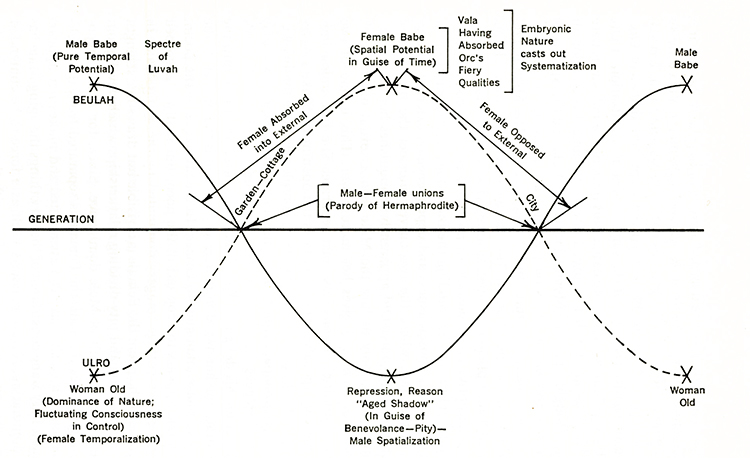

The next diagram was proposed by Twitchell in 1975 (illus. 7).

A further case in which the mentalized or allegorical message of the poem is extracted and then resolidified in the new spatial context of the diagram is Izak Bouwer and Paul McNally’s creation of two circular diagrams to represent what they perceive as the single route or narrative (illus. 8 and 9).


Diagrams, Allegory, and Transcendence
As all of these diagrams indicate, the critic resists allowing difficulty and disorientation to have the last word. The compulsion is to push further, to discover a message or allegory. This critical desire to diagram “The Mental Traveller” arguably takes its cue in part from the poem’s opacity, as I have already suggested, but also from the poem’s ostensible resemblance to allegory: it appears to personify abstract principles of some kind in the figures of the male and female. Twitchell is one of a number of critics to view the poem this way, writing of “whatever you think Blake may be allegorizing in the male” (2). More skeptically, Williams notes the poem’s “tone of normative explanation (‘And if the Babe is born a Boy / He’s given to a Woman Old’ [9-10]),” which makes it resemble allegory, but “it is an allegory like no other, whose ties to established codes (the Christian story, classical myth, etc.) are at best oblique.” He rightly points out that “despite attempts to translate it by reference to these codes or to Blake’s own ‘mythology,’ the poem retains the characteristics of an interpretive scandal, and seems always fresh in its capacity to resist easy codification” (2).
The desire to make the poem fit with a codifiable system may also be partly attributable to the legacy of Frye’s critical methods, as I have claimed. Frye notes Blake’s well-known distrust of what he called “Fable or Allegory,” likening Blake’s “allegory” to the simile, which points to something outside itself to find its meaning. By contrast, he suggests that Blake’s allegory operates via the “universal significance in the artist’s creation of particular things” (121). In this, he both assumes that Blake’s “archetypal symbolism” is stable and complete and places Blake in an idealist camp by gesturing to Romantic notions of the symbol. This is not really the place to anatomize Blake’s relationship to Romantic theories about figuration, but two things are worth noting for the purposes of this article. On the one hand, as Frye knew, Blake’s distrust of allegory was in part consonant with other Romantic-era criticisms of allegory as a rhetorical device that, “in its restrictive Enlightenment conception,” epitomized “all that passed under the name of artificial signs” (Halmi 13). On the other hand, Blake stands apart from the Romantic symbolists in several regards, especially in the notion that symbols in poetry gesture to some infinite and transcendent truth of which they are a part. It is my claim that “The Mental Traveller” engages in a kind of negative dialectic against a range of possible systems to which we might point; it seems more to push negatively against meaning than positively to mean or symbolize anything in particular. If it recalls the Bible, classical myth, or Blake’s own myth, the presence of these symbolic systems is always provisional. In other words, Blake conjures their spectres, only to negate the possibility for complete or lasting equivalence. By contrast, diagrammatic criticism has tended to foster a preference for closed, explanatory glosses without scrutinizing the moments where the very terms of the glosses come up against internal contradiction and flux across Blake’s texts.
Whereas Frye in an idealist manner endorses reading Blake’s myth as a unified network or language of archetypes, recent critics have increasingly seen in Blake’s work a logic of blockage and resistance to stable meanings. In the light of this trend, the notion, implicit in the diagrammatic criticism, that a codified system could facilitate a mental sublimation of the poem’s chaotic matter calls for reevaluation. The diagrams, in a manner shared with Damon’s Dictionary, suppose that the troublingly fragmentary and chaotic nature of Blake’s poetry requires us at every turn to supply the missing referent, the absent represented truth, in the manner of the allegorical mode or some transcendent principle as privileged by Romantic idealists. Relatedly, the same critics repeatedly downplay the material conditions of the poem in favor of their putatively more important mental analogues. In recent decades Tilottama Rajan, Peter Otto, and Steve Vine, among many others, have cumulatively contested the notion that reading and interpretation along such lines might complete the Blakean text through some transcendent vehicle or other (the imagination, the intellect, etc.). Instead, these critics advise Blake scholars to valorize the obstructions to this completion embedded within the texts themselves by way of deliberate catachresis and a variety of other visual and verbal strategies designed to thwart any semblance of significatory or narrative closure. Each of these scholars draws attention to the material, historical specificities that inhere in Blake’s texts, and that, always reaching impossibly toward the real of history, can be registered “only in the collapse of the Symbolic” and hence “in their failure to symbolize their own content” (Vine 245, emphasis in original).
Still more recently, scholars such as Saree Makdisi, Jon Saklofske, and Jade Hagan have sought to overcome the desire to stabilize, systematize, and hence transcend Blake, proposing “network architecture” as a nonlinear and nonhierarchical means of modeling Blake’s works that might celebrate limitless interconnections, mediating between minute particulars and what Saklofske calls “wide area connections” (385). Yet, as Hagan argues, Blake’s prevailing suspicion of forms and systems that can become totalizing and impersonal is such that his “attitude toward networks” ought to be construed as “ambivalent”: the network form is far from a stable or consistent key to Blake. What is impressive and valuable about such scholarship is its studious interrogation of its own methods and models. Saklofske and Hagan especially have urged us to contemplate the collisions of warring states and impulses—closure and openness, particularization and generalization, determinacy and indeterminacy—as they are thematized in Blake’s work and as they agonize and invigorate our own interpretive efforts.
Indeed, in the curious “interpretive scandal” (to adopt Williams’s felicitous phrase) of “The Mental Traveller”—occasioned in large part by its refusal to offer readers a stable spatiotemporal grounding and hence point of view—Blake ensures that any apparent completion achieved through transcendence or systematization cannot be satisfactorily accomplished. As Otto has argued, Blake’s later poems work actively to resist interpretive reduction that occurs through “recourse to an innocent, redemptive faculty or power” that might afford transcendence—such as the much-touted Romantic imagination or some supersensuous divinity (18). Faced with the syntactical and spatiotemporal chaos of “The Mental Traveller,” diagrammatic criticism looks for transcendence of its own kind, wanting to complete (and, in doing so, reduce) the poem through recourse to codifiable systems, separating mind from matter. This impulse not only sidesteps the material embeddedness of “mental fight,” but also overlooks the precise and shifting relations that Blake elaborates between mental and embodied aspects of experience.
Blake and Diagrams
Without wishing to repeat such systematization, I would like to propose that “The Mental Traveller” is fundamentally operative in Blake’s lifelong aversion to the totalizing impulse and abstracting epistemology that underpin diagrammatic forms. One of the poem’s diagrammers feels obliged to concede that “it is ironic that although Blake hated diagrams, one often has to consult one’s own schema to explain points in his poetry otherwise impenetrable to criticism” (Twitchell 1). In this section I shall put further pressure on this irony in suggesting that diagrammatic criticism, although it has been used so often in Blake scholarship, is actually rather unBlakean.
At the risk of revisiting well-worn ground, I begin by adumbrating Blake’s agonistic engagement with diagrammatic graphics. His famous caricature of Newton as a diagrammatist (illus. 10) amply attests to the notion that a diagram—as deployed by Enlightenment-era physicists like Newton—epitomizes an arrogant effort to reinscribe the dualistic division between mind and matter that he finds to be constitutive of humanity’s fallen condition in his age.


As I have suggested, our critics’ recourse to diagrams is especially ironic, since so many of the diagrams adopt the form of a smooth enclosed circle—a form toward which Blake’s attitudes were at best ambivalent. “The Mental Traveller” itself contains some much-quoted lines in which the “altering” eye collapses the world of the senses into nothing but a “Ball”:
The Guests are scatterd thro’ the land
For the Eye altering alters all
The Senses roll themselves in fear
And the flat Earth becomes a Ball (lines 61-64, E 485)
The lines rehearse a typical Blakean indictment of the kind of metaphysics that would view the world solely in terms of dead geometry, abstracted or aggregated from the minute particulars of the peopled universe. Blake reprises this passage in his famous philippic against miniaturizations of the earth-as-globe in Milton. In the Milton passage we are told that one’s “Universe” is best conceptualized as the realm of experience apprehensible from the “flat Earth” surrounding one’s moveable “dwelling-place,” as opposed to the deadening and immobile “delusion” of a “Globe rolling thro Voidness” conjured by mathematical instruments (E 127). Like Blake’s globe, critics’ circular diagrams shrink the bodies and landscapes of “The Mental Traveller” into a ratio suspended in the void of a white page. Although the final line of the poem (“And all is done as I have told”) seems to gesture toward cyclical repetition, the poem is replete with disruptions and obstructions that belie this semblance of seamless circularity, setting itself up as a veritable trap for the diagrammer. In its convolutions, breakages, and multiple trajectories the poem’s structure seems closer to what Blake might have called a “crooked” road than to the smooth lines of scholars’ diagrams.“Improvement makes strait roads, but the crooked roads without Improvement, are roads of Genius” (The Marriage of Heaven and Hell plate 10, Proverbs of Hell line 66, E 38).
Yet any honest student of Blake will no doubt identify to some extent with the diagrammatic impulse. Despite our best efforts, it can be difficult to get away from the desire to complete the text through our critical practice: this urge, too, Blake knew well. It is dramatized time and again in the figure of Urizen, whose efforts to measure and circumscribe the world around him are, after all, not entirely ill intentioned. Indeed, scholars’ frequent recourse to diagrams seems not dissimilar to the temporary comfort found by Urizen in the hurried demarcation of the Mundane Shell, rationalizing from above the daunting “Voidness” of “indefinite space” in another formidable manuscript work, The Four Zoas (E 314). Urizen’s is an earnest and perhaps not entirely unfamiliar effort to make sense of the chaos around him. As with Urizen’s petrific forms, critical diagrams seek impossibly to impose static order upon the seeming narrative chaos of “The Mental Traveller.” Consequently, they are limited by their separation of mind from matter and their tendency to smooth over the untameable changes and contradictions inherent in Blake’s relational universe. Moreover, they approach the poem from the very disembodied, top-down perspective that Urizen craves in The Four Zoas: “Where shall we take our stand to view the infinite & unbounded / Or where are human feet for Lo our eyes are in the heavens” (E 391). Urizen’s cry calls to mind the diagrammatic will to power evoked in Blake’s iconic frontispiece to Europe (illus. 12) and its reprisal in the color print Newton (illus. 10), which, as has been argued time and again, cumulatively characterize the dualistic top-down worldview as oppressive, delusional, and reductionist.

In contrast, throughout Blake’s work, the position of “human feet” is repeatedly cast as absolutely vital to all forms of experience, from sensory to visionary. It is especially central to “The Mental Traveller,” in which the travels described are vividly, sometimes violently, corporeal. As Otto has painstakingly demonstrated, again stressing corporeality, The Four Zoas (the production of which spanned the period in which “The Mental Traveller” was probably written) can be read as a call for readers to attend to a series of specific scenarios within a disorientating spatiotemporal setting in order to reach an understanding of their own fallen ontological condition. Urizen could not act alone (nor indeed could Los): In fact, Urizen’s harmonious world depends upon Los: the creations of reason must be given shape by the imagination. A body formed by reason and imagination would be little more than an inert diagram or sculpture. For the fallen body to come into being, it must also draw on Luvah and Tharmas. (78) Otto’s terms may also provide a guide for ways of reading “The Mental Traveller” that focus on tensions between dynamically conflictual components, resisting the urge to supply a meaning into which those components might be resolved. Seeking an external system to make sense of the poem can provide only temporary and imperfect resolution.
Anyone still tempted to yield to their diagrammatic impulses would do well to recall Blake’s sketch on page 25 of The Four Zoas (illus. 13).

© British Library Board: Add MS 39764 f25. Image courtesy of the William Blake Archive.
Works Cited
Adams, Hazard. William Blake: A Reading of the Shorter Poems. Seattle: University of Washington Press, 1963.
Ault, Donald. Narrative Unbound: Re-Visioning William Blake’s “The Four Zoas.” Barrytown, NY: Station Hill Press, 1987.
———. Visionary Physics: Blake’s Response to Newton. Chicago: University of Chicago Press, 1974.
Bentley, G. E., Jr. Blake Books. Oxford: Clarendon Press, 1977.
———. “The Date of Blake’s Pickering Manuscript or the Way of a Poet with Paper.” Studies in Bibliography 19 (1966): 232-43.
Blackstone, Bernard. English Blake. Cambridge: Cambridge University Press, 1949.
Blake, William. The Complete Poetry and Prose of William Blake. Ed. David V. Erdman. Newly rev. ed. New York: Anchor-Random House, 1988.
Bouwer, Izak, and Paul McNally. “‘The Mental Traveller’: Man’s Eternal Journey.” Blake 12.3 (winter 1978–79): 184-92.
Chandler, James. An Archaeology of Sympathy: The Sentimental Mode in Literature and Cinema. Chicago: University of Chicago Press, 2013.
Croft, Barbara L. “Stylistic Arrangements”: A Study of William Butler Yeats’s “A Vision.” Lewisburg: Bucknell University Press, 1987.
Damon, S. Foster. A Blake Dictionary: The Ideas and Symbols of William Blake. Rev. ed. Hanover: University Press of New England, 1988.
Fox, Susan. Poetic Form in Blake’s “Milton.” Princeton: Princeton University Press, 1976.
Frye, Northrop. Fearful Symmetry: A Study of William Blake. Princeton: Princeton University Press, 1947.
Gilchrist, Alexander. Life of William Blake, “Pictor Ignotus.” 2 vols. London: Macmillan and Co., 1863.
Hagan, Jade. “Network Theory and Ecology in Blake’s Jerusalem.” Blake 53.3 (winter 2019–20): 38 pars.
Halmi, Nicholas. The Genealogy of the Romantic Symbol. Oxford: Oxford University Press, 2007.
Hobson, Christopher Z. The Chained Boy: Orc and Blake’s Idea of Revolution. Lewisburg: Bucknell University Press, 1999.
———. “The Myth of Blake’s ‘Orc Cycle.’” Blake, Politics, and History. Ed. Jackie DiSalvo, G. A. Rosso, and Christopher Z. Hobson. New York: Garland Publishing, 1998. 5-36.
Makdisi, Saree. Romantic Imperialism: Universal Empire and the Culture of Modernity. Cambridge: Cambridge University Press, 1998.
———. William Blake and the Impossible History of the 1790s. Chicago: University of Chicago Press, 2003.
Newman, Marsha. “‘Milton’s Track’ Revisited: Visual Analogues to Blake’s Vortex in the ‘Law Edition’ of Boehme.” Interdisciplinary Literary Studies 5.2 (2004): 73-93.
Niimi, Hatsuko. “The Book of Ahania: A Metatext.” Blake 34.2 (fall 2000): 46-54.
Norvig, Gerda S. Dark Figures in the Desired Country: Blake’s Illustrations to “The Pilgrim’s Progress.” Berkeley: University of California Press, 1993.
Nurmi, Martin K. “Joy, Love, and Innocence in Blake’s ‘The Mental Traveller.’” Studies in Romanticism 3.2 (1964): 109-17.
Otto, Peter. Blake’s Critique of Transcendence: Love, Jealousy, and the Sublime in “The Four Zoas.” Oxford: Oxford University Press, 2000.
Paley, Morton D. “The Female Babe and ‘The Mental Traveller.’” Studies in Romanticism 1.2 (1962): 97-104.
Prather, Russell. “William Blake and the Problem of Progression.” Studies in Romanticism 46.4 (2007): 507-40.
Raine, Kathleen. “Blake’s Debt to Antiquity.” Sewanee Review 71.3 (1963): 352-450.
Rajan, Tilottama. “(Dis)figuring the System: Vision, History, and Trauma in Blake’s Lambeth Books.” Huntington Library Quarterly 58.3-4 (1996): 383-411.
Rose, Edward J. “Good-Bye to Orc and All That.” Blake Studies 4.2 (1972): 135-51.
Saklofske, Jon. “Remediating William Blake: Unbinding the Network Architectures of Blake’s Songs.” European Romantic Review 22.3 (2011): 381-88.
Sutherland, John H. “Blake’s ‘Mental Traveller.’” ELH 22.2 (1955): 136-47.
Twitchell, James B. “‘The Mental Traveller,’ Infinity and the ‘Arlington Court Picture.’” Criticism: A Quarterly for Literature and the Arts 17.1 (1975): 1-14.
Vine, Steve. “Blake’s Material Sublime.” Studies in Romanticism 41.2 (2002): 237-57.
Williams, Nicholas M. Ideology and Utopia in the Poetry of William Blake. Cambridge: Cambridge University Press, 1998.
Yeats, W. B. A Critical Edition of Yeats’s “A Vision” (1925). Ed. George Mills Harper and Walter Kelly Hood. London: Macmillan, 1978.