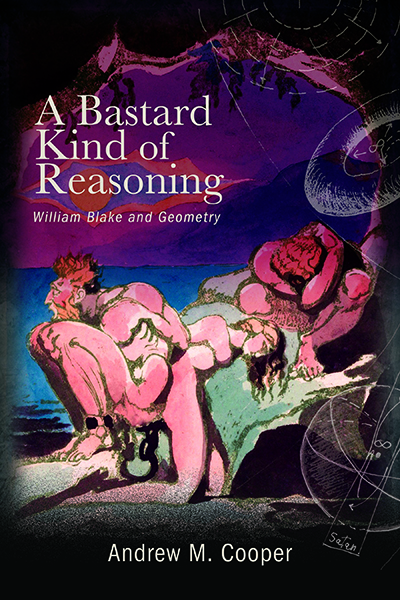
Andrew Cooper’s A Bastard Kind of Reasoning: William Blake and Geometry is a thorough and complex examination of the illuminated books alongside geometry, Enlightenment science, and phenomenology. It claims that “Blake did not simply reject Newton, geometry, and science” (2) and positions itself alongside Donald Ault’s Visionary Physics: Blake’s Response to Newton (1974). Cooper, with his provocatively tongue-in-cheek title, is eager to differentiate his views from Ault’s and offers “a less binary, more interinvolved, yin-yang or Blakean-Contrary view of the relation of Eternity to three-dimensional existence” (12). His main argument hinges on the suggestion that geometry is in fact “cosmology,” a term that will be familiar to scholars working on the illuminated books. Cooper establishes that “Blake’s engagements with geometry were not incidental but key to how he understood the workings of the universe” (6), and that prophecy is a transmission of a geometric vision (235). The opening discussion on Blake’s Newton print acknowledges the general consensus that Blake is anti-Newtonian, before boldly shifting gears. While musing over the design’s paradoxical nature, Cooper claims that Newton reveals a post-Newtonian mindset. The rest of the book extends into a steady revision of the illuminated books with Enlightenment (meta)physics and math. Of course, A Bastard Kind of Reasoning does not aim to cover the breadth of Blake’s repertoire, but what Cooper offers is a thought-provoking—and sometimes challenging—reconsideration of Blake’s relationship with science, and its impact on his visionary universe.
Geometry as Cosmology
This is perhaps the most interesting claim, and it is indeed the driving force of the argument. To support this assertion, Cooper centers most of his discussion around space-time and a careful reassessment of perception. While the majority of the book pivots around Enlightenment science—thus further contextualizing Blake’s imagery—Cooper does not shy away from using modern mathematical theorems and hypotheses to conceptualize the paradoxes within Blake’s universe. For example, he reexamines the frontispiece to Visions of the Daughters of Albion in light of the Klein bottle—a higher-dimensional Möbius strip—and phenomenology to conclude that the design is illusory and representative of “how the natural order exceeds all human conceptual systems for imagining it, so allowing new concepts to emerge, inexhaustibly” (19). In some ways, what A Bastard Kind of Reasoning does is not to offer brand new revelations about the source material. What it provides is a scientifically driven guide to these poems and their designs; in an incisive manner, Cooper recenters discussions concerning the (im)materiality of Blake’s vision around scientific hypotheses. As such, the book moves from poem to poem, trope to trope, to confirm that “Blake himself … wanted to exploit the imaginative reach of formal abstractions to generate a model of how the physical world extends beyond ordinary human sense” (41).
There is a nice balance between close readings of the illuminated books, summaries of eighteenth-century scientific output, and mathematics. The novelty of Cooper’s discussion lies in the way that he deftly transitions between all three, with the help of visuals. A Bastard Kind of Reasoning is heavily illustrated throughout, as one might expect, but the smattering of mathematical illustrations between Blake’s designs is a pleasant surprise. They alleviate the sheer volume of scientific terminology and theory that directs the argument and, as a result, they clarify the connections between geometry and Blake’s universe building.
Geometrical Perception and Visions
A question that A Bastard Kind of Reasoning tries to answer is “how, if the perception of matter’s immateriality is natural and innocent … it somehow gave way to the prevailing belief of matter’s impenetrable hardness and solidity” (82). Discussions on perception and vision augment the overarching argument about space-time, as demonstrated in Cooper’s examination of Blake’s Mundane Soul. Here, he suggests that the Mundane Soul is exploited to develop a cosmology of space-time that is plastic—where Creation, Fall, and Apocalypse are ongoing events. He further relates this to prophecy and the way that Albion “houses the prophet’s reluctant acknowledgment of the past’s necessary drag on the present, without which the future would lack any real connection to time and passage” (186). The book gently builds on each chapter to push our understanding of how Blake collapses time, space, and perception. While the density of the points can be daunting, the argument is always clear: Blake gleans from an array of sources a fourth dimension that can “impart depth, space, and freedom of motion to the rigid Euclidean geometry of the New Science” (117).
Cooper does not just consider perception and vision within the illuminated books; he also addresses our own critical purview as scholars. He invites readers to separate their analysis of Blake from the sociopolitical issues that many scholars are prone to rely on. While he does not deny the importance of historical context, he boldly states that we should not cling to the historicist underpinnings to Blake’s work. In doing so, he draws attention once more to the book’s raison d’être: visualizing Blake’s fourth-dimensional vision. Cooper is careful not to return to the structuralism and systemization of Blake’s works, most visible in Northrop Frye and S. Foster Damon, but he suggests that thinking about space-time as a physical field will naturally contribute to our understanding of how Blake’s work addresses sociopolitical issues (20-21). This is a refreshing take on the relevance of Blake’s prophetic power across history, which, he argues, is due to Blake’s ability to think about inheritors—which we, in turn, can use to consider his vision within present-day analogues (21). The book’s argument, then, is also a self-reflexive exercise where we confront our own perceptions of Blake so that we may independently see his vision.
A Bastard Kind of Reasoning takes some of the contradictions found within the illuminated books and offers an answer through geometry. The title itself is a playful double entendre of what one might find within the book: a reconstituted view of Blake and Enlightenment that begins with prior work on the subject and then ends with an alternative analysis that seeks to unite reason and imagination within Blake’s work. Cooper reinforces what is already known, such as Blake’s knowledge of Joseph Priestley and Erasmus Darwin through Joseph Johnson, before revising Blake’s world through ideas like fractals (61-83), Cartesian space (128-32), Neoplatonism (chapter 5), and the works of R. J. Boscovich, George Berkeley, and David Hartley, to name a few. The book is a valuable addition to the field and would be of interest to many who work on Blake, science, and theories of objectivity, like phenomenology. The depth of knowledge that it demands may make it a challenging read for those who are not theoretically inclined, so it is perhaps not an introductory text to Blake and science. Nevertheless, A Bastard Kind of Reasoning is an engaging read and a surprisingly succinct exploration of how Enlightenment science and geometry contribute to Blake’s vision of the universe.