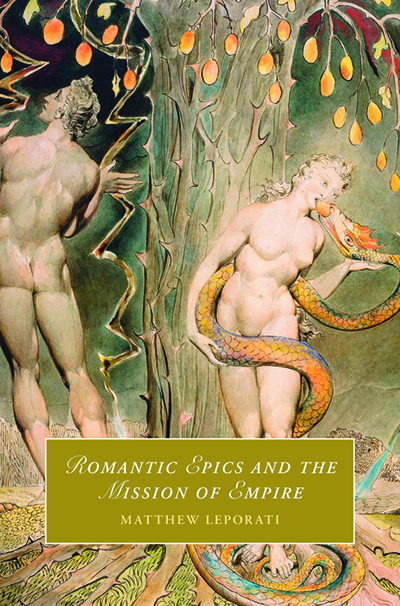
Matthew Leporati’s wide-ranging and compelling study considers two features of the Romantic era that are rarely contemplated side by side: the explosion of epic poetry at the turn of the nineteenth century and the turn toward a more evangelical and proselytizing form of Christian missionary activity. The latter is, as Leporati observes, often in opposition to the demands of empire in the early stages of colonization, but then is effectively co-opted into colonial activities as the century progresses. His book deals only tangentially with Blake, the subject of one of its chapters, but in many respects Blake’s writing in general and Milton a Poem in particular fuel several of the more critical conclusions.
Romantic Epics and the Mission of Empire is divided into two main parts, beginning with an overview that bounds through a series of epic poems—some of them famous, or relatively so, such as Keats’s Hyperion and Henry James Pye’s Alfred, but many more obscure even at the time of their composition. On a general note, what is astonishing in this first section of the book is how many epic poems were written during the Romantic period. As the author observes in his introduction, the “vast and unprecedented production of epics suggests that writers found in this ancient genre unique tools to speak to the tensions of the historical moment” (1). In the following chapter, “Epic Conversions,” Leporati provides one of the most succinct and useful definitions of that metamorphic genre, and demonstrates that this prodigious production gave the lie to the notion that epic declined with the end of aristocratic patronage and the rise of the novel. By contrast, he suggests that it was a suitably elevated means to engage with the aspirations—both lofty and, inevitably, often degrading—of empire. In this, it paralleled the revival of history painting at the end of the eighteenth century. A core theme of the book is how Romantic-era epics frequently interact with evangelical enterprises, something dealt with in considerable detail in the second and third chapters, which explore the revival of the missionary enterprise and the links between epic and heroic conversion narratives. If epic is a means to lift up national consciousness (for, as Leporati demonstrates, epic is, with only a few exceptions, both implicitly and explicitly a genre of the nation), its coincidence with missionary activity is also no historical accident, being prompted in part by a change in focus in Anglican theology from administering to the elect to achieving salvation through faith.
And yet this combination of heroic epic and evangelical missionary activity was not always a happy, nor even a necessary, one. As Leporati points out, early missionaries were frequently at odds with the activities of empire, not only in the South Americas, where Catholic priests saw the depredations of slavery as distinctly un-Christian, but also in India, where the mercantile and mercenary perspective of the East India Company frequently viewed any attempt to save souls as a hindrance to the more prosperous activity of exploiting bodies. Nonetheless, within a generation the activities of missionaries increasingly harmonized with those of temporal imperial powers and, through detailed readings of largely neglected epics such as Thomas Beck’s The Mission (1796) and Thomas Williams’s The Missionary (1795), Leporati explores with considerable nuance the shifting tensions that existed between empire and Christianity.
Despite our opening observation that this is a text that deals with Blake only in a minor explicit role, many writers discussed in Romantic Epics would have been read by him. What is more, Leporati draws attention to the significant role played by William Hayley in the revival of epic, through both his Essay on Epic Poetry and, more valuably, his important work as a biographer and editor of Milton. Whatever their other differences, conservatives and the liberal inheritors of the Whig tradition were keen to use epic to buttress national identity. Leporati’s dictum that by “seeking to fix a stable British Protestant national and imperial identity” epic poets “posit[ed] an ‘Other’ that possesses both savage elements and uncanny resemblances to the British” (80) is a familiar one now, although few other writers have waded through the glut of long narrative poems that appeared from the 1790s onward. As he points out in chapter 3, “Heroes of Conquest and Conversion,” many epics were deliberately and openly instructive—dogmatic, even—following the model laid down by Archbishop Fénelon’s Les Aventures de Télémaque (1699). At their most overt, narratives such as Pye’s Alfred (1801) or Sarah Leigh Pike’s Israel (1795) celebrated a god-given hero as an emblem of the chosen nation, leading through divine right, subtly elided from absolutism to a more delicate form of constitutional monarchy. Yet even progressive poems such as John Thelwall’s fragmentary The Hope of Albion tended to rely on the opposition of the Christian and the Other, even as they eschewed imperial violence.
Of the chapters dealing with individual authors and their epics in the second part, those other than Blake will be dealt with briefly here insofar as they demonstrate differences from or similarities to him. This is by no means a comment on the value of the individual readings: in at least three instances—Byron’s Don Juan, Wordsworth’s The Prelude, and Equiano’s Interesting Narrative—these are perhaps more popular (or, at least, more frequently read) works than Milton, while Ann Yearsley’s Brutus and Robert Southey’s Madoc deserve to be better known than they are. Yearsley’s “abbreviated epic” (108) and Southey’s poem demonstrate more of the concerns of the middle classes toward burgeoning empire, exploring the belief that Britain did indeed possess some divine manifesto to convert the nations. Yet, argues Leporati, these two poems also exhibit considerable tension toward the practice of slavery and the subjugation of indigenous peoples. Equiano and Byron are included as examples of “more transgressive understandings of identity” (161) that could be pursued within the epic form; Equiano incorporated epic elements into his text to reconfigure himself as a hybrid figure, while Byron subverted not merely the themes but also the form of epic in his incomplete poem, features that Leporati suggests he shares with Blake.
Turning to Blake, the subject of chapter 7, Leporati suggests that Blake’s purpose in his poetry follows what Saree Makdisi points to as humanity founded in heterogeneity, as in the invocation “And all must love the human form, / In heathen, turk or jew” in “The Divine Image.” Such an approach denies a basis of self-identity formed from the tired binary of self/Other, a subversion matched by Blake’s radical approach to epic, which undermines a genre based on themes of war and conquest. While Milton may appear to be a teleological epic, leading up to a crescendo where Milton confronts his own creation, Satan, the actual experience of reading the poem undermines the sense of cohesion that such narratives typically require. Rather, suggests Leporati, “The character of Satan spreads over the globe a punishment-obsessed interpretation of Christianity that attempts to assimilate all people into a single model of duty conducive to imperial oppression” (187). While Blake’s version of Satan presents the devil as seeking to unite the world in submission, Milton becomes a counter-missionary who recognizes how he unwittingly promoted such a Satanic and imperial ideology.
While Leporati seeks to engage with a critique of Blake’s co-option by colonial and evangelical orthodoxy, the strain of critical work over the past two decades that reconsiders Blake as a prophet for empire sometimes seems contrarian for its own sake. Certainly, Blake was frequently affected by a spreading colonial worldview where Britain saw itself beholden to its own form of manifest destiny, but, as Leporati points out, Blake’s anti-classicist position is almost unique among his contemporaries and resists a neoclassical cult of self-sacrifice. As such, Blake opposes both the content of classical epics and their style. Likewise, while Milton had become subsumed during the eighteenth century as an icon of the British Protestant self in service to the state as a greater good, so Blake’s Milton has to save that poet who was unknowingly of the devil’s party from himself. Ultimately, while Blake, like many of his contemporaries, may have wished to restore Christianity in Britain, his view of what such faith meant was very different from theirs.