The Ambiguities of Translation:
Fuseli, Blake, and the Making of Aphorisms on Man
Sarah Carter (carter.sphd@gmail.com) is a postdoctoral fellow at the University of Chicago. Her research is funded by the Social Sciences and Humanities Research Council of Canada (SSHRC) and the Fonds de recherche du Québec (FRQSC). Sarah holds a PhD in Art History from McGill University.
Johann Caspar Lavater’sI would like to thank Matthew C. Hunter, Andrei Pop, Colin Jones, and my peer reviewer for their thoughtful feedback on this paper. I would also like to thank Sarah Jones for her editorial expertise and Robert N. Essick for sharing the Fuseli drawing for the frontispiece to Aphorisms on Man with me. I am grateful to the Huntington Library in San Marino, California, for supporting research for this article through a short-term fellowship and the Newberry Library in Chicago for providing research space and resources while I was a scholar in residence. I also benefited from the expertise and help of the staff at McGill Rare Books and Special Collections. All translations are mine, unless otherwise indicated. Vermischte unphysiognomische Regeln zur Selbst- und Menschenkenntnis (1787) is a classic work of Enlightenment thinking that entered English circulation with a split identity. Published as Aphorisms on Man in 1788,Aphorisms on Man also included Regeln from a second work, Vermischte unphysiognomische Regeln zur Menschen- und Selbstkenntnis (1788). it was brought before an English audience through the printmaking skills of William Blake and the agency of Lavater’s childhood friend Henry Fuseli. However, Lavater might well have recalled the saying “Traduttore, traditore” (Translator, traitor). Fuseli had not failed to close the lexical gaps between the German and the English. Rather, his ideas had transformed the work, from its ambiguous frontispiece through to its concluding lines—interventions that challenged Lavater’s claim to authorship of the book. If the usual stories told about Aphorisms on Man describe the volume as a “product of friendship” or a “labour of love,” I turn this convivial alliance on its head to suggest that a closer look at its behind-the-scenes production reveals a different narrative, one that pivots on rivalry as much as collaboration.See Erle, Blake, Lavater and Physiognomy 99; Ackroyd 107. Daisy Hay has likewise called the book a “celebration of friendship” (174).
Translation, broadly conceived as a cultural transference, has long been a topic of debate. The German Romantics, for example, qualified it as an impossible feat, arguing that no perfect equivalence could be achieved between an original text and a foreign variant. Still, some translations were better than others. Lavater could therefore malign the “bungling Translator who disfigures an excellent original, and who fails to convey the spirit of his Author.”Lavater, Essays on Physiognomy 2: 241. More recently, scholars investigating the “devious side” of translation have shown that translators can do more harm than frustrating a savvy reader or undermining authorial voice.Italiano 4. As Federico Italiano argues, translation can enact cultural violence, becoming “an instrument of concealment, silencing and misdirection— … something that darkens and obscures.”Italiano 1. These assessments, although rooted in radically different contexts, share the idea that translation is always conflictual. The reason, to borrow from Homi Bhabha, is that as classic intermediate spaces, translations “provide the terrain for elaborating strategies of selfhood—singular or communal—that initiate new signs of identity, and innovative sites of collaboration, and contestation, in the act of defining the idea of society itself.”Bhabha 2; Italiano 3. Put another way, they are personal and political. Bhabha’s particular emphasis on indeterminacy is helpful for approaching Aphorisms on Man since, as this article will demonstrate, the book liaised between not only distinct linguistic milieu but also the ideas of the author, translator, and engraver. Although conceptualized as an introduction to forthcoming books on physiognomy, it pursued a different agenda to serve as one such innovative site of collaboration, contestation, and social definition.
To illuminate these complexities, I begin with the modification of the original German manuscript to show that Fuseli approached the book as a co-author. The second section brings Aphorisms on Man into conversation with Lavater’s second English title, Essays on Physiognomy (1789–98), to reveal how the same opposing priorities shaped both. The third section looks at the frontispiece. By comparing the preliminary drawing that Fuseli gave to Blake with the final engraving, I pursue the possibility that their partnership deviated from industry standards—an arrangement that invites us to rethink the work that the frontispiece does. Finally, I turn to the reception of the book to explore how it involved readers and what their participation can tell us about changing identity regimes in the late eighteenth century. Aphorisms on Man emerges from my analysis a composite creation—one that registers the competing visions of its several authors and constitutes the idea of self emerging in tandem with Romanticism.
Translating: The Aphorisms
Fuseli was first drawn to Aphorisms on Man as a friend. His translation, for which he declined compensation, has been interpreted as a favor to his childhood classmate Lavater, who supported him financially while he was studying to become a painter in Rome.Erle, Blake, Lavater and Physiognomy 99. It has also been understood as fulfilling a commitment to become an informal cultural emissary between England and the German-speaking world. Fuseli’s former mentors at the Collegium Carolinum in Zürich, Johann Jakob Bodmer and Johann Jakob Breitinger, hoped that he would introduce German authors to English readers while keeping themselves and other literati abreast of literary news in London.Fuseli’s biographer John Knowles reports that “some of the literati of Germany and Switzerland had it in contemplation to establish a regular channel of literary communication between those countries and England. Fuseli’s tutors and friends, Bodmer, Breitinger, and Sulzer, felt a lively interest in this project, and took an active part in carrying the design to execution” (1: 27). See also Regier 97. Fuseli did well; by the late 1780s, he had already successfully translated several important essays by Johann Joachim Winckelmann, including Gedanken über die Nachahmung der griechischen Werke in der Malerei und Bildhauerkunst (published as Reflections on the Painting and Sculpture of the Greeks in 1765).Johann Joachim Winckelmann, Reflections on the Painting and Sculpture of the Greeks: With Instructions for the Connoisseur, and an Essay on Grace in Works of Art, trans. Henry Fuseli (London: Printed for the Translator, and Sold by A. Millar, 1765). With these translations in mind, scholars have advanced Fuseli as a robust cultural force—not only a visual artist but a mediator of ideas.For more on Fuseli’s role as a cultural mediator, see Regier; Pop, Antiquity; and Hall. They have also shown that he was not an impartial transcriber; for one, his English diction, as exemplified in Reflections, contained its own theoretical arguments.Allentuck, “Fuseli’s Translations” 181; see also Pop, “Henry Fuseli” 83. Aphorisms on Man is consistent with these titles insofar as something of the same “unique Fuseliesque orientation” that Marcia Allentuck identifies in his Winckelmann is also present in his Lavater.Allentuck, “Fuseli’s Translations” 178. Put simply, the book sounds as though Fuseli wrote it, modeling the same obscure “epigrammatic style” as his letters.Quoted in Weinglass, Collected English Letters x. The quotation, attributed to Thomas Lawrence, is given by Joseph Farington (The Farington Diary, ed. James Greig, vol. 3 [London: Hutchinson & Co., 1924] 60). Perhaps more importantly, it also worked for him by advancing his literary career.
Fuseli began translating in 1787, working from a manuscript that combined Regeln (rules) from Lavater’s aforementioned texts.Schroyer’s timeline has Fuseli translating Lavater’s manuscript between October 1787 and May 1788. According to Schroyer, the manuscript contained Regeln that appeared in Lavater’s 1787 and 1788 volumes. See “The 1788 Publication Date of Lavater’s Aphorisms on Man” 24; the introduction to the reproduction of Blake’s copy of Aphorisms (xi); and Erle, “Leaving Their Mark” 349. Although this manuscript is now lost, there is evidence to suggest that he did not faithfully adhere to the “original, … composed … during the autumn of 1787, and transmitted in the author’s own manuscript to the publisher,” as claimed in the advertisement (Aphorisms vii). A letter to Lavater from his friend Gottfried Heisch reveals that Fuseli had selected only 700 from the original 1000 Regeln.Letter from Heisch to Lavater, 16 May 1788 (FA Lav Ms 512.138, Zentralbibliothek Zürich): “Your rules / Aphorism of men / are translated, from the 1000 about 700 were selected. I really liked what I saw of it.” (Deine Regeln / Aphorism of men / sind übersetzt, aus der 1000 ungefehr 700 ausgesucht. Was ich davon sah gefiel mir sehr.) Further evidence that the original manuscript contained 1000 rules (compared to Fuseli’s 633) is found in a letter of 19 August 1788 from Sophia Hoffham to Lavater (FA Lav Ms 512.143, Zentralbibliothek Zürich). She requests that an “Exemplar der 1000 Unphisiognomishe Regeln” be sent to London with Lavater’s son, Johann Heinrich. This abridgment was not unwarranted; Lavater had written to Fuseli in 1787, giving him the authority to omit what he thought “false or unimportant” and to “make improvements” where needed.Letter from Lavater to Fuseli, 13 October 1787 (Weinglass, Collected English Letters 38-39). As if to forestall an accusation that he had exceeded the limits of translation, Fuseli printed this letter in the frontmatter to Aphorisms on Man. But in addition to abridging the manuscript and condensing the original German phrases, he also divorced and combined sentence elements to alter meanings or advance new ideas altogether.Erle, Blake, Lavater and Physiognomy 98; Hall 132. Carol Louise Hall has underscored the differences between the original and the translation through comparative analysis. One example will suffice here: Die Menschenkenntnis soll dir das zeigen, was in Andern Vereinbares und Unvereinbares ist mit dir selbst. Sie zeigt dir das in dem Andern, was dich existenter und harmonischer mit dir selbst und mit allem Guten um dich her, macht. Selbstkenntniss zeigt dir, was dich Andern geniessbar und ungeniessbar macht.This is rule 18 in Lavater, Vermischte unphysiognomische Regeln zur Selbst- und Menschenkenntnis (Zürich, 1787) 15. See Hall 134. (Knowledge of human nature will allow you to see where you are compatible and incompatible with others. It shows you in the other, that which makes you more real and more harmonious with yourself and with everything good around you. Self-awareness shows you what makes you either pleasant or unpleasant to others.) Fuseli renders this long passage as “The study of man is the doctrine of unisons and discords between ourselves and others” (Aphorisms 9). The synoptic brevity of his translation is undeniably more impactful.Hall 133. But if translators continued, well into the eighteenth century, to see themselves as co-authors, permitted to omit, add, or modify as they saw fit, the scale of revision found in Aphorisms on Man deviates from standard practice.Burke 34.
Knowing that Fuseli had been given permission to edit freely allows us to see how he may have envisioned the translation as advancing his literary reputation without compromising his service to Lavater. Certainly, one way to read the dedication to Fuseli that opens the volume (the same one in which Lavater gives him permission to edit freely) is as an implicit argument rooted in like-mindedness.Erle, Blake, Lavater and Physiognomy 98. It assured the reader from the outset that Fuseli’s modifications were “natural,” since the translator was of the same mind as the original author—at least when it came to the content of the book: “All the world know that this is no flattery; for, in an hundred things, I am not of your opinion; but, in what concerns the knowledge of mankind, we are nearer to one another than any two in ten thousand” (Aphorisms v). However, if this proverbial passing of the authorial torch signals an exceptional trust between friends with shared values, the fact that the pair were in near constant disagreement on numerous fronts during this period challenges this assumption. Fuseli had his own priorities. Aphorisms on Man was clearly not piracy, but like the translations and reprints that did circulate without the consent or input of the original author, it participated in what one scholar has termed the “culture of the upgrade.” Where one rival author “might silently abridge; another might translate creatively; a third might add material or critical comments.”Johns 49. Fuseli engaged in all three to refine and enhance the original, adding his own material while also trimming and polishing Lavater’s.
The originality of the translation was not lost on readers. Joseph Johnson’s Analytical Review printed the following praise in July 1788: “Many of the aphorisms are so well expressed in the translation, that they have all the merit of an original thought almost intuitively struck off.”Analytical Review 1 (May-August 1788): 286-89 (on 287). This compliment to linguistic proficiency is of interest because it anticipates the fact that some of the ideas had been formulated in English. Comparative research reveals that over sixty of the aphorisms are exclusive to the translation.See Shroyer’s introduction to the reproduction of Blake’s copy of Aphorisms (xi-xii). Crucially, one appears on the frontispiece engraving—“ΓΝΩΘΙ ΣΕΑΥΤΟΝ” (Know thyself)—while another concludes the book: “If you mean to know yourself, interline such of these aphorisms as affected you agreeably in reading, and set a mark to such as left a sense of uneasiness with you; and then shew your copy to whom you please” (Aphorisms 224).Recent studies credit the final aphorism to Fuseli. See, for example, Erle, Blake, Lavater and Physiognomy 98. I will return to these aphorisms in more detail later, but their placement is of importance here. As literary bookends, they frame the contents while highlighting the authorial intervention that gave the translator the essential first and last words.
In addition to his loose translations, Fuseli also commandeered the concept. Anticipating the book’s commercial success (the letter of 19 August 1788 from Sophia Hoffham to Lavater notes that Aphorisms on Man had already sold 800 copies at three shillings apiece in its first edition),FA Lav Ms 512.143, Zentralbibliothek Zürich: “Heisch hatt mir gebeten Ihnen mein Lieber zu sagen das er sie unrecht gesagt hatt von dem preis des Buches die Aphorisms of Man— anstatt 5 Shillings so sinds nur 3— Sind schon ungefähr 8 Hundred davon verkauft von die erste Edition.” Fuseli took full advantage of his strategic position as translator, contributor, editor, and designer. He used the advertisement to communicate a plan to turn the book into a series: “It is the intention of the editor to add another volume of Aphorisms on Art, with Characters and Examples, not indeed by the same author, which the reader may expect in the course of the year” (Aphorisms viii). This second volume would focus on his area of expertise—art theory and practice. Fuseli even inserted “End of Vol. 1” on the final page as a reminder of the forthcoming sequel. Although Aphorisms on Art would not materialize until 1831, there is a strong sense of authorial continuity between the works; the aphorisms share structural similarities and turns of phrase.This delay has been attributed to the loss of the corrected proofs in a fire at Johnson’s publishing house, but Fuseli’s letters reveal a distracted but persistent effort to refine the material over time. Though admitting that the aphorisms had been “neglected, for Milton’s sake,” his letter to William Roscoe dated 15 January 1795 makes mention of Roscoe’s recent comments on them, suggesting an ongoing writing and revision process. In that letter, he admits the benefits of deferral: “Yet by the delay what they have lost in time they may have gained in Value” (Weinglass, Collected English Letters 125). These parallels support the idea that Aphorisms on Man was a double primer. It functioned not only as an English introduction to Lavater, but also to Fuseli. The following section brings this authorial appropriation into conversation with a second venture seeking to import Lavater into England, Essays on Physiognomy. As we will see, although Fuseli assisted in its production, disagreements caused more than minor hiccups. The pair may have been good friends, but they were seldom on the same page—a fact that helps to elucidate why Fuseli made the changes that he did.
Editing: Rival Texts
Published in four volumes between 1775 and 1778, Physiognomische Fragmente, zur Beförderung der Menschenkenntnis und Menschenliebe reclaimed the truth of physiognomy.See Graham; Percival and Tytler; Porter; Graczyk; and O’Rourke. It stated that a correlation between “the visible surface” of the body and its “invisible spirit” not only existed but could be measured and studied to improve society. What set Physiognomische Fragmente apart from other, older physiognomic texts was its impressive visuals and their evidentiary promise. More than mere illustrations, the book’s many engravings allowed Lavater to realign his physiognomic “art” with empirical sensibilities. During the 1770s, when he was preparing the work for publication, he invited Fuseli to provide designs. This is not surprising, given their enduring friendship and the latter’s novel painterly enterprise in Rome. But where the pair should have had much to agree on, since both physiognomy and visual art “read” the human body as an indexical sign, Fuseli found himself constantly at odds with his compatriot. As Stephanie O’Rourke has compellingly shown, Lavater was exceptionally particular about his visual aids.O’Rourke 67-69. Concerned that his draftsmen and engravers would deviate from their instructions, he personally oversaw each commission.Johnson 56. Predictably, Fuseli did not respond well to demands for revisions.Johnson 56; Allentuck, “Fuseli and Lavater” 93-94. An impassioned letter of 1771 laid out his grievances while also expressing an emerging sense of artistic identity: The biggest mistake that you commit towards me is presenting me with subjects that have been already formed in advance. Know that invention is the soul of a painter, and a painter without it may as well be in the shoemakers’ guild. Your imagination and mine may be the same, but if I am to execute your images they must flame up in my head and not in yours.Letter from Fuseli, in Rome, to Lavater, May 1771 (Füssli, Briefe 165-66, 234). (Der größte Fehler, den du in allen deinen mir vorgelegten Sujets begangen, ist, daß du mir immer vormunzest. Wisse, daß Invention die Seele des Malers, und ein Maler ohne sie auf der Schuhmacherzunft ist. Deine und meine Imagination mögen dieselbe sein; aber um ihre Bilder auszuführen, muß sie in meinem und nicht in deinem Kopf aufflammen.) Muschg suggests that vormunzen means prechewed, as if for an infant (vorkäuen [für Säuglinge]). This interpretation of the word is strengthened by the entry for munzen in Franz Joseph Stalder’s Swiss dictionary published in 1812. It lists vormunzen under munzen as a synonym for vorkauen. See Stalder, Versuch eines schweizerischen Idiotikon, 2 vols. (Aarau: Heinrich Remigius Sauerländer, 1812) 2: 221. I thank Andrei Pop for calling my attention to this definition. Although the brief had been simple—“the painter must forget himself and give his undivided attention to Nature alone”—Fuseli was loath to comply.Lavater, Essays on Physiognomy 2: 280. There is a certain irony to this statement insofar as it appears in the text in relation to a portrait of Fuseli, whom Lavater accused of not following nature. As he put it, he had neither the desire nor the ability to “shrink [his] great thoughts and noble lines” to fit the desired specifications.Füssli, Briefe 161. (Die Lust und vielleicht das Vermögen, große Gedanken und edle Linien so, daß sie auch einem hölzernen Stecher in die Augen leuchten mögen, innert drei Zolle zu bringen, habe ich verloren.) With both parties bristling, only one of Fuseli’s illustrations appeared in the Fragmente.“Head of a Dying Man” is in vol. 4, p. 415. See Weinglass, Prints and Engraved Illustrations, nos. 36 and 37.
Fuseli commanded more space in the English edition that followed. Translated by Henry Hunter, Essays on Physiognomy was published in fascicles between 1789 and 1799 with instructions for binding into three quarto volumes (divided into five parts). The book was one of three hopeful ventures to capitalize on Lavater’s growing popularity. In 1787, Joseph Johnson began preparations for an edition, having enlisted Mary Wollstonecraft to translate from the French adaptation, Essai sur la physiognomonie, destiné à faire connoître l’homme et à le faire aimer (1781–1803). However, as Mary Lynn Johnson has shown, he soon abandoned the work to become a financier of the Hunter translation, published by John Murray.Johnson 70-71. Writing to Lavater in July 1787, his friend Luder Hoffham explained that the decision was a good one from a business perspective, since Hunter was already ahead and the market could likely support only one English edition: [Hunter] has been occupied for some time with the translation of your French physiognomic work, which is to appear here in print next year with beautiful engravings. The price of each copy is £24 for subscribers, and, as I hear, there are several subscriptions already. I fear this will do Johnson harm if he publishes a new physiognomic work of yours, for many of those who have subscribed to that work will hardly subscribe again to this one.Letter from Luder Hoffham to Lavater, dated London, 27 July 1787 (FA Lav Ms 513.288, Zentralbibliothek Zürich). (Dieser Doctor Hunter wünschet sehr, Ihnen persönlich kennen zu lernen, er hat sich seit einiger Zeit mit der Übersetzung Ihres Französischen Physiognomischen Werkes beschäftiget, welches hier nechstes Jahr mit schönen Kupfern im Druck erscheinen soll, der preis von jedem Exemplar für Prenumeranten ist £24, wie ich höre sollen schon verschiedene prenumerirt haben, ich fürchte dieses wird Johnson großen schaden thun, wenn er das neue Physiognomische Werck von Ihnen heraus-giebt, denn viele die auf jenes Werck prenumerit haben, werden schwerlich auf dieses wieder prenumeriren.) But if competition discouraged Johnson, it does not appear to have been much of a concern for Murray, whose translation already had a rival—an abridged version in octavo published by Thomas Holcroft in 1789. Murray, it seems, was confident that the superiority of his own edition was sufficiently obvious to ensure its success. In a letter to William Creech, his bookseller in Edinburgh, he stated: “The greatest service you can render us is to let the two editions be seen at the same time.”Quoted in Zachs 83. Murray believed that the abundance of plates after designs by important English artists would sell the book.
The plates were an advantage in terms of desirability, but they also made the book expensive to produce. In fact, its price tag—an astounding £10,000—required joint financing.Erle, Blake, Lavater and Physiognomy 135. William Zachs describes Murray’s long-standing partnership with Johnson, including Johnson’s becoming his “silent partner” for Essays on Physiognomy (83). Profits from the 809 copies sold to 795 subscribers were to be divided between publishers and makers (the publishers John Murray and Joseph Johnson, the translator Henry Hunter, and the head engraver Thomas Holloway).Erle, Blake, Lavater and Physiognomy 134. The sheer expense of publishing the Essays made certain that profitability was prioritized over lavish presentation. Writing to Lavater from London in May 1788, Gottfried Heisch warned him not to ask too much of his English publishers, especially if his demands incurred further costs. The letter communicates a rather harsh assessment of the physiognomist’s position, seemingly in an effort to temper his unrealistic expectations: Between you, Fuseli, and Johnson there are the most dreadful misunderstandings. God knows how they arose—I won’t and can’t investigate. You think Johnson will use English money and expend English generosity for your Physiognomy? [I]t does not seem to me to be the case. The first word, which has been repeated continuously until now, is this: Lavater incurs a lot of expenses, outlays, which we don’t know anything about. We don’t want anything except two sections of outline drawings and his text. What’s the purpose of all the rest, all these draftsmen, etc.? [W]ho asked him for them? Incidentally, he changes his mind every day, starts new projects that we simply can’t get involved in, and if we write to him about it, he doesn’t answer, doesn’t stay to the point that we want him to, and always gives answers that we don’t want to know.Letter from Heisch to Lavater, 16 May 1788 (FA Lav Ms 512.138, Zentralbibliothek Zürich). Transcribed in Finsler 20; translation modified from Johnson 71. (Zwischen dir, Füessli und Johnson sind die schrecklichsten Missverständnisse. Gott weiss, wie sie entstanden, ich will und kann‘s nicht untersuchen. Du glaubst, Johnson wolle für deine Physiognomik englisch Geld verwenden und englisch generös zahlen? dies scheint mir nicht zu sein. Denn das erste Wort, was ich hörte und was mir bisher ununterbrochen wiederholt worden ist, war dies: Lavater macht eine Menge Unkosten, Auslagen, von denen wir nichts wißen wollen. Wir wollen nichts als 2 Theile Umriße u. seinen Text. Zu was dies alles, alle die Zeichner &? Wer hat’s von ihm begehrt? Uebrigens verändert er alle Tage seine Meinung, macht neue Projekten, in die wir uns schlechterdings nicht einlassen können, und wenn wir ihm darüber schreiben, so antwortet er nicht, bleibt nie auf dem Punkt, auf dem wir ihn festhalten wollen und gibt immer Atwort auf das, was wir nicht wißen wollen.) Sophia Hoffham agreed that the problems facing Lavater were due to misunderstandings and not enmity with either Fuseli or Johnson (letter to Lavater, 2 September 1788, FA Lav Ms 513.291, Zentralbibliothek Zürich): “I believe, my dear friend, that there is more of a misunderstanding between you than that the local party is mocking you. Fuseli, whom Heisch praised to me the other day, said that he certainly meant well with you and thinks very highly of Johnson. Heisch asked me again to tell you that you should try to stay on good terms with Fuseli as much as possible.” (Ich glaube mein Lieber Freund das es mehr Misverständniß zwischen Ihnen ist; als das die hiesige partie Ihnen spotte. Fusli dem mir Heisch noch den letzten Tag gerühm hatt, und sagte daß er es gewiß recht gut mit Ihnen meine, hält sehr viel auf Johnson. Heisch bath mir nochmals Ihnen zu bitten sagen daß sie so viel wie möglich trachten möchten auf ein guten fuß mit Fusli zu bleiben. Diss war der raht von einem der Lavater glücklich sehen muß.) Whether for his own benefit, or with a view to a future reader, Lavater expressed his disbelief directly on the page: “This, by God, is not true” (Ist, bey gott, nicht wahr). Heisch may have discouraged his grand ambitions—Lavater wanted to include new material, publish the work in folio, and have the drawings remade for the new format—but it ultimately fell to Fuseli to mediate. Lavater’s proposals were quickly dismissed for being economically impractical, but Fuseli framed the smaller format as good marketing. He convinced Lavater that a quarto edition would better “[please] the British public.”Knowles 1: 79.
If the publishers thought only of the profits that Essays on Physiognomy might generate, Heisch offered an altogether more optimistic assessment of Aphorisms on Man. In the same letter, he wrote of Fuseli, “As far as I can see, a very uninterested man has acted here, for he has not taken a penny for the translation of the rules and says he did it to put the money in your hands.” This was despite the fact that distance and lingering discord had created a feeling of mutual distrust. However, this is not to say that Fuseli acted altruistically. As with Johnson and Murray, whose collaboration proceeded from “principles of reciprocity,” Fuseli had demands of his own.Murray’s words, quoted in Zachs 83. We learn from Heisch that Fuseli wanted Lavater to make changes to the Essays in return for his translation of the Regeln. He demands the following from you as he is dissatisfied with what you have written about him in the French Physiognomy. Since he claims that something like this could ruin his reputation as an artist, he will provide new drawings for Hunter’s translation and the article concerning him, and you should then also make a new text for it.(Er fordert von Dir folgendes. Da er unzufrieden ist, mit dem, was du über ihn in die Franz Phisiögnomische hast setzen laßen, und da er behauptet, daß so etwas ihm seinen ganzen Künstlerruf allhier zu Grunde richten könnte, so wird er für Hunters Uebersetzung u. d. Artikel, der ihn betrift neue Zeichnungen geben und du sollest als dann auch einen neuen Text dazu machen.) It is unclear why the solicited text failed to materialize. There are no surviving letters between Fuseli and Lavater from the late 1780s or thereafter, barring a cursory note concerning Lavater’s son, Heinrich, who lived with Fuseli for five or six months while visiting London.See Füssli, Briefe 202. We do, however, learn from Sophia Hoffham that something was amiss between Fuseli, Lavater, and Johnson. She wrote the following to Heinrich in July 1792: We recently met Fuseli, and he seems to be very annoyed that he has not heard from you or your dear father. I cannot judge why they are not good to you, so I cannot comment on the matter—only I fear that it might harm your father, for Fuseli and Johnson are very good friends—the latter, when my husband was with him recently, said that he was very surprised that he did not receive anything from your father, the work is now at a stand still, and Johnson says that he will not send your father any more money until he receives the work from him—please let us know, my dearest, how it all fits together—there must be a misunderstanding somewhere.Letter from Sophia Hoffham to Heinrich Lavater, 10 July 1792 (FA Lav Ms 513.292, Zentralbibliothek Zürich). (Wir haben kürzlich die bekantshaft von Fußli gemacht, er scheinet sehr belendiget zu seyn, daß er nicht von Ihnen, noch Ihren lieben Vater gehört. Ich kann nicht urtheilen warum sie Ihnen nicht gut sind—kann daher von dem puncte gar nichts mittheilen sagen—nur allein fürchte ich, es könte Ihren Vater schaden, den Fußli und Johnson sind sehr grose Freunde—der letztere als mein Mann kurzlich bey ihm war, sagte daß er sich sehr wunderte nichts von Ihren Vater erhalten zu haben, daß werk liegt nun gans stille, und Johnson sagt er wird Ihren Vatter kein mehr Gelt schicken, bis er daß werk von Ihm erhält—. Lassen sie uns doch mein Bester wißen wie es zuzammen hängt—es muß irgend wo ein misverständniß seyn.) As late as May 1793, Sophia was still attempting to mediate between Fuseli and Lavater, albeit without knowing what had caused the fissure between them.Sophia wrote again to Lavater on 31 May 1793 (FA Lav Ms 513.293, Zentralbibliothek Zürich), asking to know what had happened between him and Fuseli, emphasizing once again that their conflict must be a product of misunderstanding and not irreconcilable differences.
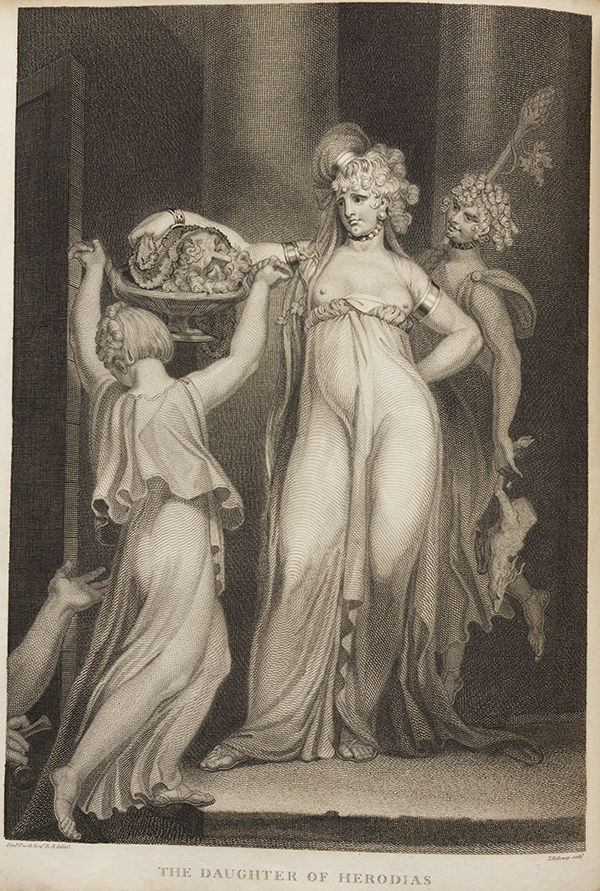
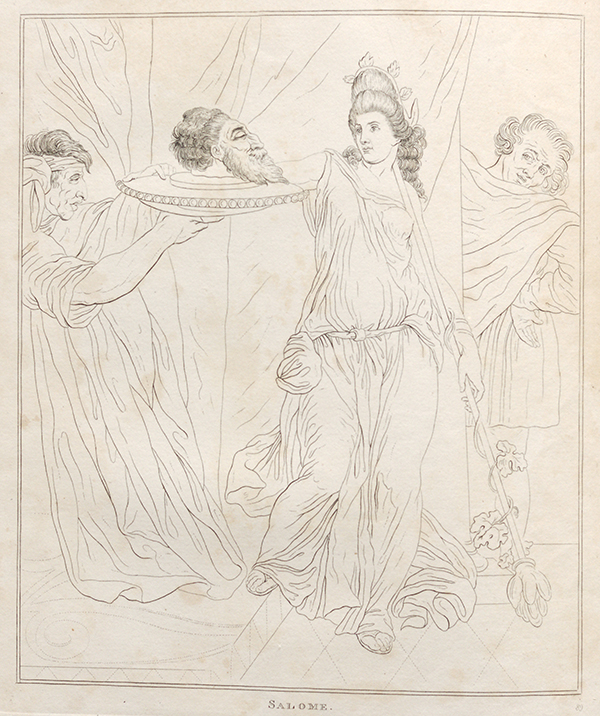
In any case, the missing text for Essays on Physiognomy presented challenges. To redress the engravers’ errors in the French edition, Fuseli used his position as consulting editor to commission new engravings based on his old designs.For more on the publishing history of the Hunter edition of Essays and Fuseli’s interventions, see Erle, Blake, Lavater and Physiognomy 149-58. However, without the new texts from Lavater (those that he had requested), the illustrations created a glaring discrepancy: the physiognomic analysis that Lavater had originally written applied to faces that now looked different.Percival 86; O’Rourke 70. To compensate, copies of the old French engravings were printed alongside the new English additions. When confronted with both versions, one is sympathetic to Fuseli. Considered together, Thomas Holloway’s “Mary Sister of Martha” (illus. 1) is more accomplished than the copy of Johann Heinrich Lips’s engraving of the same figure (illus. 2).
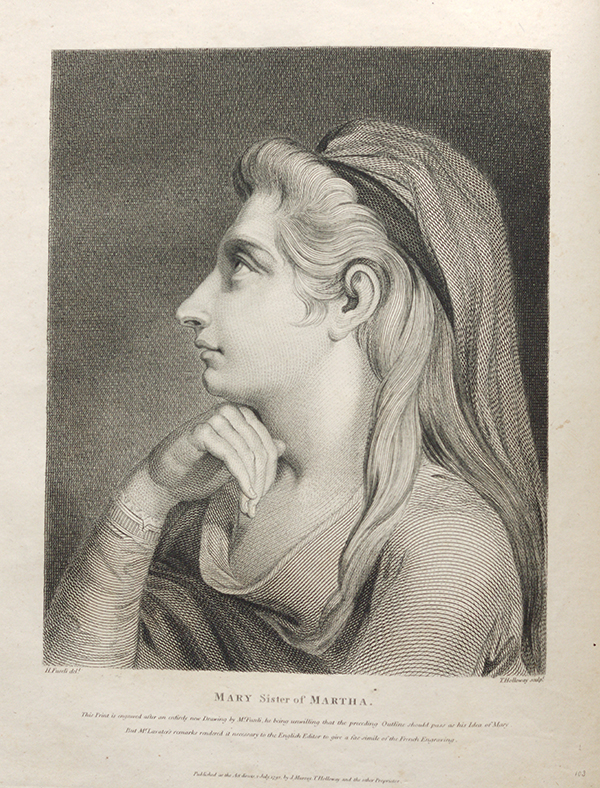
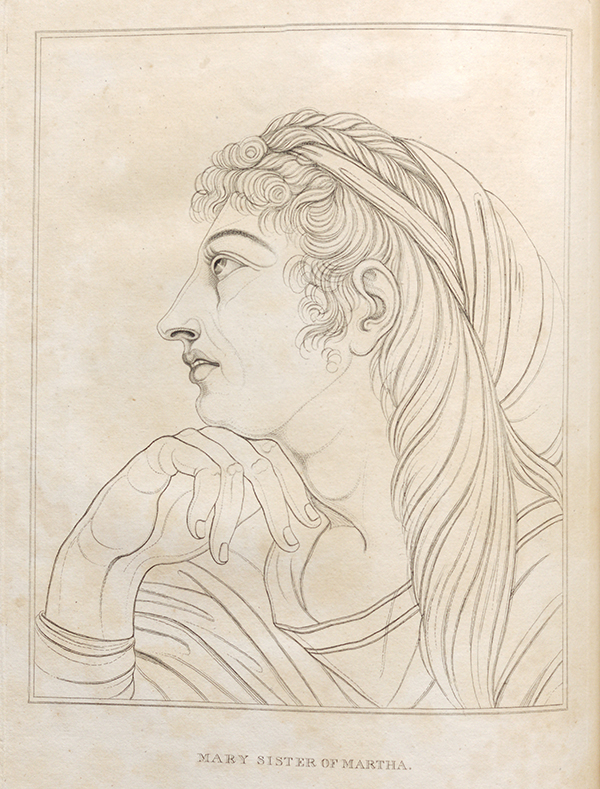
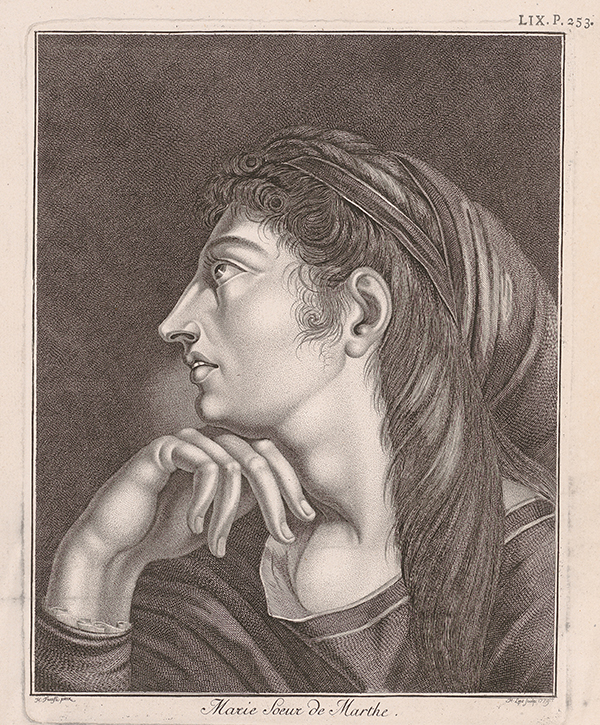
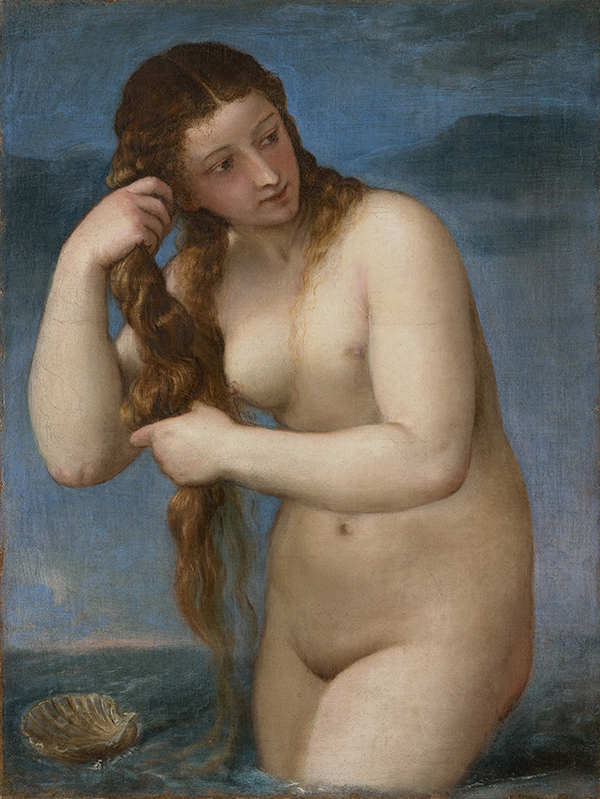
Fuseli’s interference also countered the criticism that Lavater advanced against the alleged weaknesses of his drawing. To preserve the gloss of impartial empiricism that supported his system, Lavater was not above highlighting instances where Fuseli or other contributors had exercised undue artistic license—that is, artists who had deviated from their models (nature for draftsmen and original drawings for engravers). But neither was Fuseli immune from challenging Lavater in this arena. A head of Satan (illus. 4) sits on a protuberant neck resembling nothing so much as the fleshy lower torso of a Venus anadyomene (illus. 5).I thank Matthew C. Hunter for this observation. The strange combination of Satan’s physiognomic portrait with the lower half of a female body is perhaps suggestive of lines from Milton’s Paradise Lost (book 2, lines 757-58) in which Sin describes her birth from Satan’s head: “Then shining heav’nly fair, a goddess arm’d, / Out of thy head I sprung” (John Milton, Paradise Lost. A Poem in Twelve Books [London: Printed for W. Strahan et al., 1778] 46).
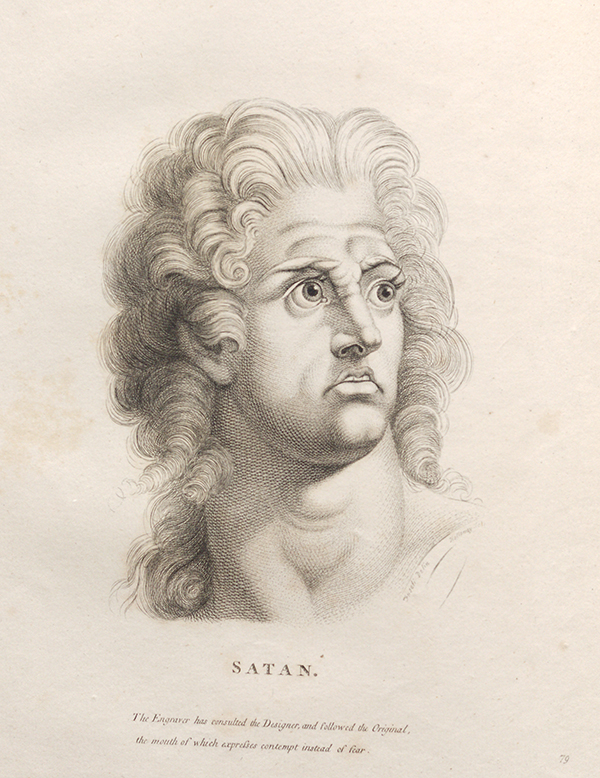
The troubled relationship between the hard truth of physiognomy and its mutable evidence is vibrantly expressed by Fuseli in a review of Holcroft’s version of Essays on Physiognomy, translated from Johann Michael Armbruster’s abridged edition. It bears quoting at length: The same sympathies with external appearances, pervade the cottage and the palace intuitively and without instruction; whatever is within or beyond this great outline, as it becomes merely a matter of taste, must forever fluctuate on conjecture, confined to the few who have leisure, sagacity, or whim, to follow its minute ramifications, to trace its more refined and fugitive forms, and to dispute for ever: their observations must be individual, mere aperçus, incapable of settled rules, and recommended only by the ingenuity that perceived them, the wit that sparkles through them, the ornaments that surround them: to strip them of these, to reduce them to naked substance, is to annihilate, not to abridge them.See Henry Fuseli’s unsigned review in Analytical Review 5 (September-December 1789): 454-62 (on 456). While the criticism functioned to promote the Hunter translation over and above its rival, it also illuminates a crucial difference between Fuseli’s thinking and Lavater’s. Fuseli, for one, stressed the merits of the work that did not depend on its empirical claims.Pop, “Henry Fuseli” 79. A concise format, free from distraction, was ideal for a scientific treatise, but the value in the Hunter edition was to be found in its ornaments—the wit of the author and the novelty of the engravings. Incidentally, these were the very things that the abridged edition omitted. As John Graham rightly notes, prospective buyers of the book were likely less concerned with the infallibility of the evidence presented than with its visual appeal. What one essentially “acquired in such a purchase [was] a picture gallery executed by some of the leading painters and engravers of the century.”Graham 45. This debate over the nature of the Hunter version underscores physiognomy’s indivisibility from visual culture as well as the role of collaboration in a book that became a vehicle for different authorial priorities.
The synchronous production of Aphorisms on Man with early fascicles of Essays on Physiognomy has led some scholars to interpret it as a soft launch—an inexpensive introduction to physiognomic thinking.The first fascicle was available in January 1788 (Johnson 54); for more on the relationship between the Essays and Aphorisms, see Allentuck, “Fuseli and Lavater” 97. However, when the engravings for Essays on Physiognomy are read in conversation with disagreements unfolding on and off its pages, we become attentive to the fact that it allowed Fuseli to support Lavater while also promoting himself. Knowing this, we can appreciate that Aphorisms on Man is not a singular instance of a translator gone rogue, but rather one example of the ways in which early modern translations functioned as highly contested spaces.
Engraving: The Frontispiece
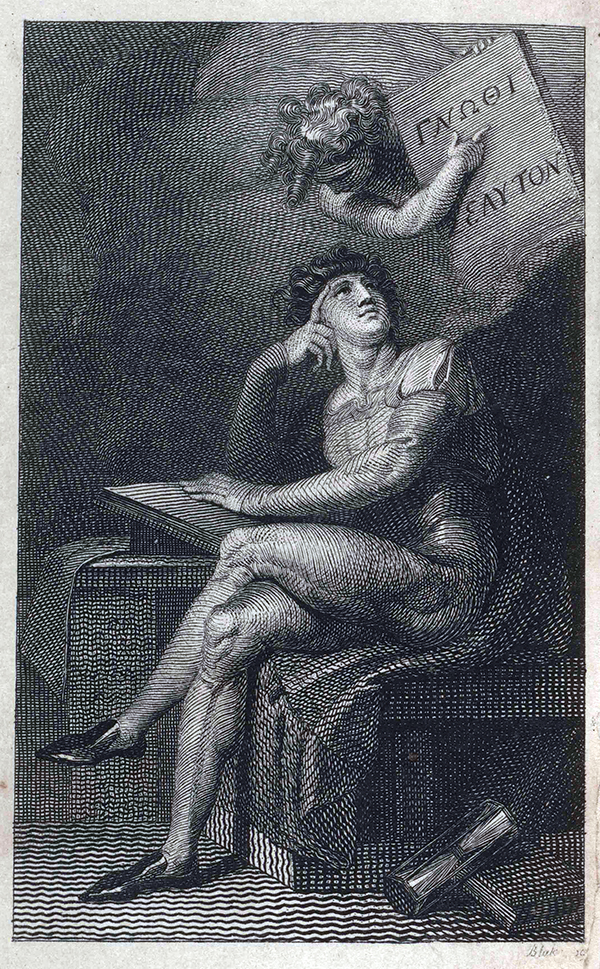
It is important to remember that Fuseli and Lavater were not the only collaborators in the production of Aphorisms on Man. Bringing the book into the hands of English readers required a small team of skilled laborers. The radical publisher Joseph Johnson directed the enterprise, which relied on different trades, including papermakers, printers, binders, and engravers, among others. The focus of this section is on one such engraver, William Blake, for whom the book unusually collapsed divisions between the personal and the professional. He was already a peripheral member of the Johnson circle when he was commissioned to engrave the frontispiece (illus. 8), having received his first contract from the publisher in 1780.This commissioned plate was for the fifth edition of William Enfield’s The Speaker (1780). There is no record of when or where he and Fuseli first met, but they probably crossed paths around that time, when Fuseli moved to no. 1 Broad Street, close to Blake’s family residence at no. 28.For more on the artistic community living in the vicinity of Broad Street, see Martin Myrone, “‘Blake Be an Artist!,’” William Blake, ed. Martin Myrone and Amy Concannon (London: Tate Publishing, 2019) 27-28. We do know that they did not begin working together until the late 1780s, a moment that Blake later qualified poetically as a time when Fuseli had been given to him for a season.Letter from Blake to John Flaxman, 12 September 1800 (E 707).
Scholars have long been fascinated with their relationship. Upon discovering the preliminary drawing for the frontispiece to Aphorisms on Man (illus. 9), Ruthven Todd wondered why Fuseli had left “so much to the imagination of the engraver” in a book to which he had given “so much of himself.”Todd 174. Todd was describing the “liberties” that Fuseli had taken in the process of translation. Mirroring his own free negotiations with the original manuscript, Fuseli invited Blake to rework his drawing. Why allow a man then known only as a commercial engraver to perform his own transformation? The question is a good one, especially given how inimical Fuseli could be to engravers who worked on his designs during this period. In a biting letter to William Roscoe penned in 1796, for example, he voices his displeasure with “one Mr. Thomson,” an engraver to whom a painting of his had been assigned without his consent: He may be a Man of talents, and if he is not, I Care not, for as Your friend Politian Says, the Length of the Shadow makes no alteration in the hig[h]th of the Man. Nor will I Say any thing about the Credit they force me to give them. … All, the best Engraver Can do, is, to mar Your work and empty Your pocket.Letter from Fuseli to Roscoe, 14 September 1796 (Weinglass, Collected English Letters 160-62). Fuseli casts engravers as inconvenient middlemen who not only profit from but actually render a disservice to artists. In 1798, it was the engraver Moses Haughton who troubled him. Fuseli suggested that Haughton might have done more justice to his drawing The Nurse, designed as the frontispiece to Roscoe’s translation of a poem by Luigi Tansillo. “It is done with more freedom than taste,” he complained, “and with more assurance than penetration or Amore …. It wants much more finishing to front Your work with propriety—or to be intitled to the pompous Fecit under it.”Letter from Fuseli to Roscoe, 17 August 1798 (Weinglass, Collected English Letters 187); Weinglass corrects his original attribution from Matthew Haughton to Moses Haughton in his Prints and Engraved Illustrations 186-87. In both cases, Fuseli questioned whether engravers deserved credit for their efforts.In another dramatic disavowal, Fuseli renounced authorship of the engravings after his work that appeared in the German and French editions of Essays on Physiognomy. Advising his cousin, who wanted to publish a book after his work in the style of Flaxman’s outline drawings, he bade him avoid republishing those “disgusting things in Lavater’s physiognomies that he claims are copies after me.” The only designs that he acknowledged as his own were those that he personally reworked and saw printed in the English edition of Essays. See the letter from Fuseli to Heinrich Füssli (his cousin) dated 1805, quoted in Weinglass, Prints and Engraved Illustrations 320. Haughton, it seems, failed to appease. Roscoe printed his translation without the engraving, a choice that Fuseli later thanked him for, since Haughton had “travestied” his figures.Weinglass, Collected English Letters 192. Haughton would later win Fuseli’s approval, managing to balance those qualities that his employer valued most in an engraver, “fidelity, diligence and taste,” but only, it seems, when he began working under close supervision.Letter from Fuseli to Roscoe, 20 August 1802 (Weinglass, Collected English Letters 250, 263-64).
As Robert Essick has argued, this hierarchical dynamic between artists and engravers was predetermined by the market: Certainly it was an activity demanding disciplined skill, but reproductive engraving was dependent upon a rigorous division of labour and the subordination of individual expression to uniformity and repeatability. All illustrations in a book had to conform to its format, and this mechanical unity was extended to graphic style. If more than one engraver was employed, all had to practise compatible techniques. In spite of an engraver’s prerogative to “sign” his plates, the truly autographic tended to be submerged beneath the anonymity of a corporate and systematic enterprise.Essick, Commercial Book Illustrations 5. Essick, like Fuseli, pinpoints a tension between engravers’ signatures and their claim to authorship. They may have signed their work, but they were rarely given much freedom of expression. Working with Fuseli and Johnson thus provided Blake with a rare opportunity to contribute his own ideas.For more on Johnson and Blake, see Erdman, Prophet against Empire 156-57. See also Hay 183-234 and Mee 16. Blake may not have been able to pursue his ambition to become a professional painter, assuming full membership of the Royal Academy as both John Flaxman and Fuseli had done once they had returned from Italy, but Johnson did support Blake as an author. He exhibited his illuminated books in his shop and later printed proofs of his poem The French Revolution (1791), although it was never formally published. Moreover, comparisons between Fuseli’s original drawings and Blake’s final engravings suggest that Blake had more input than one would expect of an engraver. Exactly how much of the detail he worked out on his own is difficult to determine in any of their several collaborative plates. This is especially true for the frontispiece to Aphorisms on Man, for which there is no extant intermediate drawing. However, visual analysis can provide important clues toward determining his artistic agency.
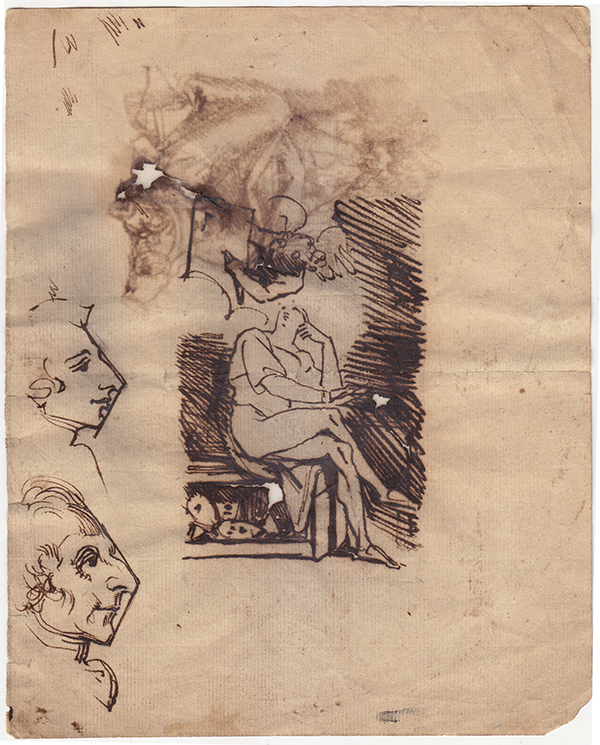
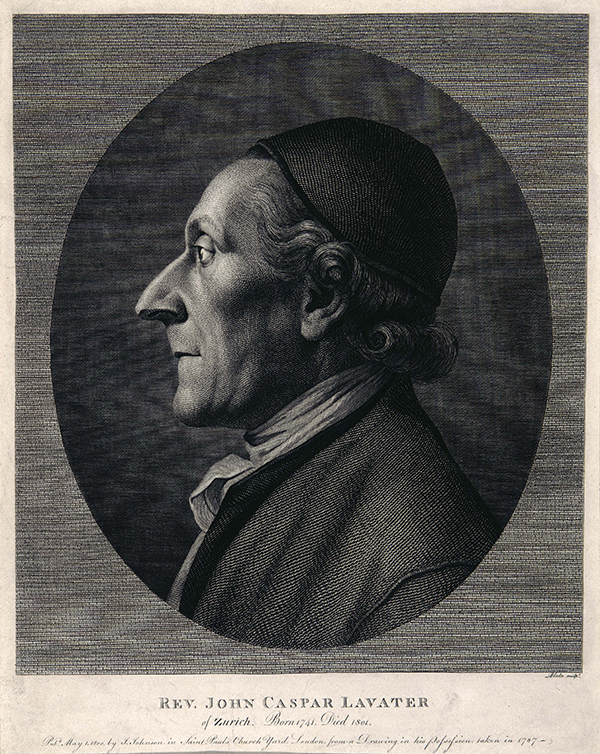
Fuseli’s drawing illustrates a moment of contemplation and composition. The seated male figure rests his right hand on his writing table and supports his head with his left. With one index finger extending across his temple, he turns to look up. There, a winged cherub holds aloft a tablet inscribed with the Greek letter Γ (gamma). In the left margin, independent of this composition, two profiles have been delineated, each with a measured line that reaches from expansive forehead to pointed chin. These heads contend with physiognomy in its most basic form. Challenging our confidence in the power of an image to communicate anatomical precision, however, is the fact that neither of the faces is distinctly recognizable. Impeding our efforts further, their resemblance and the intervening lines invite comparison. Is this the same individual shown in different life stages, or is one the author and the other the translator?Essick speculates as to the identities of the heads and their physiognomic relationship to the seated figure (whose ambiguous identity he remains open to). He writes, “Thus, the seated figure represents Lavater composing his aphorisms—and perhaps also Fuseli in the act of translating and editing his friend’s words” (Commercial Book Illustrations 40). Scholars have wondered if the older profile could be Lavater and the younger Fuseli. Meanwhile, Sibylle Erle has suggested that the similarities between them—made explicit through the addition of triangulating lines—indicate their shared vision.Erle, Blake, Lavater and Physiognomy 102. But a closer look at the hooked nose of the lower profile discloses an important difference. If compared with a portrait of Lavater that Blake was working on around the same time, it does not coincide with the “almost imperceptible arch” of the “ferret nose” for which he was known (illus. 10).Essick dates the first state of this engraving to 1787 (Separate Plates 150). It should be noted that Blake never met Lavater and would have been working from a likeness. The letter from Heisch to Lavater in which he mentions Fuseli’s choice of aphorisms (see note 15) suggests that the engraving might have been intended for the book, or otherwise as promotional material: “Your rules / Aphorism of men / are translated, from the 1000 about 700 were selected. I really liked what I saw of it. This also applies to the copperplate engraving of you, for which the drawing at Hofham served as the original.” (Deine Regeln / Aphorism of men / sind übersetzt, aus der 1000 ungefehr 700 ausgesucht. Was ich davon sah gefiel mir sehr. So auch der Kupferstich von dir, wozu die zeichnung bei Hofham als Original gedient hat.) Neither does the angularity of the chin match the squareness of his jaw. These small departures may seem insignificant, but attention to minutiae was the basis of physiognomy. In any case, Blake selects a younger model for the frontispiece, who, even if he shares features with the upper profile, nonetheless resists easy identification.
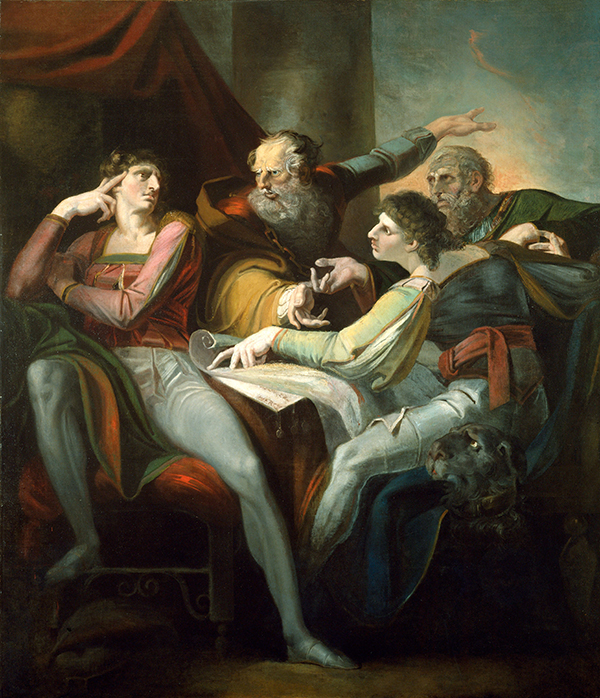
Reading the figure in the frontispiece as one of the profiles assumes that physiognomy is at work in the final engraving. Given the use of measured lines (a physiognomic method), this seems right, but what if the design has been leading us in the wrong direction? As the debates over the Essays show, physiognomy occupied a middle ground between the empirical demands of science and the aesthetic concerns of art. What if Blake opted for the latter, choosing to emphasize artistic quirks instead of facial ones? Put another way, what if Blake “pictures” one of the authors, in this case Fuseli, through means other than portraiture? The composition, for example, recalls a series of paintings and drawings that Fuseli made in the late 1770s and early 1780s featuring male figures in pensive postures.Both Weinglass and Hall have noted these similarities. See Schiff nos. 560-63. While the rough drawing provided the basic compositional structure, Blake may have drawn details from other sources, including Fuseli’s Dispute between Hotspur, Glendower, Mortimer, and Worcester (illus. 11).
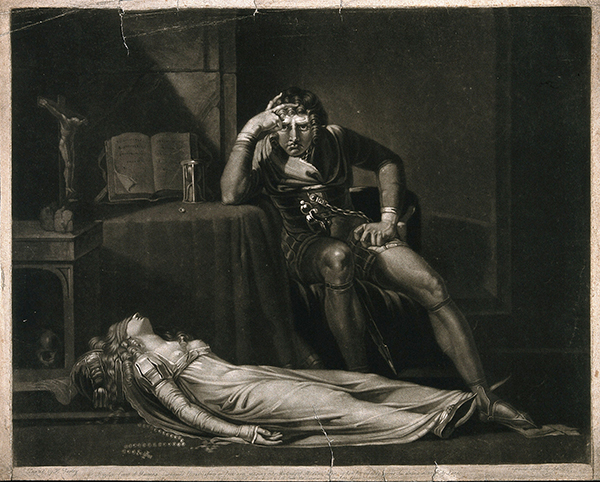
Readers noticed this correspondence. In addition to commenting on the superior quality of Blake’s engraving compared to the “general run of frontispieces” found in most books, one reviewer stated that “the drawing seems to be in the style of Fuseli.”English Review; or, An Abstract of English and Foreign Literature 13 (1789): 121-23 (on 123). This observation would be remarkable if Blake had worked up the final engraving from the drawing alone. Of course, it is possible that Fuseli made a second, more finished drawing that is now lost, or otherwise gave Blake detailed instructions. However, further collaborations do suggest that the pair worked on more equal terms than was usual for the industry.Todd 175. Todd makes the same case for Blake’s engraving of Michelangelo after Fuseli, which, he argues, was based on a rough sketch and worked up by Blake. There is, however, evidence to suggest that Fuseli may have made equally rough drawings for other engravers. Weinglass points out that he gave John June a very rudimentary drawing for the plate of David and Goliath as published in Willoughby’s Practical Family Bible (1772). The drawing, now preserved in the Swedish National Museum, is significantly different from the final plate. See Weinglass, Prints and Engraved Illustrations 90-91. Take, for example, Blake’s wash drawing of Fertilization of Egypt, now in the collection of the British Museum, which appears to mediate between a very rough line drawing by Fuseli and his own polished engraving as published in Erasmus Darwin’s The Botanic Garden (1791). This evidence is especially telling, since the figure of the rain god, barely discernible in the Fuseli, assumes Urizenic features in the print.Roe 160, 174. More recently, Martin Priestman has suggested that Fuseli’s role remained “embryonic” and that “a great deal of the final picture’s detail is purely the work of … William Blake” (105). Essick and Rosamund A. Paice survey the debate over the artists’ respective contributions and propose that the sketch of a sistrum on the verso of Fuseli’s drawing was added by Blake (88). John Beer and Susan Matthews have convincingly taken the middle path and argued that the engraving reflects an active dialogue between the artists (Beer 35, 38; Matthews 45-47). It suggests, at the very least, a reciprocity of ideas (between Blake and Fuseli as well as Blake in his different professional roles), even if it cannot confirm that the designer and engraver were creative partners. One final clue that Blake may have shaped the design for Aphorisms on Man is found further afield, in his own work. He had at least enough claim to the composition to repurpose it for the frontispiece to his collection of poems Songs of Innocence (illus. 13), a work dated only one year later.Essick, Commercial Book Illustrations 41.
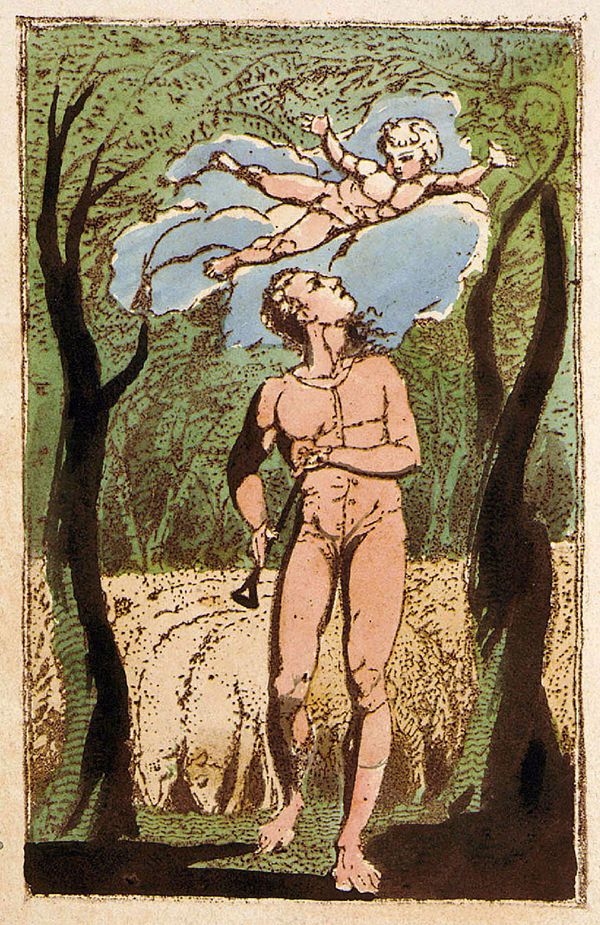
11 x 7 cm. Library of Congress, Lessing J. Rosenwald Collection, call no. PR4144.S6 1789b. Image courtesy of the William Blake Archive.
This position, which I share with Todd and others, means that the engraving traverses the same murky waters between fidelity and originality that Fuseli had to navigate in his role as translator. Just as we cannot be sure to what extent we read Fuseli or Lavater, neither can we confidently demarcate the boundary between Fuseli and his engraver. Moreover, it seems to me that Blake relishes the opportunity to outdo his colleague—challenging Fuseli using a borrowed visual vernacular. But how should this shape our reading of the image, or indeed the book? One enticing path forward is to embrace the authorial ambiguity that the frontispiece supports visually.
For this reading to work, we must first attend to the established frontispiece conventions that Blake subverts. His singular male protagonist, for example, is strongly reminiscent of an evangelist shown in the act of penning his gospel. Caravaggio’s The Inspiration of Saint Matthew or Michelangelo’s prophet Isaiah on the Sistine Chapel ceiling are familiar early modern variations of the medieval iconographic formula that usually also featured an “angel as a spectacular apparition emerging from heaven at a distance above and behind.”Lavin 79. Fuseli made a drawing after Michelangelo’s prophet between 1776 and 1778. See Schiff no. 672. Such portraits visualized divine intervention in the creative act. The angel in the frontispiece, together with the epigraph on the title page (“è cœlo descendit γνωθι σεαυτον” [It descended from heaven Know thyself]), confirms that divine power is operative here too. But thereafter Blake departs from canonical sources by depicting his “author” without a quill or pen. The male figure lays his free hand flat on the surface before him. If we take into consideration the collaborative nature of Aphorisms on Man, it is perhaps intentional that the frontispiece is equivocal. The figure could be the author, the translator, the engraver, or all three at once, since each had a hand in the making of the book. In this way, the frontispiece can be said to welcome the same intellectual exercise required of the aphorisms themselves.Fuseli explained to his biographer Knowles “that an aphorism … ought not to contain its own explication” (Knowles 1: 160). It encourages the reader/viewer to pause and reassess initial assumptions.
With these frames in place, we can return to the details of the final engraving that Blake would have us consider more carefully. The hollow space below the seated figure is no longer filled with an assortment of artifacts resembling masks, cranial casts, or real human skulls, as in the drawing. Instead, it boasts the accoutrements of a library—a collection of tomes and an overturned hourglass. If the discarded accessories resemble the death masks that Lavater privileged as ideal evidence for physiognomic inquiry, Blake pursues a different theme. The books connote knowledge, but the blank page of the open volume insists on a specific kind: self-definition. One learns something of oneself, as per the inaugural maxim, through the active and introspective practices of close reading and thoughtful annotation. Remember that the final aphorism explicitly emboldens the reader to put pen or pencil to paper: “If you mean to know yourself, interline such of these aphorisms as affected you agreeably in reading, and set a mark to such as left a sense of uneasiness with you.” The importance placed on making known one’s ideas evokes the autobiographical practice of the Swiss-French philosophe Jean-Jacques Rousseau, whose work Fuseli admired. It also shifts emphasis from the legible surfaces of the body to the invisible contours of the mind. Whereas Lavater argued that the profile portrait offered unmediated access to the sitter it represented, Rousseau conceptualized it as a tool of concealment.MacCannell 286; Rousseau, “Préambule du manuscrit de Neufchâtel,” Œuvres complètes 1: 1149-50. Profiles, after all, reveal only one half of the face. Instead, Rousseau believed in bringing a true and distinct self into focus through a conscious exploration of his thoughts in writing. The reader/viewers of Aphorisms on Man were similarly equipped to emerge from the experience knowing their own minds.Both Erdman (E 883) and Erle (Blake, Lavater and Physiognomy 116) note the emphasis that the book places on self-awareness. This interpretation opens up another possibility for the pensive youth. As a neoclassical ideal, he is a candidate for the superlative anonym—an allegory of the self. He is the very self that readers discovered through their intimate engagement with the book.
Reading: Dissenting in the Margins
The material nature of Aphorisms on Man supports the idea that the book functioned as an exercise in self-discovery. Its wide margins and the generous space between aphorisms allowed not only for simple marks but also for the kind of discursive annotation contained in Blake’s personal copy, now in the collection of the Huntington Library. Its small format (octavo) made it exceptionally mobile; it could be set on a bedside table or carried in a pocket. As one contemporary reviewer asserted, it was also a book that wanted to be read more than once.Critical Review: or, Annals of Literature 66 (July-December 1788): 141-43. We know that Blake returned to it several times, since his annotations cross-reference each other.Earlier notes that address later ones could only have been written during secondary readings. See Erle, “Leaving Their Mark” 358. Other evidence, such as staining and damage, implies that it was well loved by him, if not also lent to friends.A note written by a subsequent owner, Robert Hoe, is pasted on the front flyleaf: “This copy which was Blake’s, had to be rebound; it was in broken Sheepskin, & more than dirty.” The book was rebound in ochre morocco by R. W. Smith and finished by F. Mansell (Essick, Huntington Collections 182; E 883). The latter is speculative, but taking seriously the prospect that he shared his copy returns us to the question of self-presentation. Blake was not alone in responding to the book as instructed; many copies of Aphorisms on Man contain marks.See, for example, copies held at Rare Books and Special Collections at McGill University, the Hanna Holborn Gray Special Collections Research Center at the University of Chicago, Harvard University Library, the Getty Research Institute, and the Wellcome Collection. The copy at McGill (Blake 2.1 L3A6 1789), which belonged to John Sherwen (M.D., Member of the Royal College of Physicians, also of the Royal College of Surgeons and corresponding member of the Medical Society of London), contains underlined words, lines, curly brackets (braces), x notations, and notes written in pencil and black pen by different hands. It should be noted that no other copy that I have encountered is as wonderfully discursive as Blake’s. Neither was this unusual. Writing marginalia was common in the eighteenth century, and as one scholar has demonstrated, handwritten notes were “identified with named individuals (normally the owners of the books) and understood to reflect their personal views.”Jackson 60. This is consistent with Aphorisms on Man. Blake inscribed his name twice (once below that of Lavater and once on the flyleaf); other copies of the book, including many of those listed above, contain the names of their owners. See also Bloom 84-85. Thus scholars have increasingly turned to Blake’s annotations as a means to access his ideas. Scott Juengel, for example, compellingly argues that the marginalia register “the minute calibrations of his [Blake’s] critical sympathy and retreat as if annotation were a viable substitute for the conversable world” (707). Crucial here is the fact that Blake addresses a reader or a community of readers. The implication of the command “and then shew your copy to whom you please” (Aphorisms 224) is that once complete with manuscript notes, Aphorisms on Man became a “portrait” of its owner—intelligible to others.Hall makes a similar observation, stating that the book functioned as a vade-mecum that provided “an instant psychological profile of the reader” (135). Apprehending the book as a literary equivalent of a self-portrait reminds us that the image is mediated—that it cannot provide perfect “access to a ‘real’ Blake” or any reader.Snart, “Recentering” 137. Nonetheless, it is fair to assume that the marginalia illuminate something of Blake’s thought, especially concerning social relations.
Insofar as the book allows us to better understand Blake, we can also invert the lens and use Blake to further explore the authorial complexities of Aphorisms on Man.See Snart, The Torn Book 22-23. There is evidence to suggest that Blake invited others to contribute to his unfolding conversation with Fuseli and Lavater on its pages. He wrote most of his annotations horizontally in black ink, prompting speculation that notes written otherwise may be those of another reader. For example, the word “Admirable!” is written vertically in pencil in the margin on page 10 beside aphorism 20, a deviation that could indicate a different hand. Similarly, “no fumbler kisses” next to aphorism 503 on page 169 is written clumsily with a dull pencil, suggesting the same. The pencil lines through aphorism 287 on page 101, the word “unsophisticated” underneath, and the ochre ink that appears next to aphorisms 21 (“See 384”) and 384 (“See 20 & 21”) pose more difficulty. The handwriting is like Blake’s elsewhere in the book, so it may be that he wrote these later using a different pen (or pencil).E 883. For a discussion of Blake’s annotating practices, see Snart, “Recentering” 141, 145-46. Although we are not able to determine who may have read the book and when, these clues substantiate the theory that he extended the call to annotate among friends; in other words, that he solicited new voices—new authorial rivals.Erle stresses the collaborative nature of reading (“Leaving Their Mark” 358).
Blake is likely to have received his copy between May and July 1788 (E 883). He must have begun annotating it in its unbound state, since his notes run deep into the inner margins and appear as offsets on pages remote from their original placement. While he finds many of the aphorisms agreeable, underlining liberally and praising those that strike him as true using exclamations such as “Most Excellent” and “Pure gold,” he also asserts himself when he disagrees, judging specific aphorisms “false” or observing that they make him feel “very uneasy.” Some of the aphorisms produce more complex responses, especially those that make him uncomfortable because he finds them to be true, such as no. 518, “You may have hot enemies without having a warm friend; but not a fervid friend without a bitter enemy. The qualities of your friends will be those of your enemies: cold friends, cold enemies—half friends, half enemies—fervid enemies, warm friends,” to which he responds with an X and “very Uneasy indeed but truth.” He had learned this from personal experience; his enmities burned as brightly as his friendships. In addition to his discursive engagement, Blake also read with an editorial eye. He corrects small typographical errors, like those noted on the errata page, and revises aphorisms based on his own ideas. An interesting example is no. 549, where he substitutes antonyms: “He, who hates [loves] the wisest and best of men, hates [loves] the Father of men; for where is the Father of men to be seen but in the most perfect of his children?” Reinforcing his position, he responds in the margin with “This is true worship.” Although the meaning remains unchanged—that we find god in the best of humankind irrespective of whether we love or hate our fellow mortals—it is love that makes the recognition of the divine in man the basis of true worship. The change is subtle, but it encapsulates what Blake seeks to accomplish with his marginalia. Transforming the page into “a site of contestable authority,” as Jason Snart has argued, he critiques Fuseli’s Lavater while at the same time establishing common philosophical ground.Snart, “Recentering” 137. One must locate unisons and discords with others in order to know and better oneself.
Finally, Blake’s thoughts are not limited by what appears on the page, since he engages with his own ideas as expressed in other annotations and external sources. These intra- and intertextual connections create a rich countertext that leads the reader in directions that only Blake could determine. One annotation that speaks directly to his relationship with the book as a collaborator is found on page 7. Here, he underlines the concluding line of aphorism 14, “The object of your love is your God,” to which he responds, “This should be written in gold letters on our temples.” Erle has offered several interpretative pathways for the ambiguous line. The word “temple,” she ventures, “could mean church, in which case it would be a critique of the institution which neglected to tell believers [of the true nature of their religion], or it could mean forehead, in which case it would be an expression of moral character.”Erle, Blake, Lavater and Physiognomy 117. I find the former reading more compelling for its intertextual specificity. Pliny tells us that “Know thyself” was one of a series of maxims inscribed on the temple of Apollo at Delphi, “written in letters of gold.” Blake may be suggesting that “The object of your love is your God” is the modern equivalent of that ancient aphorism and should be carved on Christian churches in the same manner as the oracular truths on the temple of Apollo. If this is correct, he is also nodding to the Greek aphorism itself, which he could not but have discussed with Fuseli while engraving the frontispiece. Fuseli likely chose ΓΝΩΘΙ ΣΕΑΥΤΟΝ, since he provides the first letter in his drawing, but neither should we rule out the possibility that Blake proposed the idea.We should also consider the fact that Fuseli often chose Greek inscriptions to embellish his drawings (and, notably, for portraits of himself). Todd ventures that Fuseli provided the inscription, since Blake had no knowledge of Greek at this time (174). In any case, his annotations suggest more than a casual engagement with the aphorisms. In many ways, Blake assumes the responsibility of the ideal reader, modeling the critical engagement that Fuseli envisioned when he wrote his concluding aphorism as a command.
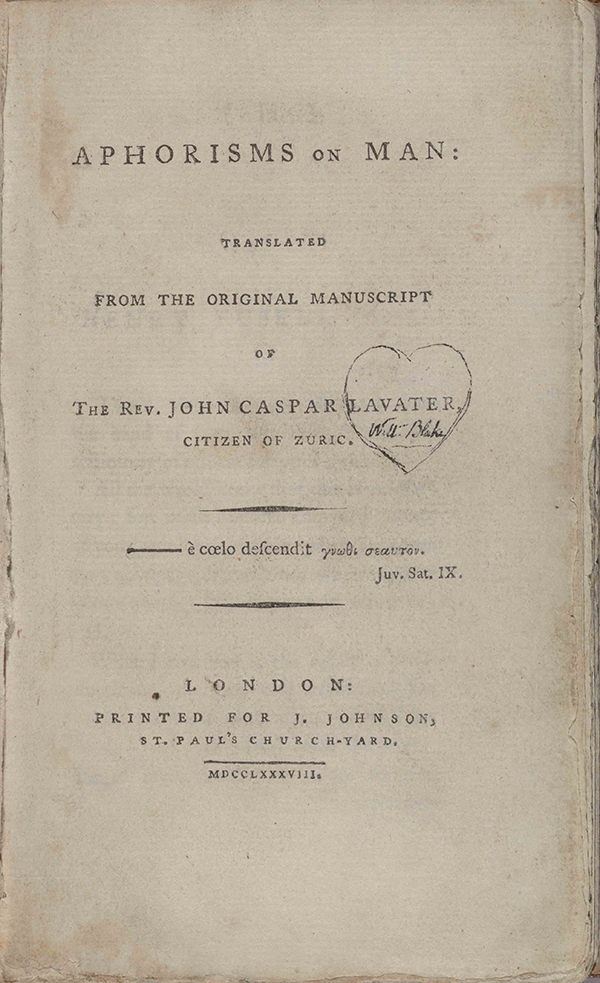
Finally, it is important to emphasize that Blake’s revisions and critical comments do not indicate that he found Aphorisms on Man to be unsuccessful. Rather, they suggest that, like Fuseli, he thought to improve it.Like Fuseli, Blake exceeded his revisions and went on to pen his own aphorisms, “Proverbs of Hell.” See Essick, Commercial Book Illustrations 41; Erle, “Leaving Their Mark” 351; Hall 136. On the last printed page, he justified his comments in these exact terms: “I hope no one will call what I have written cavilling because he may think my remarks of small consequence For I write from the warmth of my heart. & cannot resist the impulse I feel to rectify what I think false in a book I love so much. & approve so generally” (p. 224). He expressed his admiration even further by inscribing his name on the title page below that of Lavater, enclosing them together inside a heart (illus. 14).
Conclusion
In calling upon its reader/viewers to focus on their thoughts in the private act of reading, Aphorisms on Man may be understood as participating in a broader psychosociological shift. As Dror Wahrman has argued, those once predisposed to resist self-scrutiny began to look inward at exactly this moment in the late eighteenth century. Aphorisms on Man aligns with the new identity regime that Wahrman describes as emerging in tandem with Romanticism to the degree that it privileges “the characterization of self in terms of psychological depth; the emphasis on human difference and individuality; the rekindled interest in innate, intuitive, and instinctive traits or behaviors, [and] the developmental perspective on human growth.”Wahrman 290. As a novel interface between the self and others, the book functioned as an ideal terrain for elaborating modern selfhood. But, as I have argued, this was true not only for its reader/viewers, but also for its authors. It is only when we look closer at the working relationships behind Aphorisms on Man and other early modern translations like Essays on Physiognomy that we see the importance of rivalry as well as friendship. Shifting emphasis away from physiognomy, Fuseli used his translations as platforms to assert an authorial identity that complemented his artistic ambitions and rising professional stature. And, as if recognizing the authorial ambiguity already operative in his loose translation, he invited Blake to do the same with the frontispiece design. Although not radical in the usual political sense associated with books published under the auspices of Joseph Johnson, Aphorisms on Man bred its own critical form of dissent. Its contributors—author, translator, engraver, and readers—wrote or rewrote the book in their own images.
While “Designed to Promote the Knowledge and the Love of Mankind” in a similar spirit to the Essays, Aphorisms on Man ultimately pursued a different goal. Instead of proving formal relationships between internal and external traits, it invited readers to learn about themselves through the practices of reading and writing. It created, as it were, a portrait of the mind. Indeed, according to Alexander Gilchrist, “Blake showed his notes to Fuseli; who said one assuredly could read their writer’s character in them.”Gilchrist 1: 62. While I agree that the marginalia allow us to glimpse something of Blake’s philosophy, I propose that we examine his copy with the same prudence as Rousseau when faced with a profile—mindful of the fact that while it reproduces a likeness, it shows us only one side. Finally, a book as clever as Aphorisms on Man similarly prompts us to reconsider the limits of our own methodological frameworks. Turning it inside out to consider how it was made, as I have done, prompts new thinking about authorship in light of the ambiguities of translation.
Works Cited
Ackroyd, Peter. Blake: A Biography. 1995. New York: Ballantine Books, 1997.
Allentuck, Marcia. “Fuseli and Lavater: Physiognomical Theory and the Enlightenment.” Studies on Voltaire and the Eighteenth Century 55 (1967): 89-112.
———. “Fuseli’s Translations of Winckelmann: A Phase in the Rise of British Hellenism with an Aside on William Blake.” Studies in the Eighteenth Century II. Ed. R. F. Brissenden. Toronto: University of Toronto Press, 1973. 163-86.
Beer, John. Romantic Influences: Contemporary—Victorian—Modern. Basingstoke: Macmillan, 1993.
Bhabha, Homi K. The Location of Culture. 1994. Abingdon: Routledge, 2004.
Bloom, Harold. Blake’s Apocalypse. Garden City, NY: Doubleday, 1963.
Burke, Peter. “Cultures of Translation in Early Modern Europe.” Cultural Translation in Early Modern Europe. Ed. Peter Burke and R. Po-chia Hsia. Cambridge: Cambridge University Press, 2007. 7-38.
Erdman, David V. Blake: Prophet against Empire. 2nd ed. Princeton: Princeton University Press, 1969.
———, ed. The Complete Poetry and Prose of William Blake. Newly rev. ed. New York: Anchor-Random House, 1988. [Abbreviated as E]
Erle, Sibylle. Blake, Lavater and Physiognomy. London: Legenda-Modern Humanities Research Association/Maney Publishing, 2010.
———. “Leaving Their Mark: Lavater, Fuseli and Blake’s Imprint on Aphorisms on Man.” Comparative Critical Studies 3.3 (2006): 347-69.
Essick, Robert N. The Separate Plates of William Blake: A Catalogue. Princeton: Princeton University Press, 1983.
———. William Blake’s Commercial Book Illustrations. Oxford: Clarendon Press, 1991.
———. The Works of William Blake in the Huntington Collections. San Marino: Huntington Library, 1985.
Essick, Robert N., and Rosamund A. Paice. “Newly Uncovered Blake Drawings in the British Museum.” Blake 37.3 (winter 2003–04): 84-100.
Federmann, Arnold. Johann Heinrich Füssli: Dichter und Maler, 1741–1825. Zürich: Orell Füssli Verlag, 1927.
Finsler, Georg. “Lavater in Amt und Privatleben.” Johann Caspar Lavater, 1741–1801: Denkschrift zur hundertsten Wiederkehr seines Todestages. Zürich: Stiftung von Schnyder von Wartensee/Commissionsverlag von Alb. Müller, 1902. 1-56.
Füssli, Heinrich. Briefe. Ed. Walter Muschg. Basel: Verlag Benno Schwabe, 1942.
Gilchrist, Alexander. Life of William Blake, with Selections from His Poems and Other Writings. 2nd ed. 2 vols. London: Macmillan and Co., 1880.
Graczyk, Annette. “Constructs of Life Forms in Lavater’s Physiognomy.” Life Forms in the Thinking of the Long Eighteenth Century. Ed. Keith Michael Baker and Jenna M. Gibbs. Toronto: University of Toronto Press, 2016. 153-78.
Graham, John. Lavater’s “Essays on Physiognomy”: A Study in the History of Ideas. Bern: Lang, 1979.
Hall, Carol Louise. Blake and Fuseli: A Study in the Transmission of Ideas. New York: Garland Publishing, 1985.
Hay, Daisy. Dinner with Joseph Johnson: Books and Friendship in a Revolutionary Age. Princeton: Princeton University Press, 2022.
Italiano, Federico. “The Dark Side: An Introduction.” The Dark Side of Translation. Ed. Federico Italiano. London: Routledge, 2020. 1-15.
Jackson, H. J. Marginalia: Readers Writing in Books. New Haven: Yale University Press, 2001.
Johns, Adrian. Piracy: The Intellectual Property Wars from Gutenberg to Gates. Chicago: University of Chicago Press, 2009.
Johnson, Mary Lynn. “Blake’s Engravings for Lavater’s Physiognomy: Overdue Credit to Chodowiecki, Schellenberg, and Lips.” Blake 38.2 (fall 2004): 52-74.
Jones, Colin. The Smile Revolution in Eighteenth-Century Paris. Oxford: Oxford University Press, 2014.
Juengel, Scott J. “William Blake’s Enemies.” SEL: Studies in English Literature, 1500–1900 58.3 (2018): 703-29.
Knowles, John. The Life and Writings of Henry Fuseli. 3 vols. London: Henry Colburn and Richard Bentley, 1831.
Lavater, Johann Caspar. Aphorisms on Man (1788 ): A Facsimile Reproduction of William Blake’s Copy of the First English Edition. Intro. R. J. Shroyer. Delmar, NY: Scholars’ Facsimiles, 1980.
———. Aphorisms on Man. Trans. Henry Fuseli. 2nd ed. London: Printed for J. Johnson, 1789.
———. Essays on Physiognomy, Designed to Promote the Knowledge and the Love of Mankind. 5 vols. London: Printed for John Murray, H. Hunter, and T. Holloway, 1789–98.
Lavin, Irving. “Divine Inspiration in Caravaggio’s Two St. Matthews.” Art Bulletin 56.1 (1974): 59-81.
MacCannell, Juliet Flower. “History and Self-Portrait in Rousseau’s Autobiography.” Studies in Romanticism 13.4 (1974): 279-98.
Matthews, Susan. Blake, Sexuality and Bourgeois Politeness. Cambridge: Cambridge University Press, 2011.
Mee, Jon. “Networks.” William Blake in Context. Ed. Sarah Haggarty. Cambridge: Cambridge University Press, 2019. 15-22.
Mee, Jon, and Sarah Haggarty. “Introduction.” Blake and Conflict. Ed. Sarah Haggarty and Jon Mee. Basingstoke: Palgrave Macmillan, 2009. 1-11.
Messina, Maria Grazia. “Shakespeare and the Sublime.” Shakespeare in Art. By Jane Martineau et al. London: Merrell, 2003. 61-95.
Mitchell, W. J. T. Picture Theory: Essays on Verbal and Visual Representation. Chicago: University of Chicago Press, 1994.
O’Rourke, Stephanie. “Fuseli’s Physiognomic Impressions.” Art, Science, and the Body in Early Romanticism. Cambridge: Cambridge University Press, 2022. 60-103.
Paley, Morton D. William Blake. Oxford: Phaidon Press; New York: E. P. Dutton, 1978.
Percival, Melissa. “Johann Caspar Lavater: Physiognomy and Connoisseurship.” Journal for Eighteenth-Century Studies 26.1 (2003): 77-90.
Percival, Melissa, and Graeme Tytler. Physiognomy in Profile: Lavater’s Impact on European Culture. Newark: University of Delaware Press, 2005.
Pop, Andrei. Antiquity, Theatre, and the Painting of Henry Fuseli. Oxford: Oxford University Press, 2015.
———. “Henry Fuseli: Greek Tragedy and Cultural Pluralism.” Art Bulletin 94.1 (2012): 78-98.
Porter, Martin. Windows of the Soul: The Art of Physiognomy in European Culture, 1470–1780. Oxford: Oxford University Press, 2005.
Priestman, Martin. “‘Fuseli’s Poetic Eye’: Prints and Impressions in Fuseli and Erasmus Darwin.” Romanticism and Illustration. Ed. Ian Haywood, Susan Matthews, and Mary L. Shannon. Cambridge: Cambridge University Press, 2019.
Regier, Alexander. Exorbitant Enlightenment. Oxford: Oxford University Press, 2018.
Roe, Albert S. “The Thunder of Egypt.” William Blake: Essays for S. Foster Damon. Ed. Alvin H. Rosenfeld. Providence: Brown University Press, 1969. 158-95.
Rousseau, Jean-Jacques. Œuvres complètes. Ed. Bernard Gagnebin and Marcel Raymond. Vol. 1. Paris: Gallimard, 1959.
Schiff, Gert. Johann Heinrich Füssli, 1741–1825. 2 vols. Zürich: Berichthaus, 1973.
Schroyer, Richard J. “The 1788 Publication Date of Lavater’s Aphorisms on Man.” Blake 11.1 (summer 1977): 23-26.
Snart, Jason. “Recentering Blake’s Marginalia.” Huntington Library Quarterly 66.1-2 (2003): 134-53.
———. The Torn Book: UnReading William Blake’s Marginalia. Selinsgrove: Susquehanna University Press, 2006.
Todd, Ruthven. “Two Blake Prints and Two Fuseli Drawings, with Some Possibly Pertinent Speculations.” Blake 5.3 (winter 1971–72): 173-81.
Wahrman, Dror. The Making of the Modern Self: Identity and Culture in Eighteenth-Century England. New Haven: Yale University Press, 2004.
Weinglass, David H., ed. The Collected English Letters of Henry Fuseli. Millwood, NY: Kraus International, 1982.
———. Prints and Engraved Illustrations by and after Henry Fuseli: A Catalogue Raisonné. Aldershot: Scolar Press, 1994.
Zachs, William. The First John Murray and the Late Eighteenth-Century London Book Trade. Oxford: Oxford University Press/British Academy, 1998.