Memories of David Bindman
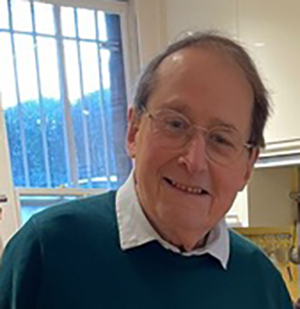
David Bindman and I first met during the summer of 1966. I was then doing research at the British Museum on Blake’s watercolors for Young’s Night Thoughts, and I went to hear a presentation by David at the Courtauld Institute. The subject was part of David’s doctoral dissertation on Blake’s art, then in progress under the sponsorship of the Courtauld’s director, Anthony Blunt, and his paper had to do with symmetry in Blake’s art c. 1800. While a graduate student at Columbia University in 1959, I had attended Professor Blunt’s Bampton Lectures (published as The Art of William Blake), and this had made me aware that I needed to study art history further to continue to do the work that I intended. David’s luminous presentation reinforced that conviction.
David’s Blake as an Artist was published by Phaidon in 1977. Only the second general study of Blake’s art by a professional art historian (the first having been Blunt’s own), it was widely recognized as expanding and deepening its subject. Much of the Blake scholarship from the mid-twentieth century on was conducted by professors of English like myself, and our literary training in the analysis of symbolism led us to find iconography the most congenial part of art history. David’s approach included such elements as structure, style, color relations, and materials. In this instance it was revolutionary to apply traditional methods.
The revelation that Blunt had spied for the Soviet Union occurred during one of my research periods in London. It had been rumored that he was the “fourth man” in addition to the Cambridge spies Guy Burgess, Donald Maclean, and Kim Philby, known to have been Russian agents. In 1979, violating an agreement made fifteen years previously, the British government revealed his identity. David filled me in: British Intelligence had obtained military secrets about the invading Nazis’ battle plans against Britain’s Russian ally but would not share them with the Soviet government, and Blunt had provided the information the Russians needed. I got an idea of what the public reaction was like when on a flight to London after a trip to Paris I saw a tabloid rag with a headline screaming that Anthony Blunt had caused the execution of some fifty Dutch radio operators! It turned out that MI6 had, coincidentally, given a Dutch network the name “Operation Blunt,” and that this venture had been discovered by the Nazis, with murderous consequences. It had nothing at all to do with an art historian who was in the process of being ostracized by his profession. Blunt was stripped of his knighthood, deprived of his Cambridge fellowship, and expelled from the British Academy. In consultation with a young scholar to whom David had introduced me, I wrote a letter to the Times warning that the attempt to punish scholars through their academic institutions rather than courts of law was likely to go as badly in Britain as it had in my own country, but a Times editor informed me that no further correspondence on the subject would be published.
In 1982–83 David organized the exhibition William Blake: His Art and Times at the Yale Center for British Art and the Art Gallery of Ontario, with an impressive 192-page catalogue that gave due attention to the cultural and sociopolitical backgrounds of Blake’s art. David and I spent considerable time together at the ensuing conference in Toronto with our friends Bob Essick and Bo Lindberg, and what I most remember is how much fun it was. A poster advertising the conference displayed plate 7 of Urizen copy A (beginning “Los howld in a dismal stupor”), showing a contorted naked figure in flames, with bulging eyes and a mouth forming a horrified O. We pretended to imitate this facial expression and bodily posture in a group photograph that we gave to some of our colleagues. Sophomoric humor maybe, but a reminder that friendship with David always involved a lot of laughter.
David’s long association with the William Blake Trust culminated in his massive 1987 edition William Blake’s Illustrations of the Book of Job, to which he contributed a substantial essay. In 2024 he produced his final exhibition and catalogue, William Blake’s Universe, in collaboration with Esther Chadwick, at the Fitzwilliam Museum and the Hamburger Kunsthalle. Like his Hamburg exhibition almost fifty years previously, William Blake’s Universe gave considerable regard to German cultural connections, including displays and texts relating to Jacob Boehme, illustrator Dionysius Freher, and an artist on whom Boehme’s influence was profound, Philipp Otto Runge.
Interested in sculpture as well as painting, David published studies of the sculptors Roubiliac, Canova, and Thorvaldsen, as well as the introductory European Sculpture from Bernini to Rodin. His John Flaxman exhibitions and catalogues (Royal Academy 1979, Sir John Soane’s Museum 2006) led me to a greater appreciation of Flaxman’s brilliance as a designer, and he also introduced me to University College’s marvelous collection of plaster casts of Flaxman sculptures and drawings.
This short account has hardly done justice to David’s profound work on Blake and his contemporaries, let alone to his extensive other scholarly interests, but it should at least be mentioned that he collaborated with Henry Louis Gates, Jr., on the multivolume Image of the Black in Western Art, published from 2010 on, expanding on the volumes published previously from 1976 to 1989. Just a month before he died, David had been putting finishing touches to his final volume, The Image of Nubia, co-edited with Rita Freed.
The diversity and depth of his research made him a great scholar. Nothing could have made him a greater friend.