1. Introduction
[1.1] Greetings Gentle Viewers! Just as Laura Hollis (Elise Bauman), a first-year journalism student at Silas University, invites you into her life as part of the affective landscape of the web series Carmilla, I would like to invite you into a part of my life. I discovered Carmilla as a young lesbian doing her undergraduate degree in a liberal arts university in Pune, India. YouTube's algorithm suggested that I watch Carmilla because I was rapidly consuming lesbian content at the time. While being an active part of the Carmilla fandom, I could not help but wonder what drew me and other fans of the series to have such intense feelings about these characters and their stories. The chance to explore the answers to the question I posed then has come now; through this essay, I argue that the online Carmilla fandom can be understood as a lesbian community of feeling based on the exchange of positive and negative affects.
[1.2] Carmilla is a contemporary adaptation of Joseph Sheridan Le Fanu's 1872 novella of the same name. The series follows human Laura Hollis, her vampire lover Carmilla Karnstein (Natasha Negovanlis), and their group of friends—LaFontaine (Kaitlyn Alexander), Lola Perry (Annie Briggs), Wilson Kirsch (Matt O'Connor) and Danny Lawrence (Sharon Belle)—as they fight ancient gods, a hostile university administration, and other supernatural beings. Much of the online Carmilla fandom can be found on YouTube, Tumblr, and Archive of Our Own (AO3). YouTube hosts the series. Season one of Carmilla has approximately three and a half million views, season two has approximately two million views, and season three has approximately one million views. Each episode has around two to three thousand comments. On Tumblr, the #Carmilla tag is vast, diverse, and still, five years after the show's end, sees a handful of new posts every day. When the series was still running, the tag saw a few hundred new posts every day. That number plateaued for a while and then spiked again when the movie was released in 2017. On AO3, there are currently 6,079 in-progress or completed fan fics set within the Carmilla universe or featuring characters from the web series (as of July 27, 2020). The number of fan fics centred around Carmilla and Laura's romantic relationship (aka Hollstein) is 4,977 (as of July 27, 2020).
[1.3] Carmilla fans continue to be intensely dedicated to the series. The sustained power of the Carmilla fandom is exemplified in the first CarmillaCon which took place in Toronto on October 5 and 6, 2019. The con was the product of Carmilla fans coming together to host a convention dedicated to "the little web series that could"—a phrase often used by Carmilla fans to describe the series. The convention did not receive endorsement from any of the companies that produced the web series: Smokebomb Entertainment, Shaftesbury, or U by Kotex.
[1.4] Drawing on the work of media and gender studies scholars such as Alexander Cho (2015) and Ann Cvetkovich (2003, 2012), I argue that for Carmilla fans, YouTube, Tumblr, and AO3 enable the creation of affinity spaces and archives of lesbian feeling. Building on the conception of affect described by psychoanalytic theorist Teresa Brennan (2004), I claim that affect flows within the fandom. According to Brennan, affects are emotions that have an energetic dimension to them, in the sense that they can both enhance and deplete (3). Positive affects such as belonging enhance, while negative affects such as anxiety and anger deplete. Brennan argues that identities are formed based on a process called "othering" (12). This process involves unloading negative affects onto oppressed groups such as women and people of color. I argue that othering occurs in the Carmilla fandom through arguments around the character Danny Lawrence (Sharon Belle), a white human character who kills Mattie Belmonde (Sophia Walker), a Black vampire in season two. Here I will be engaging with the scholarship of fan studies scholars such Mel Stanfill (2019), Rukmini Pande (2018), Zina Hutton (2020), and Samira Nadkarni (2019), who argue that fandoms continue to be structured around whiteness.
[1.5] Online fan interaction on YouTube, Tumblr, and AO3 surrounding Danny and about other details of the show can be read through new media scholar Alexander Cho's (2015) description of Tumblr as an affinity space. Affinity spaces are social spaces, usually online, in which people bond over shared interests. Carmilla's online fan culture can also be understood as an archive of lesbian feeling—particularly AO3. According to lesbian scholar Ann Cvetkovich (2003), queer performance is central to the creation of lesbian publics because it brings bodies together. I interpret femslash fan fiction—and Carmilla fan fiction in particular—as a contemporary example of queer performance that creates communities through the process of being written, read, and discussed. While the term "femslash" covers all erotic relationships between women regardless of their sexual identities, I will be using the term in relation to fan fiction about canonical lesbian relationships, as in Carmilla's case. I argue that femslash fan fiction on AO3 can be understood as an archive of lesbian feelings because it makes relationships between women available to memory.
[1.6] In this essay I also explore the positive and negative affects exchanged within the online Carmilla fandom and show that they are integral to forming online lesbian communities of feeling. I would argue that an exchange of affect, as described by Brennan (2004), determines the boundaries of the Carmilla fandom as an affective community in terms of whose feelings are valid and whose are not and is therefore central to understanding the fandom as an archive of lesbian feeling. I will explore positive affects such as belonging, nostalgia, and happiness and the negative affects of isolation and silencing as they (both positive and negative affects) travel through the major platforms of YouTube, Tumblr, and AO3.
2. Affinity on YouTube, AO3 and Tumblr
[2.1] In this section I show how the formal qualities of the Carmilla series on YouTube and the structure of AO3 and Tumblr encourage shared affinities through the give and take of affect. Toward this end, I refer to scholarship on the vlog, affinity spaces, and participatory cultures.
[2.2] Carmilla's vlog-like episodes hosted on YouTube enable its comments section to act as an affinity space in which fans of the series partake in a transfer of affect, not only with each other but also with the characters. By uploading vlog-like episodes on YouTube, Carmilla situates its characters and viewers within the affective economy of YouTube. Fan and media scholar Louisa Ellen Stein argues that in YouTube's affective economy, success is determined by participation, interaction, and the sharing of supposedly authentic emotion (2015, 161). Film scholar Laura Horak argues that vlogs by trans youth generate powerful impressions of authenticity and intimacy through certain formal qualities: close framing, a private setting, direct address, and an amateurish style. Furthermore, she claims that these qualities make the subject come across as real and their statements as true (2014, 575). The character Laura is similarly framed in Carmilla: she faces the camera directly while sitting in her dorm room, thereby creating a sense of intimacy with the viewer, encouraging the audience to earnestly listen to her. Almost every Carmilla episode begins with Laura looking into the camera and greeting the viewer, mimicking the conventions of popular YouTube vlogs. Laura's monologues are clearly scripted, but her display of unabashed emotion when talking about her nightmares, heartbreaks, and frustrations while directly addressing the audience by looking into camera invites the viewer to form a bond with her and her friends.
[2.3] Within the world of the series, Laura records these vlogs as part of a journalism project, and often refers to the audience watching the Carmilla series as belonging to the audience that is watching her journalism project unfold. Therefore, when watching the series, we are hailed as Silas University students, which blurs the boundaries between real and fictional. For example, in episode 1.9 "Nancy Drew," Laura expresses gratification at having so many viewers. She says: "I can barely believe this…I mean when I put the videos up, I thought there might be a few of you out there who had seen the weird and wanted to help…But the fact that there are so many of you, I mean…I'm overwhelmed." When she says "you," she is evidently referring to her viewers within the world of the show but also, implicitly, the viewers of the show. The difference between these two audiences is that one is aware of the series being set in a fictional supernatural university and that episodes are uploaded onto the producer's channel while the other is a part of the fictional university and is watching Laura's vlogs over the Silas ethernet. However, an overlap occurs with the suggestion that both audiences are watching her videos at the same time.
[2.4] Laura encourages Carmilla viewers to express themselves by performing a series of complex, seemingly uncensored mix of emotions, including self-doubt and fear. Furthermore, some of these viewers go on to YouTube to give advice to characters in the comments section, perhaps because the vlog format is associated with real people who read comments on their videos and may incorporate some of their viewers' advice into their daily lives. One commenter, Sumithri Venketasubrmanian, calls Laura out, while supporting Carmilla's decision to break-up with her in the comments section of episode 2.15 "No Heroics." They write:
[2.5] The moment somebody tells you "if you really loved me you would…is that moment you should scoot on out of there. Nobody should tell you how to love them; you show your love and affection how you want to, and if they try to tell you how to do that, it's emotional manipulation and that's got no place in a healthy relationship. You go, Carmilla!
[2.6] This commentator is scolding Laura and supporting Carmilla as if they are real people and not fictional characters. When I first read this comment, I remember thinking "Maybe Laura will stumble across it and get a reality check." Fan studies scholar Veerle Van Steenhuyse argues that our exposure to a character's thoughts, emotions, and memories encourages us to construct a character's self as real and coherent and as a result we respond emotionally to that character's actions (2011). Thus, Carmilla's vlog-like episodes encourage its viewers to form strong affective relationships with its characters.
[2.7] The comments section on Carmilla episodes also creates an affinity space in that commenters not only bond over their shared interests in Carmilla but also in other media being consumed by Carmilla fans such as Buffy the Vampire Slayer (1997–2003), The L Word (2004–2009), Xena: Warrior Princess (1995–2001), and Adventure Time (2010–2018) (Keegan 2016; Ng and Russo 2017; Farr and Degroult 2008; Cameron 2017; Jane 2015). One comment with thirteen likes says "If you ship Bubblegum and Marceline from Adventure time…I'm pretty sure that you are going to like this. :3." Some commenters mention how other real vloggers, such as MilesChronicles, a trans YouTuber from Los Angeles, mentioned loving this series and that is why they decided to watch it. All of these references reflect a shared interest in queer media. They also introduce Carmilla fans to a variety of existing queer media.
[2.8] Just as Carmilla fans interact and share their various media affinities on the series' YouTube comments, similar fan interaction takes place on AO3. Fan interaction is built into the very structure of AO3—a free online archive of fan production—because the meaning of fan works resides as much in the social ties created by the exchange of narratives, the sharing of gossip, and the play with identity as it does with the words on the page. AO3 has been created and is run by fans and, according to their mission statement, is dedicated to preserving the history of fan works and fan culture (Riley 2015). Acafan Olivia Riley argues that several structural elements of AO3, from its search engine to its header format, allow fans to attribute meaning to fan fiction outside of the main text (36). She claims that tags, pairings, and warnings on a fic give the reader an idea of what to expect and a basic understanding of the content, which increases the pleasure one derives from the story. Many Carmilla fics have tags such as "ugh! I'm such a lesbian" or "Oops I'm gay." These tags gesture toward a story's outpouring of lesbian and gay feelings in the form of clichéd romances and intimacy. Furthermore, the larger community can add meaning to an author's work through the comments section. Here, the author can interact with readers and fans themselves can discuss future ideas for fan fic and elements of the story they liked or disliked.
[2.9] Fan interaction forms the basis of the concept of an affinity space. AO3 is an affinity space in which fans of the Carmilla series align with one another on the basis of a shared endeavor: writing, reading, and commenting on fan fiction. In the image below one can see a connection forming between multiple people through an exchange of positive affect over an in-progress, alternate universe (AU) Carmilla fic in which Carmilla is Laura's favorite author and a chance meeting leads to an intense romance (figure 1). As the commenters share their positive opinions, the author feels encouraged.
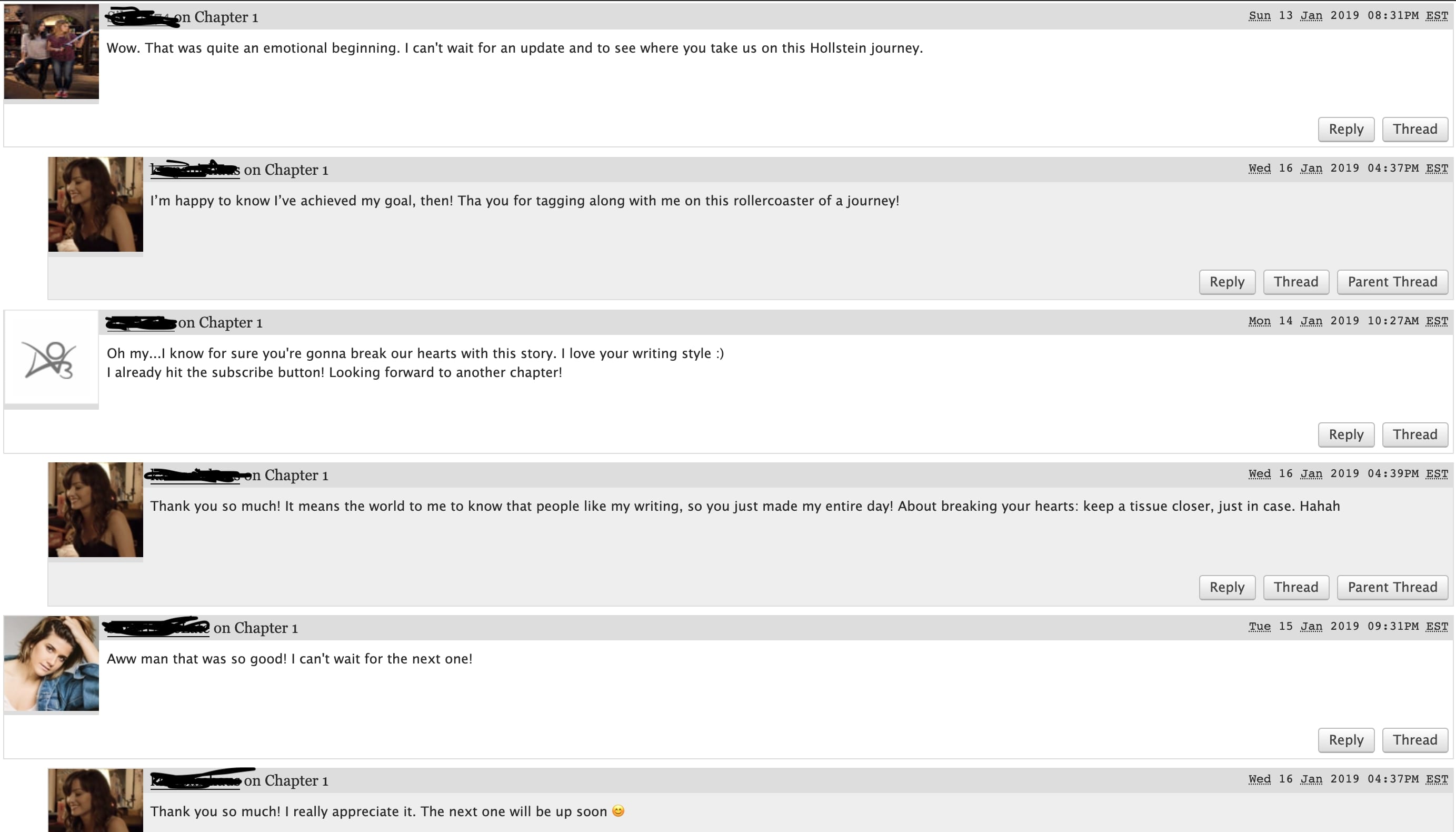
Figure 1. Exchanging positive affect.
[2.10] While it is impossible to determine the gender and sexuality of these fans, it is noteworthy that some of them have chosen avatars of lesbian characters from the Carmilla series. Avatars can be understood as visual embodiments of a user's identity in virtual environments (Carter, Gibbs, and Arnold 2012; Talamo and Ligorio 2001). Users interact with one another through their avatars and as a result develop relationships on the basis of shared interests. Social psychologists Alessandra Talamo and Beatrice Ligorio argue that avatars often reflect the multifaceted nature of identity by being purposefully chosen based on varied interests (2001). The writer's and commenters' affective investment in Carmilla and its fandom is reflected in the photos they have chosen for their avatars: one of Elise Bauman, the actor who plays Laura Hollis; one of Carmilla; and one featuring both Laura and Carmilla.
[2.11] These images also reflect the characters that these fans prioritize: the writer is clearly a fan of Carmilla's character, while the commenter with an image of Elise Bauman as their avatar may feel particularly connected to her real-life persona and the commenter with both Laura and Carmilla as their avatar is likely a Hollstein shipper. The reflection of affective investment through avatars and an exchange of positive affects via the comments section on a fan fic gesture toward an online space where affective flows construct an atmosphere of belonging. The writer and commenters have created a sense of belonging by validating each other's opinions and interpretations of the series and by choosing Carmilla-related avatars as an indication of their investment in the series.
[2.12] For Carmilla fans, Tumblr acts as both an affinity space and a participatory culture. Moreover, the act of reblogging intensifies affect across the site. Tumblr is a space that encourages the expression of fannish behaviors through images instead of text. Alexander Cho describes Tumblr as "image aggregation on steroids" (2015, 43). Tumblr pages are collections of posts that give the appearance of grand chaos because there is little to no text and because of the simplicity of the reblogging process.
[2.13] Cho describes the reblogging of images and text posts that have no relationship with one another as "a terrain of affinities speaking at a thousand miles a minute" (2015, 44). Queer Tumblr users flirt, circulate porn, and provide information on how to deal with homophobia and coming out to a conservative family. Users also share opinions and/or fan works about various fandoms and may edit the theme of their blogs to reflect their individuality. For example, one Tumblr blog dedicated to Carmilla is organized around Carmilla's colors, which are red and black—black because that is the character's favorite color and red because blood is her source of nutrition.
[2.14] Tumblr is host to a participatory culture dedicated to the creation of community artifacts. This emphasis on participation makes the #Carmilla tag on Tumblr an affinity space. Cho defines affinity as something that is influenced by lived bodily experience (2015). Two contrasting Tumblr blogs demonstrate how people with different personalities can be pulled together through the #Carmilla tag into a shared affinity space. These Carmilla fan blogs, "vampire" and "buttercup," which I have renamed for anonymity, are polar opposites of each other—the former exuding broodiness, while the latter has a very bubblegum aesthetic—but they are brought together by their shared love for Carmilla. The ways in which Tumblr brings together fans of different experiences and diverse interests aligns with fan scholars Alexis Lothian, Kristina Busse, and Robin Anne Reid's understanding of online fannish spaces as ever expanding, bringing together people across geographies, sexualities, gender identities, political spectrums, and neurodiversities (2007, 104). These varied experiences and consequently varied affinities contribute to the nonlinearity, incoherence, and impermanence of encounters on Tumblr.
[2.15] The intensity of affect builds on Tumblr though user practices of repetition—reblogging the same image at different points in time. For example, one particular meme about how fans feel about Carmilla's cliff-hangers has been reblogged at least 154 times by a variety of fans over approximately one year. The meme involves a heart beating at a normal pace while resting, beating slightly faster while exercising, and finally beating fast enough to come out of one's chest after watching a cliff-hanger at the end of an episode (figure 2).
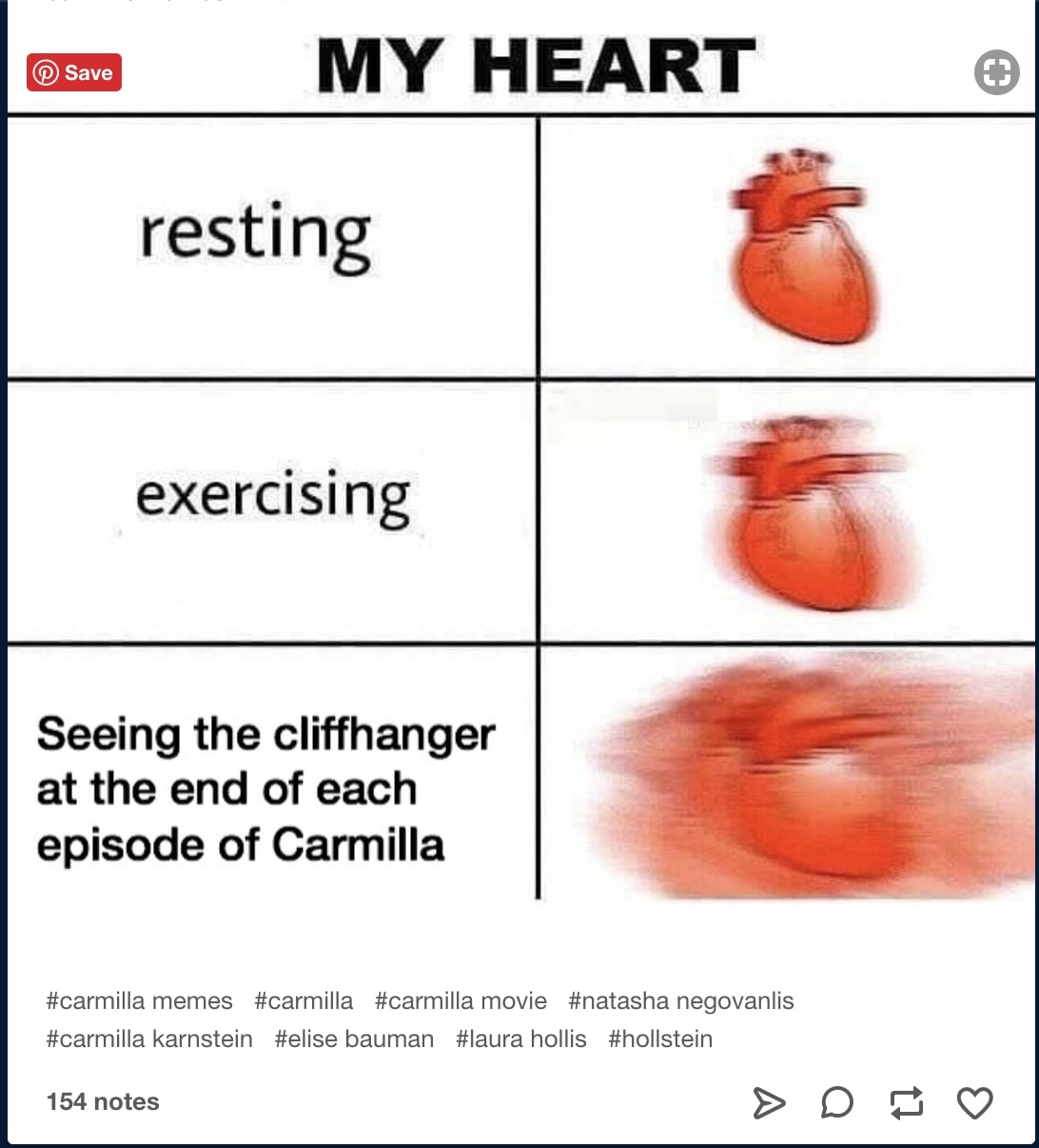
Figure 2. Beating heart meme.
[2.16] The continuous reblogging of this meme indicates how Carmilla fans may share certain feelings of anxiety when confronted with an episode of Carmilla that ends in a cliff-hanger. It is also a constant reminder of how we may feel while watching said cliff-hanger, which in my case was a looming sense of dread.
[2.17] Even the decision to reblog an image is submerged in affect that is based on affinity. Tumblr users often reblog posts that resonate with them—a post about Carmilla fans storming into Shaftesbury, the company that produced the series, to demand more Carmilla content has been reblogged a total of 350 times, indicating a shared desire by many in the Carmilla fandom to see a sequel to The Carmilla Movie. As a result, positive affects are able to travel through Tumblr because of its encouragement of reblogging content that speaks to varied experiences and interests. The Carmilla fandom benefits from this encouragement because it gives Carmilla fans the opportunity to express their intense engagement with the series by reblogging posts related to it.
[2.18] There are noticeable commonalities between the ways in which YouTube, AO3, and Tumblr act as affinity spaces in relation to the Carmilla series. Exchanges over comments, reblogging posts one resonates with, and sharing experiences with other common media being consumed is central to the creation and transfer of an affective intensity among Carmilla fans. These shared affects are often preserved on these sites, most visibly on YouTube and AO3, and can therefore be mined at a later date.
3. YouTube and AO3 as archives of lesbian feelings
[3.1] Here I explore Carmilla fan activity on YouTube and AO3 as an archive of lesbian feeling. In my discussion on AO3 I also refer to the performative and transformative aspects of femslash fan fiction.
[3.2] In her discussion of archives of lesbian feeling, Cvetkovich describes documentary films and videos as extensions of the traditional archive because of how the visual format makes visible documents that otherwise may have remained obscure. She claims that they use a primarily visual archive of popular culture in order to create archives of feeling (2003, 181). I argue that YouTube does something similar through thumbnails. Thumbnails are small still images from videos that aid in their recognition. The thumbnails that show up on one's YouTube homepage are related to videos one is currently watching or has previously watched.
[3.3] My YouTube homepage is an archive of my lesbian feelings, reflected by the assortment of tiny images on the screen. As a fervent consumer of lesbian and queer vlogs, all one can see on my homepage are images of women kissing each other, hugging each other, or staring at the camera teary-eyed while possibly recounting their coming-out stories (figure 3).
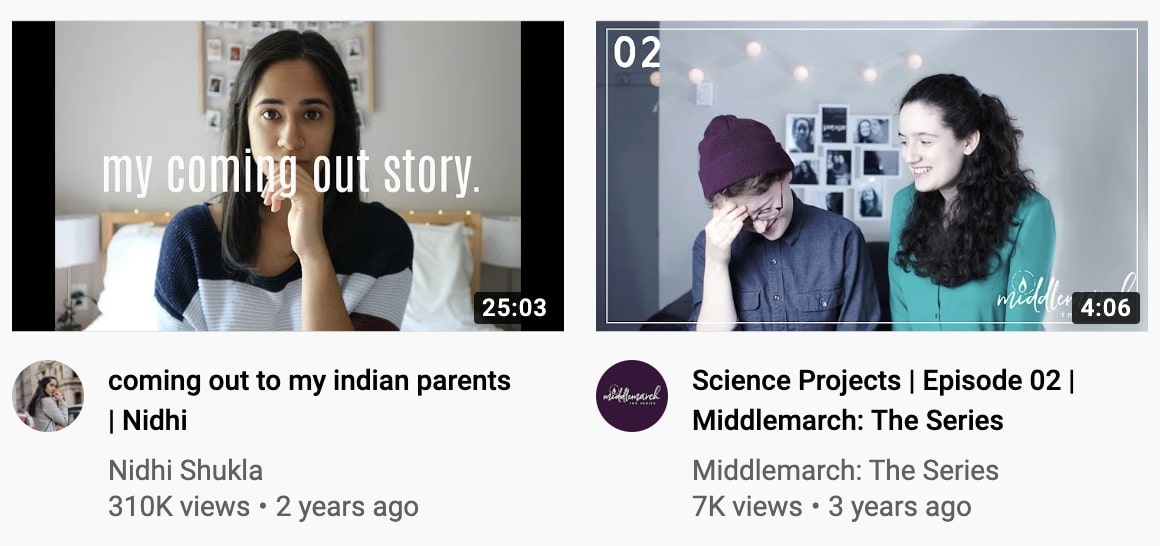
Figure 3. Screenshot of my YouTube recommendations (taken on March 27, 2020).
[3.4] Furthermore, the recommended section on YouTube is a conglomerate of video thumbnails I may otherwise have not found. YouTube is an archive of lesbian feelings not only because it hosts a range of lesbian content—including Carmilla—and its structure that allows us to search for videos we may want to watch but also because of the way in which it displays such content—through thumbnails that act as visual reference points to the subject matter being dealt with in the video.
[3.5] Femslash fan fiction on AO3 also functions as a digital archive of lesbian feelings. According to Cvetkovich, lesbian public cultures take sexuality outside of the bedroom and make private conversations about kinks, the butch-femme binary, and more the focus of collective conversations (2003). Femslash fan fiction represents sexual and romantic relationships between women and is at the centre of lesbian fan practices. In the tags on Carmilla fan fic, smut is a very popular genre. Fan fiction labeled smut usually involves an explicit sexual encounter among two or more people. In the comments, readers often disclose the ways in which they achieved a certain level of sexual satisfaction through the fic. For example, on an AU fan fiction titled "A Gardener, and a Student" in which Carmilla is Laura's family's gardener, reader mightywiz has commented "I think everyone is going to need a cold shower after that!!! Feel free to write as much of this as a you like :)." The response elicited in the reader through this fic is reminiscent of film scholar Linda Williams's argument that representing certain kinds of intense feelings, in this case sexual pleasure, prompts the body of the viewer (or reader) to respond in ways that mimic the feelings being depicted (1991, 4). Through a declaration of their need for a cold shower, this commentator is spurring conversation about lesbian sexual encounters.
[3.6] Angst with a happy ending is another genre of fan fiction popular within the Carmilla fandom—about 15 percent of Carmilla fan fiction on AO3 has this tag. This genre gives fan fiction authors room to explore elements in a relationship that cause characters to clash. For example, in "Still Falling For You" standardusername describes how Carmilla's penchant for running away from her problems and Laura's need to constantly be in control leads to the demise of their relationship. When they meet each other a few years later, they review everything that went wrong in their relationship, which prompts them to get back together after acknowledging that they both need to change. When they confront moments of heartbreak, we readers hurt with them as well. A comment by SpicyTaco on the second chapter of "Still Falling For You" states: "Pfff that hurt. In both good and bad ways. Your writing is so amazing…you truly make me experience every emotion they do. It's so agonizing and I can't wait to read more."
[3.7] Here too an exchange of affect is taking place, wherein the reader is reacting positively to the author's ability to make them empathize with the character. Being made to feel agonized can be cathartic. Cvetkovich argues something similar in her discussion of depression. She writes that while depression may manifest as inertia, in public cultures that encourage its expression, it can also be the foundation for new kinds of attachment (2012, 6). In the example mentioned in the previous paragraph, a bond is formed due to a transfer of affect on the basis of being hurt. Fan scholars writing about the hurt/comfort genre of fan fiction, such as Judith May Fathallah (2011, ¶ 3.2) and Elizabeth Woledge (2006, 111), claim that hurt/comfort fics—which involve a character in physical pain and/or emotional distress being cared for by another character—open up possibilities for writers and readers to explore a character's vulnerabilities through intimate relationships that are not solely sexual. As a result, these fics encourage a kind of radical empathy for our favorite characters. Similarly, angsty fan fiction that ends well is popular with readers because it gives us the chance to delve into well-detailed backstories and the characters' pain while knowing that everyone will eventually be happy.
[3.8] Such fics also make visible the complex entanglements shared by women in romantic or erstwhile romantic relationships. In making lesbian forms of being visible, AO3 also acts as a rogue archive. New media scholar Abigail De Kosnik defines rogue archives as online spaces that can be accessed by everyone without a paywall or any other institutional barriers, with content that can either be streamed or completely downloaded, wherein people can upload their work without fear of censorship (2016, 18). De Kosnik argues that online fan fiction archives are dedicated to proving that queer and female ways of being and creating exist and have always existed (17). AO3 embodies all of the characteristics of a rogue archive by being a fan-run, nonprofit, and noncommercial online archival space for all types of fan works. De Kosnik also provides another lens through which to view femslash fan fiction as an archive. She proposes that fans treat media itself as a type of archive, which they plunder to create new work and design virtual archives to store those works (11–12). Therefore, femslash fan fiction functions as an archive in two ways: by making lesbian sexuality public and by preserving the cultural memory of media works that fics have taken from and transformed.
[3.9] It is possible to map Cvetkovich's (2003) archive of lesbian feelings onto online spaces because she makes no mention that a public only refers to those congregated in physical spaces. In her discussion of what constitutes lesbian public cultures she refers to sexual acts, queer transnational publics, incest, AIDS activism, butch-femme discourse, and grassroots archives. Online public spaces allow for similar kinds of activism and the creation of archives, and they also afford those doing the activism and creating the archives a certain degree of anonymity. I argue that this affordance of anonymity differentiates the lesbian publics formed by femslash fan fiction from the lesbian publics discussed by Cvetkovich. The promise of anonymity online gives those still in the closet the confidence to participate in lesbian public cultures as well.
[3.10] Cvetkovich (2003) defines lesbian public cultures as counterpublics built around sex, feelings, and trauma. Femslash fandom is built around trauma because it can be a way of expressing one's sexuality without coming out in one's off-line life, which indicates a fear of not being accepted by friends and family. Additionally, looking for connections and validation online suggests that one may not be receiving enough affirmation in one's off-line life. Loneliness or feeling out of place in the spaces you inhabit is a kind of trauma. However, there are also lesbian fans whose experiences with femslash are not based on trauma but on joy and acceptance. Fan scholar Julie Levin Russo argues that while some fans may be drawn to femslash to explore and experience situations that would not happen in real life, many are drawn to femslash because it allows us to delve into sexual and romantic instances that we can experience (2017, 157). Carmilla's femslash fandom on AO3 can best be described, to paraphrase Cvetkovich, as a form of affective, erotic, and personal living that is public in the sense that it is accessible, available to memory, and sustained through the collective activity between fan fic author and reader (2003).
[3.11] Francesca Coppa describes fan fiction as akin to amateur theatre productions wherein authors guide characters' bodies through space via stories. Writers of fan fiction direct performances by relying on their audience's preexisting knowledge of sets and wardrobes, of the character's body, and their expressions and movements (2014, 236–7). Similarly, Cvetkovich (2003) emphasizes queer performance's ability to create publics by bringing bodies together in a particular space. Femslash fan fiction is also a performative space that brings bodies together online, one in which authors are given the opportunity to explore the potentialities not only of a fictional universe but also of their own bodies and identities.
[3.12] In keeping with Cvetkovich's (2003) idea of queer performance and its relationship to the building of counterpublics, I consider femslash fan fiction as a lesbian public built around feelings because it brings people together not only through the act of writing but also through the fannish gift economy and discussions that occur via the comments sections. And so, my final claim of this section is that femslash fan fiction, as cultural texts, are repositories of affect. These affects are not only encoded in the content of the text itself but also in the practices that surround their production and reception.
[3.13] By hosting lesbian content, displaying that content through thumbnails, and being home to countless femslash fan fics, YouTube and AO3 make visible queer forms of being that have always existed. As a result, when accessed by people who have been neglected and left out of the traditional archive, they encourage a sense of belonging.
4. Negative affect, race, and whiteness in Carmilla fandom
[4.1] I have loved Carmilla since the trailer for its first season aired. However, while watching the first season, two questions crept up on me: Why is the only character of color, Natalie (Lisa Truong), a minor character who is kidnapped during a wine-and-cheese party? Why is it otherwise a sea of just white? Scrolling through YouTube, Tumblr, and AO3, I was unable to find a single Carmilla fan that echoed my concerns, even though I am sure that some fans had the same feelings that I did. I, too, did not say anything online about the absence of queer characters of color on the show.
[4.2] Mel Stanfill writes that while the internet makes it possible for global fandoms to exist, the default assumption of fandom continues to be whiteness (2019, 24). The anonymity of Tumblr and AO3 gives voice to those who feel left out of public discourse but also reinforces the assumption that everyone who writes fan fiction or has a Tumblr blog is of a specific race and geography (white and North American), unless otherwise mentioned in the user's bio. In this section, I analyze how race is tackled within Carmilla itself and how an othering of certain fans across racial lines occurs within the online fandom. Toward this end, I will be engaging with episodes from the series, comments made by the writers and producers of the series during the Creator's Panel at CarmillaCon, comments on the YouTube episodes, and Tumblr posts.
[4.3] Three new characters of color were introduced in season two: Mattie Belmonde (Sophia Walker), a Black vampire antagonist; Mel (Nicole Stamp), a Black human who becomes one of Laura and Carmilla's helpers; and Theo (Shannon Kook), an Asian frat boy with a minor role. Mattie is Carmilla's sister in the sense that they were both raised by the same vampire mother. She is also the new chair of Silas University's board of directors. Her origins can be traced back to the novella. In the novella she is described as "a hideous black woman, with a sort of colored turban on her head…nodding and grinning derisively towards the ladies, with gleaming eyes and large white eyeballs, and her teeth set as if in fury" (Le Fanu 1872, 88). Her description in the novella is beast-like—she is a creature with little control over her base desires versus Carmilla who is a prim and proper countess of the night.
[4.4] Mattie retains none of those characteristics in the show besides her race. She is portrayed as intelligent, pragmatic, witty, and immensely fashionable. Jordan Hall, the white writer of the web series, says that she decided to introduce Mattie into the series because she saw an opportunity to intervene into a long history of white people's derogatory writing about people of color. On the Creators Panel at CarmillaCon in 2019, she said: "That moment when we found like that one little reference to Matska and I was like "Oh look! There's an actual character of color there, who is being treated horribly. How can we fix that?" Hall continued: "Just because some old Irish guy writes terrible things about you, doesn't necessarily mean you have to accept his story" (Hall et al. 2019). While she fuels Carmilla's vampiric nature and is apathetic to the lives of humans, Mattie also deeply cares about her sister. Throughout the series Carmilla and Mattie engage in small acts of physical and emotional intimacy. Her death in episode 2.30 "Co-Existence" is especially hard to watch because she does not die for any wrongdoing. She is killed by a white character on the basis of an alleged crime, encapsulating an extremely significant aspect of the Black experience.
[4.5] In episode 2.29 "Godslayer" Danny, Laura, and Baron Vordenberg (Ian D. Clark)—vampire slayer and member of the Silas University board—accuse Mattie of massacring students working at the university newspaper and a group of Danny's sorority sisters. Mattie insists on her innocence by saying: "Do you have any idea how sick I am of being accused of murder sprees I didn't even get to commit?" Danny and Vordenberg refuse to believe her, which further angers her. Mattie begins to walk slowly toward Vordenberg and starts to put her hands around his neck, saying: "You want to blame me for carnage. I will show you carnage." Danny stops her from attacking Baron Vordenberg and demands that Mattie give her an answer about her sorority sisters. Mattie catches Danny's hand, twisting her arm, and holds her in a grip so tight that the audience can hear the crunch of Danny's ribs. She warns Danny: "That temper of yours is gonna put you in a bind someday." However, Mattie does not make any move to take Danny's life. At that moment, Danny kills Mattie in what she considers to be self-defence by taking a magical necklace off of Mattie's neck and stomping on it. In a breach of Carmilla's confidence, Laura had told Danny how to kill Mattie using the necklace.
[4.6] I have only found two references in the online Carmilla fandom to Mattie being a Black vampire. One is an article by Princess Weekes, the Black queer assistant editor of The Mary Sue, titled "Mattie Belmonde: The Dark Horse of Carmilla." Weekes writes: "The authors took a character who in the novella was a racist stereotype and turned her into one of the few well developed black female vampires that have ever existed in media. Period" (2017). The second is on Tumblr, where a fan of the series expressed their desire to have a spin-off with Mattie as the central character. This fan claims that they instantly fell in love with Mattie because she is a Black woman dressed in dark clothing with a beatific smile. According to this fan, she deserves a spin-off because her character was let down by some of the writing in the show. I see these two reactions to Mattie as being in conversation, with Weekes arguing that her character was treated well by the writers and the fan arguing that Mattie was not given her due. The latter reaction could be attributed to the conditions surrounding Mattie's death.
[4.7] In the comments on episode 2.30 "Co-Existence," the episode after Mattie's death, fans express visceral anger toward Laura and Danny and wonder if Laura and Carmilla's relationship could be salvageable after Laura's betrayal. However, fans do not explore the racial implications of Laura telling Danny how to kill Mattie. The outrage expressed is more about Laura's betrayal of Carmilla's trust rather than how that betrayal led to the death of a Black central character. For example, a fan writes in The Most Curious Thing "Laura…you're breaking my heart. Like, do you even know why Carm told you that in confidence?"
[4.8] Furthermore, several fans read Danny's murderous reaction to Mattie's tight grip as a reasonable act of self-defence. A post on Tumblr tagged #Danny Lawrence begins with the Tumblr user claiming to be Danny's lawyer. This desire to be Danny's lawyer has parallels with white cops on trial for brutality against Black people. The blogger argues that while Danny is not blameless in Mattie's murder, Mattie is far from innocent. @hatterwithaheart writes: "Danny was actually saving herself, and protecting her friends. Danny may have accused Maddie [sic] unfairly, but did not attack Maddie. Maddie attacked her…I believe that Danny did the right thing. Mattie was dangerous, and was endangering Danny." Similar to white supremacists who use the excuse of self-defence to justify violence against Black people, those who align themselves with Danny put forth a similar excuse to explain her treatment and subsequent murder of Mattie.
[4.9] There are a handful of comments that reflect some understanding of the racial implications of Danny's killing of Mattie. One of my favorite comments, unfortunately now deleted, relating to Mattie's death states:
[4.10] Danny, the same girl that previously kidnapped Mattie's sister, killed her mom, and put a lunatic in power. She falsely accused Mattie of murders, and then stopped her from exacting revenge on an actual monster. Yeah, I'd break her ribs too. But then Mattie didn't even plan on killing her. She just reacted to Danny manhandling her. So who're the real assholes here.
[4.11] The commentator is calling out Carmilla fans who insist on labelling Danny's actions as self defense. I attribute the absence of conversation about the racial implications of a white character killing a Black character in supposed self-defence to two possibilities: first, most of the commenters are white and are therefore ignorant of the systemic racism meted out against Black people and, second, Carmilla fans of color, particularly myself, may have chosen not to talk about the racial aspects of Mattie's killing in fear of facing vitriol from other fans. In practicing self-censorship, I gave into an anxiety that has been explored by several fans and acafans of color such as Rukmini Pande (2018), Samira Nadkarni (2019) and Zina Hutton (2020).
[4.12] Silencing oneself for fear of being trolled or harassed shows how certain fans that may want to advocate for Mattie fear taking on the unwanted affects (in this case anger) of Danny supporters. For example, on a comment by Savannah Raaye on this episode stating "I genuinely dislike Laura! Carmilla deserves better…" another fan BlancheNeigefan replied, "Carmilla let her violent, callous, bigoted vampire sister [Mattie] get near Laura and her human friends, until said sister nearly murdered one of them…LAURA deserves so much better." While these kinds of emphatic replies are to a comment that makes no mention of race, one can only imagine the kind of replies a fan would receive if they mentioned the racial aspects of Mattie's killing. Moreover, I read these replies as racist in themselves because they uncritically characterize a Black woman as monstrous.
[4.13] In the online Carmilla fandom, there are three main kinds of Danny fans: fans who prefer shipping Laura and Danny over Hollstein; fans who are indifferent to character pairings but believe that Danny was let down by the writers because of how she was phased out of the series after turning into a vampire; and fans who ship Hollstein but also love Danny. These three groups combined make up a significantly vocal part of the Carmilla fandom. I argue that their vociferous, uncritical championing of Danny can create a toxic environment for Carmilla's fans of color.
[4.14] Some Danny fans have critiqued the series for becoming more Hollstein-centric in the third season instead of focusing on other characters, particularly Danny. At the same time, some Danny fans (e.g. those that ship Danny and Laura) claim to be victims of bullying by fans who ship Laura and Carmilla. Fans of Danny claim to have been derided and shamed to the extent that they no longer feel like they are part of the Carmilla fandom. In a Tumblr post dated December 30, 2016, one particular fan, @qualitytrasnmaterial, speaks about how they feel physical pain when Danny is portrayed as "a bitch" in Carmilla/Laura fan fiction because Danny is actually "warm, loyal, giving, and a fighter." She argues that fan fic writers only portray Danny as a villain because "your hate glasses are still on." Despite Danny's discriminatory actions, she continues to remain a beloved character among a vocal part of the fandom, who feel that they are the ones being discriminated against by other fans, while Mattie is almost entirely left out of online fan discourse.
[4.15] Central to Brennan's (2004) process of othering is the projection of judgement onto marginalised communities. This fan's blaming of fan fic writers' portrayal of Danny as a villain is similar to the YouTube comments claiming that Danny had reason to murder Mattie, in that both attribute Danny's faults to others and not the character herself. In this case fans who express their dislike for Danny are told that it is not she who is problematic but fans' inability to see her as a strong, loyal, warrior. Danny fans often turn a judgmental gaze onto other characters, particularly Carmilla and Mattie, and other Carmilla fans who do not vocally support her.
[4.16] By not acknowledging the problematic aspects of a white character killing a Black central character, white fans of the series display their privilege. Furthermore, a lack of discussion about racial elements within Carmilla creates a fan space that is uncomfortable for a fan of color. Certain fans of the series have expressed their discontent with the lack of queer characters of color in Carmilla by deciding to produce content with lesbians of color at the center of the narrative. For example, one of the vendors at CarmillaCon was Howl, an in-production web series about a lesbian of color werewolf (note 1). The story is clearly influenced by Carmilla, with the series following Kendale "Kenni" Monroe, whose interest in werewolves takes an investigative turn when people in her university town begin to disappear. Kenni's investigation leads her to discover that the girl she is crushing on, Cordelia "Cordy" Blacktail, comes from a family of werewolves and it may be Cordy's family that is behind the disappearances. However, this kind of fan work that centers characters of color is not typical of the Carmilla fandom. Unfortunately, Howl did not reach their fundraising goal.
[4.17] The racism of the Carmilla fandom does not manifest as open hostility toward marginalized people but as a refusal to examine or even acknowledge whiteness and racial inequality. As Stanfill argues, failing to consider whiteness has the effect of whitening the fan (2019, 24). To ignore race is to support the racial status quo and implicitly benefit from current racial systems. Declaring race as simply irrelevant without examining its social impact is problematic and makes it harder to recognize current inequalities, let alone disrupt them (25). Mattie's relative absence from Carmilla's online fandom, uncritical and vocal support for Danny, and the categorization of Mattie as a monstrous villain indicate Carmilla's ambivalent relationship with race. Fans who defend Mattie often face resistance by a significant portion of the Carmilla fandom. In the unequal dumping of negative affects, whereby Danny fans band together to argue against Mattie's defenders, the community legitimizes certain affective connections with the media object over others. The interplay of positive and negative affect within the online Carmilla fandom creates a fraught space that is both saturated with belonging, nostalgia, love, desire, and friendship and simultaneously violent, lonely, and isolating.
5. Conclusion
[5.1] Laura's vlogs encourage Carmilla's viewers to feel like they too are part of the world of the series. With every supernatural mystery that Laura and her friends attempt to solve, fans of the series help them via YouTube comments. In this give and take of affect, wherein Laura shares her life with viewers and in turn viewers share their own experiences and opinions, a relationship between the characters and the audience is formed. This relationship fosters a sense of belonging between Carmilla fans, which prompts them to produce fan works such as fan fiction, fan art, and fan videos. In the consumption of a media object, the production of fan works, and subsequently the consumption of fan works on YouTube, AO3, and Tumblr, positive affects are shared among Carmilla fans. Furthermore, a sense of belonging is fostered on AO3 through centering of lesbian experiences that have been left out of popular culture and encouraging the expression of one's affective investment in the series through the acts of writing, reading, and commenting on Carmilla fan fic. On Tumblr, this sense of belonging is created through reblogging of posts that reflect one's intense engagement with the Carmilla series.
[5.2] Inclusion within and exclusion from the fandom is determined by whether or not your emotions align with those of the majority of the fandom. Just as shared interests are a product of lived experience, so are shared emotions. Therefore, the ways in which a fan aligns with the emotions of the majority of the fandom is dependent on their experiences, and a fan's experiences are connected to their racial identity. While the Carmilla fandom can be defined as a community of feeling—one that has formed over shared investment in a media object—its treatment of characters and fans of color make clear the exclusions that reinforce the creation of fandoms along the lines of racial boundaries.