1. #FreeBritney and cyberactivism
[1.1] In April 2019, two comedians recorded an "emergency episode" of Britney's Gram, their podcast dissecting Britney Spears's Instagram posts. In the episode, entitled "#FreeBritney," Tess Barker and Barbara Gray noted that they had received an "anonymous tip from a credible source" confirming their suspicion that the pop star was trapped in a controlling and authoritarian situation maintained by her father, Jamie Spears. According to anonymous reports obtained by the fan duo, Britney entered a psychiatric facility against her will, after refusing to take her medication and arguing with Jamie earlier that year. Speculation about the singer's condition quickly appeared on celebrity blogs, although a video was posted on her Instagram account reassuring her fans (https://www.instagram.com/p/BwnqpG5g7qn/).
[1.2] As news sources had reported in 2008, Britney was required to live under Jamie's legal conservatorship after having a mental breakdown and undergoing psychiatric intervention. According to the court's decision, Jamie "was given control over his daughter's financial assets" and the right to intervene in her personal affairs, including monitoring medical appointments and visits from friends and family (Jones 2008). Over the twelve years that followed, Britney never gave an interview disclosing the details of this legal scheme that changed her life. Instead, media interviews always revolved around specific commercial topics, like the release of new music or products like perfume.
[1.3] This situation changed in June 2021, when for the first time Britney publicly called for the end of the conversatorship during a court hearing. The singer said that she was forced to work on several occasions, that she is prevented from becoming pregnant, and that she is traumatized by the situation created by her family and others involved in the conservatorship. "I get I feel ganged up on and I feel bullied and I feel left out and alone. And I’m tired of feeling alone. I deserve to have the same rights as anybody does, by having a child, a family, any of those things, and more so," she concluded (note 1).
[1.4] Since 2008, many fans have called into question the real intention behind the conservatorship, which turned out to be profitable for the conservators and extended over more than a decade. And it wasn't only Jamie and his lawyers who profited; Britney's legal team received over $1 million in 2019 as a result of her conservatorship (Contreras 2020). However, it was only after the podcast episode was released that a fan-generated movement began to organize, gaining notoriety on social networking sites as it illustrated the point that the internet is "a useful site for social activism in many forms" (Gurak and Logie 2003, 25), including fan activism (figure 1). Indeed, as Britney's fans demonstrate, the transition from static web pages to interactive platforms "has facilitated the creation and spread of content, changing social-movement activism and organizing" (McCaughey 2014, 2).
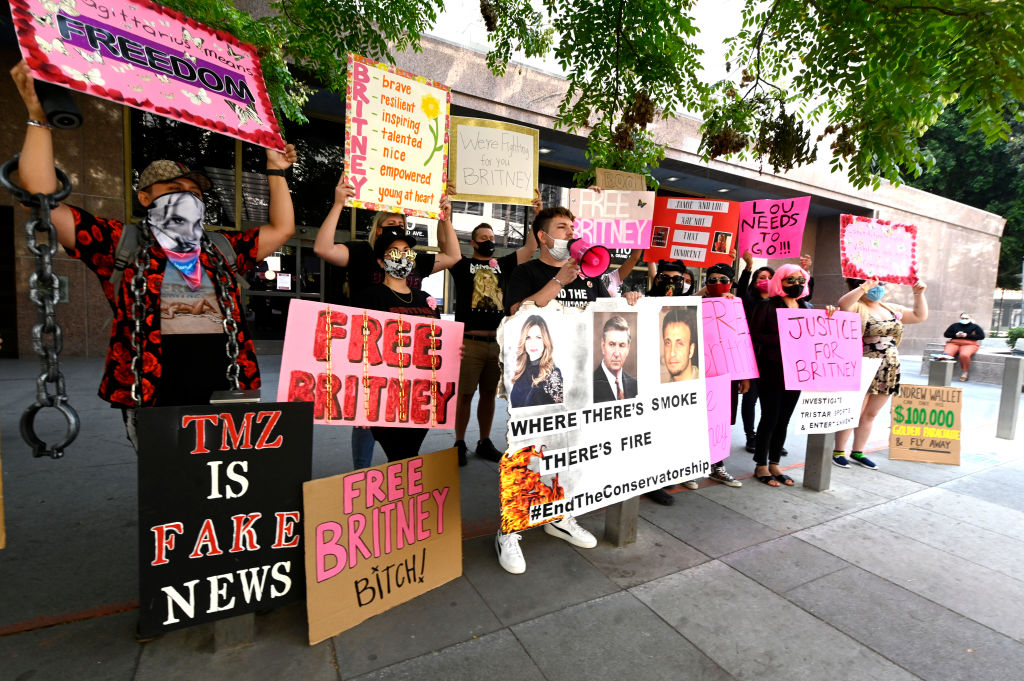
Figure 1. One of the fans protests with a loudspeaker while holding a sign critical of the singer's father and agents, September 16, 2020, Los Angeles, California.
[1.5] This is exactly what happened in the case of #FreeBritney. In messages posted on social networking platforms, fans questioned how the same person who was legally considered to be totally unable to take care of personal and professional affairs was somehow also able to record new songs, perform concerts on world tours, and launch product lines with partners. Messages with the #FreeBritney hashtag claiming the singer's right to freedom trended on Twitter, Instagram, Facebook, and Tumblr throughout 2020 (note 2). The #FreeBritney cause was adopted by supportive fellow celebrities like Paris Hilton, Miley Cyrus, and Lindsay Lohan as well as signal boosted by the mainstream press, including the New York Times, Los Angeles Times, and Washington Post.
[1.6] The #FreeBritney activism revolves not around large topics such as "digital rights themselves, [or] on broad social issues such as economic inequality or identity-based rights" but rather on "a very specific, local matter of concern" (McCaughey 2014, 2): a single celebrity's right to agency and freedom. And like all online activism, it is shaped by attempts to "take advantage of the technologies and techniques offered by the Internet" (Vegh 2003, 71), including strategies such as awareness and advocacy, organization and mobilization, and action and reaction. What should be highlighted is that "only the Internet allows an activist to distribute a message to thousands of people all over the world at once and to publish information that is accessible from anywhere anytime with virtually no cost" (Vegh 2003, 74).
2. Analyzing fans' cyberactivism
[2.1] I must note that Britney's right to freedom was questioned by fans in spontaneous, disorganized ways since the first years of the conservatorship. However, when such ad hoc actions were carried out by anonymous fans, the tendency was for them to be ignored by the fandom at large; there was simply not enough fan engagement for the effort to become a true campaign. The few times that fan-led actions were recognized by a larger community, they were repressed or silenced by outside forces; for example, "Jamie Spears threatened legal action against fan site Breathe Heavy if its Webmaster did not either comply [with] his demands [to remove content] or shut it down" (Kreps 2009).
[2.2] Such heavy-handed threats of legal action may at least partially explain why these dispersed demonstrations took so long to turn into a proper movement. However, after the 2019 podcast, public awareness of Britney's plight coalesced into something bigger. Small, independent initiatives that grew out of fandom were able to make themselves heard, including sites like FreeBritney.net (https://www.freebritney.net/), the @FreeBritneyLA Instagram account (https://www.instagram.com/freebritneyla/), and celebrity channels on YouTube. Fans use these collaborative platforms for online advocacy, maintaining the movement and working proactively.
Video 1. Trailer for the documentary Framing Britney Spears, produced by the New York Times and Left/Right, which aired February 5, 2021, on FX and Hulu.
[2.3] Public awareness regarding #FreeBritney has therefore increased. The media periodically reports on this celebrity topic, although such news sometimes transgresses the boundary between public service information and content focused on her private life (Dubied and Hanitzsch 2014). For example, the New York Times published one of the first articles in mainstream media to explain the #FreeBritney campaign to a general audience (Jacobs 2019). BBC News, in addition to an explanatory article, published "Britney Spears Appears to Endorse the #FreeBritney Movement" (Savage 2020), giving voice to the lawyer who defends her. Conversely, however, some newspapers have pointed out inconsistencies in the #FreeBritney campaign that call into question the legitimacy of fans' complaints. For example, in a fact-checking article, USA Today stated that there was "no evidence Spears is unwillingly being kept in an abusive conservatorship" as up to that point she had "not publicly shared a desire to end the conservatorship" (Link 2020).
[2.4] The fan-created #FreeBritney movement used the momentum it generated online to organize in-person events. Since the beginning of 2020, at every conservatorship hearing, groups of fans have been spotted outside the Los Angeles court building, holding banners and posters demanding the investigation of the conservatorship by an independent lawyer and transparency throughout the process. Fans clog social media sites with images and videos of the face-to-face protests, forcing the mainstream media to pay attention to them (figure 2). Formal petitions have been registered on Change.org and WhiteHouse.gov, both with over 100,000 signatures.
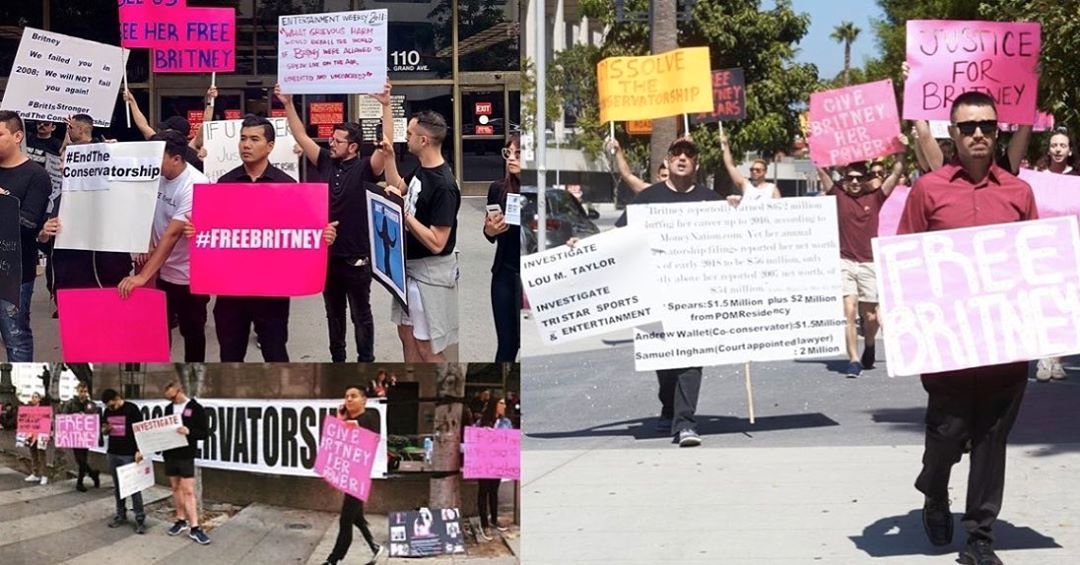
Figure 2. Fans wield signs demanding the end of Britney Spears's conservatorship as they march to #FreeBritney on January 22, 2020, in Los Angeles, California.
[2.5] It does not seem an exaggeration to argue that this type of activism may have the capacity to call into question the dichotomy between commercial and political activists, which is usually used to frame this sort of fan phenomenon. Because it touches on the contemporary dynamics of citizen participation, such fan organization has the potential to develop around real-world political and civil issues through the creation and implementation of pop culture transmedia content strategies (Brough and Shresthova 2012). That is to say, perhaps #FreeBritney points the way to a new form of online activism that mixes commercial and political, public and private, fan and fan object (figure 3).
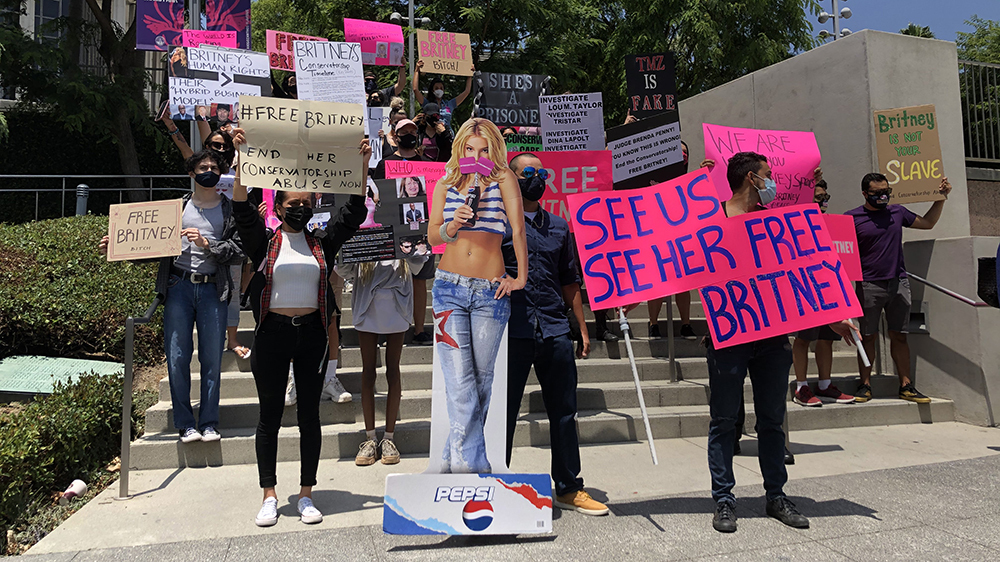
Figure 3. A life-sized cutout of Britney Spears stands with her fans at a #FreeBritney protest outside the courthouse on July 22, 2020, in Los Angeles, California.
[2.6] Yet even a movement with libertarian intentions can engender the reverse effect; only time will tell whether this fan activism could be involuntarily resulting in an overexposure of Britney's life, like the one that led to her collapse in 2008, which in turn led to her current conservatorship. Media coverage could be inappropriately providing private facts for the audience's titillation while presenting it as a public service. However, #FreeBritney has demonstrated that fans can use social media tools to amplify a message beyond a devoted fan base, with far-reaching implications for fan activism.
[2.7] A key driver of the movement has been Britney's recent posts via her Instagram account, which is the subject of conspiracy fan theories about who really controls it. In a July 14, 2021, video, she thanked fans for their support using the hashtag #FreeBritney (https://www.instagram.com/p/CRU8i50AAm_/); on August 6, 2021, she posted another video of a fan replacing the US flag with one about her campaign outside his house (https://www.instagram.com/p/CSXQJ3qJDZM/). Such recognition has driven the movement to grow transnationally, involving fan activists in several countries.
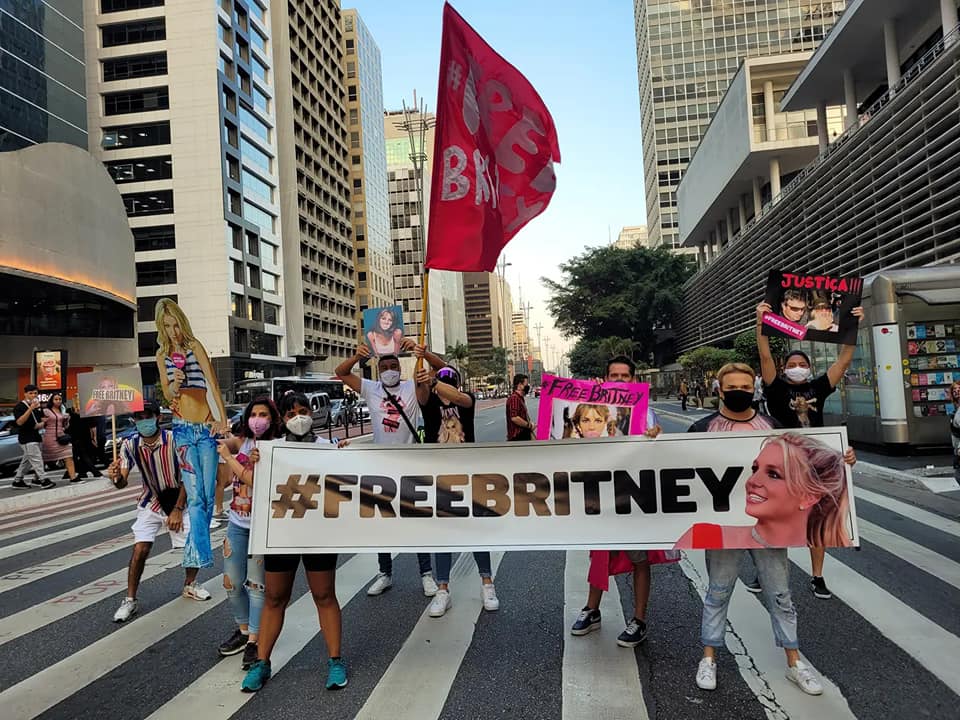
Figure 4. A group of Brazilian fans promoting the campaign on the main avenue of the city of São Paulo, on August 15, 2021.