1. Introduction
[1.1] Traditional sports coverage often highlights the personal lives of athletes in connection to their families, childhood achievements, and relationships with mentors and peers to build narratives of surmounting personal struggles, doing so within a heteronormative lens. Hockey real person fiction (RPF), on the other hand, reimagines these stories to portray new configurations that escape heteronormative constraints and subvert their function. Instead of building personal narratives to achieve a certain effect in their sporting narratives, RPF humanizes the athletes and their relationships, heedless of the end goal of sporting success.
[1.2] The text RPF rewrites in the creation of fan fiction is made from a collection of clues in the form of social media posts and journalistic coverage, relentlessly investigated for traces of a presence that may be incorporated into a larger narrative frame that is then played with to construct fans' stories (Popova 2017). Milena Popova (2017) builds on Richard Dyer's concept of star image to offer a separation between the star as a textually produced media image and the real person. "Stars are, like characters in stories, representations of people," Dyer ([1998] 2006, 10) argues. The construction of the star image, built from different public-facing fragments, is key to the writing of RPF. For hockey RPF, this text is often the National Hockey League (NHL) as an entanglement of cultural practices centered around the players as stars—as textually produced images embodying different dominant discourses. Hockey works as a matrix of discourses that center the body as the main site of meaning-making. This allows for poignant readings on the part of the fans, who push slash's tradition of positioning bodies in space (Coppa 2006) to interesting degrees.
[1.3] We investigate the selection and characterization of a prominent protagonist of hockey RPF, Nolan Patrick, through the lens of queer and disability studies. The main question we endeavor to answer is the following: Why is Nolan Patrick such a prominent character in hockey RPF fandom despite his lack of impact in the NHL? Our hypothesis is that his personal history with disability and failure propels fans to read him as defiant to NHL normativity. We provide insight on what may lead fans to select specific players to write about, adding to the literature on hockey RPF as well as celebrity studies. We also reaffirm the connection established by previous authors such as Robert McRuer (2006) and Jack Halberstam (2011) between queerness and disability, highlighting how failure in sports may motivate fans to build innovative readings of sporting bodies.
2. Game plan: Acafandom as method
[2.1] While our research object is widely available online, we are mindful of the fact that out of almost thirty-four thousand stories, around twenty thousand are available only to registered users of the Archive of Our Own (AO3). We consider this indicative of authors' desire to retain the subcultural quality of their fan activity. Kristina Busse and Karen Hellekson (2012) discuss the ethics of research on fandom and fan texts by highlighting fans' expectation of privacy and the difference between public access and widespread distribution. Although some of these stories may be available online and easily found by those looking for them, there is a clear interest on the part of hockey RPF fandom to guarantee the separation between fan spaces and the outside. To honor fans' expectation of privacy while still arguing that hockey RPF provides an interesting addition to the scholarship on slash fan fiction, we have opted not to offer textual examples or refer to specific stories. Although we recognize this may pose limitations to our discussion, we follow the tradition of fan studies as a discipline, positioning ourselves not as academics looking at a foreign object from the outside but rather as fans first and foremost. This requires that we acknowledge that our account of all fictions and practices investigated here are diffracted by our experiences as fans.
[2.2] As described by Louisa Stein, an acafan positioning emphasizes "the necessary synthesis of academic and fan" (quoted in Jenkins 2011a). Authors such as Jonathan Gray, Matt Hills, and Alisa Perren have discussed at length what it means to be an acafan. Matt Hills criticizes the impulse of acafandom to presume it "can speak for a fandom" (quoted in Jenkins 2011b). We recognize that, as argued by Hills, to speak of one's own fandom may lead to problems such as mischaracterizing the part for the whole or participating "in a drastically skewed account of pop culture passion." Our understanding of acafandom here speaks of a provisional positioning that should be frequently renegotiated as a methodological approach that allows the object to demand something from the researcher instead of the opposite. In our interpretation, we work to construe a partial account that leaves space for further investigation.
[2.3] Our participation in the hockey RPF fandom as fan fiction readers and writers has spanned the course of a decade, and it is this participation that has led us to consider the character of Nolan Patrick as a research object. Júlia joined the hockey RPF fandom ten years ago through the Chicago Blackhawks. Popova's (2017) description of the crisis of legitimacy experienced by fans of the Patrick Kane/Jonathan Toews pairing speaks a lot to Júlia's own experience with RPF. Natália joined the hockey RPF fandom more recently; she was already a fan of the sport and part of a project dedicated to hockey coverage for Brazilian fans. Her main pairing is Jamie Drysdale/Trevor Zegras. In both of our cases, we often select stories to read by sorting them by number of kudos on AO3. It is also relevant to point out that from 2020 to 2022, Nolan Patrick's prominence in the fandom was such that it was almost impossible not to come across stories written about him.
[2.4] Our experience as readers and writers of Nolan Patrick fan fiction with multiple other players has led us to remark upon the discrepancy between Patrick's impact in the league and his popularity in RPF fandom. This in turn has led us to compare him to other prominent hockey RPF characters who have experienced histories of migraines or concussions in ways that have affected the narratives constructed around them in RPF fandom, namely the Pittsburgh Penguins' Sidney Crosby and the Washington Capitals' Nicklas Bäckström. In contrast to Crosby and Bäckström, Patrick has arguably influenced team outcomes to a far lesser degree. As such, we argue his popularity stems not from his role in the league or on the Philadelphia Flyers, but rather from the lack thereof. Patrick's lack of success in the league is the point of entry for fans' cripping of his narrative. In consonance with Cynthia Barounis's (2009) discussion of the queering and cripping of normative masculinity, we consider hockey RPF fandom to crip hockey narratives. The foregrounding of the idea of sports failure in hockey RPF is made into a queer-crip way of existing, of pushing beyond the boundaries of normative narratives of success. Barounis's account of how mass media often frames the surmounting of disability through the success of heterosexuality vis-à-vis the surmounting of queerness through the success of able-bodiedness in their analysis of Murderball and Brokeback Mountain suggests that the way hockey RPF fans interweave failures of both able-bodiedness and heterosexuality conveys a refusal to have one make up for the other. This refusal may work as a poignant effort in queer-cripping traditional hockey and Hollywood narratives. We build our description of Patrick's portrayal in hockey RPF fan fiction through an analysis of tag usage as well as other information collected from AO3. We also offer an interpretation of fandom's portrayal of him that builds on our own perspective as part of the fandom.
[2.5] In this sense, it matters to highlight that we stray from prioritizing criteria such as verifiability and reliability, essential to quantitative research (Griffin 2013), to emphasize how research within fandom may require different sets of criteria that dialogue with the subjectivity of fan practices. Although traditional academia tends to emphasize objectivity as a key requirement (Vist et al. 2021), an acafan positioning allows us to foreground the act of reading as interpretation, as always involved in a negotiation of meaning. We choose to implicate ourselves as part of the hockey RPF fandom with the goal of acknowledging that discussing an active fandom that produces such niche fan fiction about living people may cause discomfort on multiple levels. The discomfort we attempt to lessen with the choice not to refer to textual evidence of published fan fiction is that of the fandom. This may inevitably result in a flattening of the differences between individual stories and authors' approaches to their selected fan object. We recognize that it is these differences that make hockey RPF a fruitful constellation and propose that our discussion invites further work on the genre.
[2.6] Discussing hockey RPF runs the risk of exposing the real people whose lives are made into fan fiction to the existence of this fandom and practice. Recent controversies surrounding how fans of hockey romance novels have blurred the line between fan spaces and real athletes' personal lives (note 1) have pointed to the fact that there is plenty of discomfort to go around when players and their families are exposed to how fans discuss them. Still, the case remains that scholarship on fan fiction often deals with sensitive and taboo topics, and that in the interest of investigating fandom practices, we often find ourselves ceding weight to the argument that the existence of this cultural phenomenon justifies—and even requires—its discussion.
[2.7] Within the context of different RPF fandoms, there is general agreement on the separation between fact and fiction. Fans are playing with fiction construed at different levels, aware that what they depict in their writing has little to do with players' real lives. Fans share an awareness of the unknowability of these players' lives, often noting that even media coverage and social media posts are public-facing fragments of the players' lives that constitute their own fiction, as noted by Popova (2017) in their discussion of how fans play with what Dyer ([1998] 2006) calls the star image. Our discussion of a specific NHL player without question speaks more to the fiction created by media coverage and the subsequent fictions built upon it by fans than to the player himself. This is a problem in RPF that becomes magnified in its research, as open access publication further complicates the issue of public access versus widespread distribution. Just as there is no agreement on whether RPF fan fiction can be ethical, there may be no agreement on whether research on RPF can be either. This dilemma constitutes an open, ongoing discussion with no set solution as of right now.
[2.8] Another issue is that we write about these players but not to them, even if, just as they may happen upon the fan fiction written about them, they may happen upon an article written about fan fiction written about them. Our double object of research here is in no way Nolan Patrick the person, but rather the multiple fictions written about him at the media coverage and fan fiction levels. Research findings are just as contextually specific as fan fiction, in the sense that the dialogue between fan fiction writers and readers is made up of certain contextual agreements that find their own equivalents in the conversation taking place between researchers and their readers.
3. Body check: Compulsory heterosexuality and able-bodiedness in men's ice hockey
[3.1] Approaching the centrality of the body in hockey RPF is an endeavor made possible only in dialogue with a new materialist tradition that has been building over the last three decades toward a new ontology of matter that can account for the mutually constitutive relationship between discourse and materiality. Judith Butler's Bodies that Matter (1993) articulates an argument that unmakes the supposed irreducibility of biological fact to defend that discourse has been entangled in the making of matter since the very first philosophical traditions. Karen Barad (2003) builds on Butler to propose a view that retrieves both matter and discourse from accounts of subordination to assert that reality is not material or discursive, but always already both. Barad's emphasis on the world as necessarily material-discursive further points to how neither may be irreducible. If hockey RPF is concerned with bodies, we must trace this concern back to the text fans are engaged in rewriting, highlighting how the literature on sporting bodies negotiates the relationship between materiality and discourse in their procedures.
[3.2] Jeffrey Montez de Oca (2013) provides an overview on sporting masculinities that sheds light on how it "has consistently focused on relations of power, patriarchy, and exclusion" (149). His account of how sports have worked to maintain regulatory discourses that reaffirm hegemonic models of masculinity also pinpoints how the effort necessary to attempt the impossible goal of ideal masculinity has the effect of turning it into a particularly crisis-prone identity. The regulation of masculinity requires constant and contradictory discursive reworkings to retain its place of dominance. It also requires the creation and maintenance of institutions that can appropriately regulate bodies to (re)produce desired models of masculinity; in this sense, asserts Montez de Oca, "the sport-media complex [works as] a preeminent masculinizing institution." What this complex does to bodies is an accruement of meaning that extrapolates their own boundaries. As described in Montez de Oca's review, "bodies in sport media operate as commodities that symbolize idealized ways of being a man in society and desirable ways of life." According to Shari L. Dworkin and Faye Linda Wachs, notes Montez de Oca, the sport-media complex turns "individual male bodies" into "masculine texts" (150).
[3.3] The relationship between body and text is dear to our argument as well, to the extent to which we argue that hockey RPF partakes in a similar material-discursive exchange to produce representations that center the body as a site of counter discourse. The prevalent regulatory discourses at play in the mattering of masculine bodies seem extensively preoccupied with the intersection between different axes of subjugation. The crafting of masculine embodiment and its foundational fiction relies on surveilling sexuality and bodies' occupation of space and time to immediately disavow every emerging desire as deviance. In this context, the body is made to do only what it is told it can. It endures what it is told to, as highlighted by Don Sabo's (2001) account of how power is ascribed as natural to the male body as cause and effect of its ability to withstand physical and mental suffering. Media representations of sporting masculinities often foreground men's ability to surmount the challenges posed by their own bodies, notes Montez de Oca (2013). The narrative of men's domination of bodies—particularly their own—furthers the impetus for surveillance required for the maintenance of hegemonic masculinity. In this regard, guaranteeing the surmounting of the body and its material-discursive configurations must become the primary goal.
[3.4] This mastering of the body is key to the intersections between race, gender, sexuality, and disability at play both in the construction of hockey masculinities in varied discursive fields and in their subsequent deconstruction in hockey RPF. Nathan Kalman-Lamb (2018) locates the cost of players' engagement with projects of "social reproductive work" in the "personal sacrifice of the body through injury, both acute and chronic," where "the damage is not simply physical; it can also lead to a crisis of identity, as most athletes understand themselves as people with extraordinary physical capacities" (32–33). The project of maintaining the illusion of hegemonic masculinity requires the violence that athletes are compelled to subject themselves and others to. Injury, which Kalman-Lamb argues is not a fault but a feature of hockey, is key to the elaboration of traditional sports fans' imagined communities, as it highlights willingness to sacrifice oneself for the game.
[3.5] As recounted by Cheryl A. MacDonald (2014) in her review of the relationship between masculinity and ice hockey in Canada, men's ice hockey works as a key site for the enactment of hegemonic masculinities, with cultural practices inscribed at every level to ensure its reproduction. In his robust account of the everyday lives of American Hockey League players, Michael A. Robidoux (2001) brings to the forefront the complexity of the homogenizing process that male hockey players are subjected to. "To all the young players entering into the professional hockey community," recounts Robidoux, "the notion of becoming 'one' does not end with sharing team goals and commitments; it also includes adopting a collective worldview that is both narrow and restrictive." Such a unifying process is configured through repetitive ritualistic behaviors whose iteration amounts to "a shared identity, one informed by a physically dominant, white, heterosexual male model" (127).
[3.6] This homogenizing is enacted at the body level through action and language, further exposing the material-discursive production of masculine bodies in hockey. The effect of this effort amounts to a culture of self-regulation in which repeated injuries are normalized and disability is often seen as a personal failure to be surmounted in a timely fashion. Hockey's troubled history with concussions and other severe brain injuries has been consistently downplayed by media coverage (Kalman-Lamb 2018), further pointing to the expectation that injury and/or disability be swept under the rug. In this sense, insofar as hegemony requires flexibility and is itself flexible to incorporating acceptable degrees of difference into its matrix, even severe disability must be made to seem mild. To this extent, materiality in the context of hockey is constructed as subordinate to discourse, with the body folding to accommodate the narratives of endurance that are imposed on it. On the occasion that matter should call attention to its own materiality, there is sure to be trouble.
[3.7] In his work toward the development of a crip theory, McRuer (2006) borrows Butler's preoccupation with the simulacrum-like quality of gender and the impossibility of perfectly performing according to norm. Gender is never not troubled, as its impossible standards are never reached, but it is exactly the striving for this impossible achievement that justifies the iterations that give it its natural and stable appearance. McRuer's work mobilizes Butler's concepts to the thinking of disability, positioning it as mutually contingent on materiality and discourse. McRuer articulates an account that posits both appropriate gender and able-bodied performativity as compulsory in the context of neoliberalism. The intersections between gender performativity and compulsory heterosexuality are further explored as McRuer sketches out a connection between disability and the two for a critique of hegemony's investment in homogenization. Homogenization involves compulsion "produced and covered over with the appearance of choice…mystifying a system in which there actually is no choice" (7). Normalcy is rewarded whereas difference, construed as deviance, is punished. The critique of normalcy is key to McRuer's argument, as both able-bodiedness and heterosexuality have historically been construed as invisible, natural non-identities. McRuer is careful to locate this construction historically to argue that visibility is not a fixed attribute, tracing how both disability and queerness have fluctuated between visibility and invisibility to arrive at the point in which acceptable degrees of difference are made visible in cultural representation, if only in a spectacularized manner.
[3.8] McRuer's (2006) concern with how hegemony works to incorporate difference propels him toward the development of a methodology that builds upon queer theory as a critical tool involved in the actualization of oppositional ways of life. If "the system of compulsory able-bodiedness, which in a sense produces disability, is thoroughly interwoven with the system of compulsory heterosexuality that produces queerness" (2), crip theory joins queer theory to refuse assimilation into either system.
[3.9] The mutual contingency involved in the production of both queerness and disability may be further thought of in terms of Halberstam's (2011) account of failure. To locate "all the in-between spaces that save us from being snared by the hooks of hegemony" (2), Halberstam's figuration of failure opts for lingering in the historical association between failure and queerness to find, in the pockets of counternarratives, possibilities of being. Halberstam's critique is concerned with breaking from capitalist models of success dependent on the systems of heterosexuality and (re)productivity. Instead of longing for assimilation and directing efforts toward "the grim scenarios of success that depend upon 'trying and trying again'" (3), an anti-assimilationist project embraces the queer art of failure to ask itself "what kinds of rewards can failure offer us?" (3).
[3.10] It is precisely this question that we attempt to answer by looking into hockey RPF. Henry Jenkins (1992) addresses slash fans' curious processes of textual selection by arguing that they often gravitate toward texts that are either heavy in homoerotic subtext or have already been appropriated for similar fannish readings. This phenomenon is similarly in effect for the selection of Patrick as a prominent hockey RPF protagonist, particularly between the years 2019 and 2021; hockey's covert but pervasive homoeroticism stems from how sports often rely on men's obsession with the possibilities of other male bodies, as well as from the heavy homosociality at play in masculinizing institutions (MacDonald 2014). Moreover, hockey RPF was already popular in its subcultural context by the time Patrick took the spotlight as a character of interest. It is also necessary to acknowledge that both hockey and slash fan fiction privilege white narratives. White supremacy appears in hockey, among other things, through the centering of white masculinity as the only one fit to occupy these sporting spaces, as it is these men's whiteness that renders violence in hockey unthreatening (Szto 2021). In slash fandom, white narratives have been historically foregrounded by fans, in detriment of stories centered around characters of color (Fazekas 2014). Patrick's whiteness may very well be a factor in his selection as an RPF protagonist.
[3.11] These three factors alone, however, are not enough to account for the selection of Patrick as a protagonist, as hockey has quite an abundance of white players available to be made into RPF protagonists. Thus, what we propose is that Patrick's selection may be at least partly due to how a narrative of failure has been ascribed to him by journalistic coverage and hockey fans' social media posts, allowing RPF fans to locate a gap in the imposed normativity of hockey discourses and fill it with queer meanings of their own making.
4. The real person in the fiction: Interweaving private and public narratives
[4.1] Access to the individual is granted through a collection of fragmented narratives sprawling across different platforms. However, this process should be understood not through the lens of representationalism, but rather in terms of diffraction—to borrow Donna Haraway's (1992) pertinent metaphor—to the extent to which diffraction "does not produce the 'same' displaced, as reflection and refraction do" (300). In this sense, the mediatic narratives about Nolan Patrick do not so much reflect him as they construct him.
[4.2] Hockey media creates its fictions, the first of which is the narrative of legacy ascribed to Patrick from the start. Born in Manitoba, Canada, Patrick's familial links to hockey have been dear to the construction of a pre-draft story of Canadian identity. Son and nephew to former NHL players and brother to hockey-playing sisters, Patrick was set up to be the standout in a family of athletes, with a sizable body made for endurance and a mind finely tuned to the intricacies of the game of hockey. Both of those inherited qualities accrued a certain sense of surety to his path in the NHL. This highlights how the body becomes subordinate to discourse in the sporting fiction, built to fulfill the function of realizing a certain prescribed fate despite the toll it may take. Said hierarchization subjects matter to what Don Sabo and Sue Curry Jansen have called the "pain principle" (quoted in Montez de Oca 2013, 153), with the value of a body resting on its endurance. The subordination of the body to discourse is at play at multiple levels—in his narrative, Patrick's body, like those of every player who undergoes selection in the NHL draft, becomes the bearer of contradictory meanings ascribed to it by the evaluating committees of different league franchises and sports publications. The complicated relationship between body and discourse becomes even more fragmented in this context in which bodies should both stand out for their abilities and be in accord with the hegemonic norm.
[4.3] Failure and success are each one side of the coin. Severe injury to his shoulder and a mistreated hernia throughout his years in junior hockey in the Western Hockey League proved insufficient to puncture the logic of legacy Patrick seemed destined to follow; it may have derailed it, relegating him to second overall pick of his draft class instead of the expected first, but it did not stop it just yet. In this sense, success visibly rests on the mind's mastering of the body, with injury construed as an obstacle whose surmounting should reveal sufficient strength of character. McRuer (2006) remarks on this in his discussion of hegemony's incorporation of acceptable difference: acceptable is only what can be appropriately conquered, should it require a lifetime of iterative attempts or not—or, if not conquerable, it is only that which can be commodified as spectacle to further neoliberal fictions of inclusion. The undecidability surrounding the construction of Patrick's second fiction lasted throughout his first two seasons in the NHL, in 2017–2018 and 2018–2019, which, although tinged by concussions, were not completely interrupted by them.
[4.4] It is at the level of the body that Patrick's second fiction comes to be. Patrick's diagnosis with chronic migraines interrupts the narrative of surmountable challenges that had marked the legacy fiction imposed on him. It is at this point that failure becomes irreducibly attached to the public's perception of him—the continuity ascribed to discourse's making of the body is deconstructed by this interruption to reveal the mutual contingency of the material-discursive. No longer can either realm appear to take precedence over each other, but this does not mean that their entanglement becomes easily understood. Instead, this moment of rupturing normalcy in which the fiction of failure takes over completely requires a renegotiation of the relationship between them. In relation to hockey RPF's characterization of Patrick, we argue that it is in the tragedy at the in-between space of these two fictions that fans locate their playing field.
5. Intermission report: Observations on Patrick's performance on AO3
[5.1] Since April 2017, over 1,400 works have been uploaded to the "Nolan Patrick" tag on AO3. Of these, more than 90 percent fall under the M/M category, with very few containing Archive Warnings. Sorted by number of kudos, only seven stories out of the one hundred most popular do not feature the Travis Konecny/Nolan Patrick pairing as the main relationship. In terms of the overall "Men's Hockey RPF" tag, this pairing is the fourth most popular, with over 1,230 published works, despite becoming less popular within the fandom over the past two years. Our analysis of each tag allowed us to develop two tentative graphs tracing Patrick's popularity as a character, as well as the popularity of the Travis Konecny/Nolan Patrick pairing, throughout the years. As seen in figures 1 and 2, both the "Nolan Patrick" and the "Travis Konecny/Nolan Patrick" tags saw the most publications in 2020 and 2021.
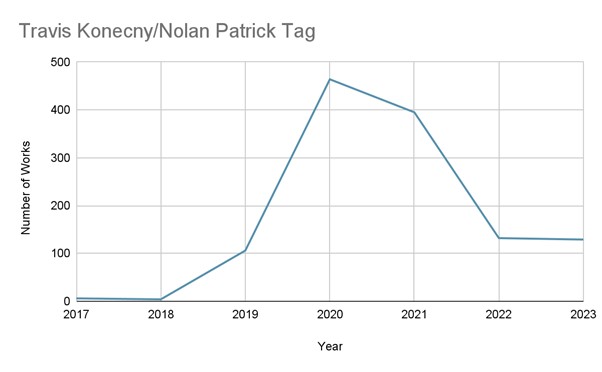
Figure 1. The number of works in the "Travis Konecny/Nolan Patrick" pairing tag on the Archive of Our Own from 2017 to 2023. Source: data collected from the Archive of Our Own in December 2023.
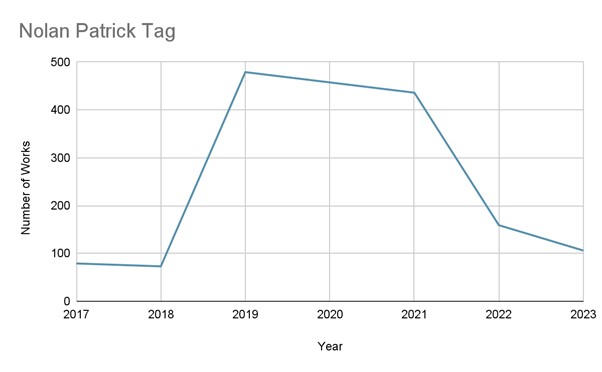
Figure 2. The number of works in the "Nolan Patrick" character tag on the Archive of Our Own from 2017 to 2023. Source: data collected from the Archive of Our Own in December 2023.
[5.2] We understand that a few aspects may have contributed to the popularity of Patrick's character, as well as this pairing, in these years, namely (1) the cumulative effect of the injuries that Patrick had endured throughout the years, as well as a renewed understanding of his disability; (2) the legacy narrative imposed on Patrick due to his family's history with hockey; and (3) Patrick's close homosocial relationships with other hockey players, in particular Konecny.
[5.3] In relation to the "Travis Konecny/Nolan Patrick" tag, the most frequently used additional tags on AO3 are "Friends to Lovers" (133), "Fluff" (124), "Getting Together" (121), "Podfic" (119), "Established Relationship" (100), "Philadelphia Flyers NHL Team" (89), "Pining" (75), "Not Hockey Players (Hockey RPF)" (72), "Alternate Universe" (71), and "Headaches & Migraines" (59). The prominence of this pairing owes a large debt to the social media content created by their formerly shared franchise, the Philadelphia Flyers, which has worked to construct a narrative thread that frames their differences and similarities within an "opposites attract" dynamic.
[5.4] The specificities of the Konecny/Nolan pairing are dependent on the interplay between each character's construction. Exploring the intricacies of Konecny as an RPF character in a sufficiently thorough manner would require another article altogether. However, we briefly note that in contrast to Patrick's characterization in fandom, Konecny's is less constant—the fragments that make up his public image are less attached to rigid narratives, allowing more space for play. Our view is that Patrick's characterization is more repetitive and established, relying on the reiteration of the specific narrative threads explored in the previous section.
[5.5] Key to our discussion here is the prominence of the "Headaches & Migraines" tag and what that may indicate about fans' characterization of Patrick. The relative popularity of this tag works along the grain of our proposed reading, to the extent to which we locate the growth in fans' interest in Patrick as a response to the fiction of failure ascribed to him by journalistic coverage and hockey fans' social media posts. From our experience as readers, we note that even stories that do not feature the "Headaches & Migraines" tag include Patrick's history of injury and disability as a part of the fabric of his characterization. The most popular story in the "Konecny/Patrick" tag, deemed so by the number of kudos it has received, centers around the theme of career-ending injury. The cumulative effects of his multiple injuries and chronic migraines are fundamental to understanding the general readings of his character. In this sense, RPF fans seem to linger on Patrick's inability to subvert the narrative of failure imposed on him. This subsequent failure—to break free from those imposed fictions—occurs at the junction of body and discourse, allowing Patrick to be construed in fan fiction as someone who needs to subvert expectations against his own will. We read fans' lingering in Patrick's failures through the lens proposed by Halberstam, that is, as critically connected to a nexus of queer-crip experience, as articulating other critical ways of being in the world.
[5.6] The number of alternate universe stories with the tags reinforces how RPF subverts traditional sports coverage: whereas media posits personal stories as means to a sporting end, in RPF, hockey is often the means to the end of new experiences. It removes them from the cultural backdrop that enforces heterosexual masculinity, but this backdrop still informs the fiction, as it creates even more satisfaction in the subversion of heterosexual norm. Patrick's disability is still prominent outside of hockey, making him into quite a melancholic character even when the sporting stakes are removed from the stories. This melancholy is yet another rejection to the telos of success enforced by normativity; fans' construction of Patrick as a melancholy character insists on the value of a disabled narrative not as a stepping stone for triumph, but rather as valuable in and of itself.
[5.7] The theme of melancholia intersects with depictions of sexuality in different ways: Patrick is more often than not portrayed as gay instead of bisexual, for example, and we take this to be at least partly due to the narratives of loss ascribed to him, which fans may find echo the manner in which gay narratives are portrayed in media (Halberstam 2011). The despondent tone often given to the character has the effect of bringing more attention to sexual interaction as a means of rousing self-discovery and freedom. The exploration of experiences not previously allowed by male sports culture provides an escape of melancholia. It skews regulation. The regulation of non-normative desires is a regulation of the body, and its transgression is performed there—it shapes, in the stories, how Patrick dresses, when fans make a point to emphasize differences in his style of clothing, how he walks, speaks, the tone of his voice, how his hands touch himself and other bodies, perhaps most importantly how they no longer do once he steps out of the game. Understanding the violent crash of bodies as a mark of hockey, fans' rewritings of affection through touch express a refusal of how hegemonic sporting masculinities require camaraderie and competitiveness to be established through violence. The tenderness between Patrick and Konecny in their stories, for example, is highlighted by the prominence of the "Pining" content tag, which stresses a subversive depth of feeling and emotional connection. This, in combination with the frequency in which the "Friends to Lovers" and "Fluff" tags appear, characterize the transition between different types of affection and desire, as well as suggest that fans portray their connection through gentleness instead of violence and dispute.
[5.8] An interesting aspect of Patrick's character in hockey RPF is that the most popular stories in his tag often forego mentions of his on-ice violence. Patrick's presence in the NHL and throughout his junior career has been marked by a relatively high number of penalty minutes and a refusal to stand down when about to engage in physical and verbal altercations. It appears fans' writing of Patrick may be very little influenced by his performance as a player; instead, fans often give more prominence to what his absence—literal or figurative—from the ice allows them to create. When depicted, the aspects of his game foregrounded by fans are exactly the moments of failure, of injury, or when he finds himself outperformed by opposing players.
[5.9] For fans, Patrick's inability to overcome failure at both the material and discursive levels means losing the battle to his own body as well as the sport that seemed to define his identity throughout his life. That the fans build upon Patrick's ability trouble in ways that point to the discursive indissolubility between it and the intersecting axes of gender and sexuality suggests a connection between failure and fans' critical imaginations, sketching out the rewards of failure in new figurations of the body. The question we borrow from Halberstam—"what kinds of reward can failure offer us?"—unravels, in hockey RPF, through different narratives of possibility. As Patrick negotiates with the homogenizing, regulatory gaze hockey players turn toward themselves and each other, what he wants his body to do and feel transgresses the boundaries of what is allowed by the discourses that have shaped him for so long. When fan fiction works toward Patrick's transgressions, it both represents the body and constructs it as the site where different desires are manifested. Despite how little use fans seem to make of Patrick's on-ice performance, the rink still works as a physical limit that requires players to interact with one another in regulated ways. Touching of all sorts is allowed within the confines of the rink, on the ice; thus, what to make of the work of touch once the ice is no longer involved as a place of expression becomes a central issue in hockey that can only arise through Patrick's narrative of failure. Outside of the boundaries established by hockey, touch requires a reimagination that fans write through different sorts of crashes between bodies. In writing these moments, there is still emphasis on a body built for hockey: namely, in the repurposing of this machinery.
[5.10] In considering fans' (re)writing of the body in Nolan Patrick slash fan fiction, we highlight the challenges of understanding oneself in relation to the perception of others; in this sense, the idea of legibility is pertinent because Patrick's history allows fans to read him as untouched by, or at least opposite to, the coercive cis heteronormativity of Canadian hockey culture. In addition, his sparse social media activity made it so his telling of his own story was often undermined by media coverage, creating gaps between these two versions of Patrick that fans seemed happy to fill. In this sense, fans transpose the issue of legibility to their texts to create a narrative fissure between Patrick's self-perception and the interpretation, by other characters in the diegesis, of his body and what it may be allowed to desire or perform. In our experience, this gap between the body and its perception tends to be the central conflict in Patrick's characterization. It is relevant to note that Patrick's particular disability, his chronic migraine disorder, must rely on an account of the self. We build on Margaret Price's (2018) discussion of invisible disabilities, noting that while they are often described in terms that further the split between mind and body, hockey RPF's portrayal of Patrick dissolves this Cartesian split. The issue of what is visible to others in the body versus what is experienced by oneself also relates to the specificities of migraines as an invisible disability, making it so Patrick's articulations of different ways of living, in fan writing, spring from his own body mind. Fans recognize the invisibility of Patrick's disability and media's expectations of resilience and write to make it visible, constructing a fictional reality where the lack of empathy toward Patrick is openly criticized through his humanization as a disabled character.
[5.11] It has not escaped our attention that empathy in fandom and elsewhere tends to be directed more frequently toward white characters or celebrities. We build upon Mel Stanfill's (2019) work on how whiteness redeems men from failing to produce appropriate performances of masculinity. It may very well be the case that Patrick's failure can be seen as subversive only because his whiteness allows it. In this sense, hockey as a white supremacist space and fandom as a cultural practice that has a history of privileging white narratives converge to suggest that whiteness might be a prerequisite for a (re)interpretation of sporting failure. We note that sports featuring mostly Black players, such as the National Basketball Association and the National Football League, are not often taken as texts to be transformed, regardless of the homoeroticism in them, as well as of the number of experiences in the nexus of injury-disability that are never made visible (note 2). Our hypothesis that hockey RPF fans choose Patrick out of other possible players due to a queer-crip reading of sporting failure should come with the caveat that this queer-crip reading may be made possible only because his whiteness makes him universally accessible to fans.
6. Overtime report: Final remarks and considerations
[6.1] The cartography of information used to create the fan object is reinterpreted so that the reasoning behind each fragment of different stories matches this impulse to undo the careful project that hockey has made of Patrick's body. It is this argument that we continually return to. The difficulties of working with hockey RPF as a research object make this a work less concerned with painting a picture of how Patrick is depicted in fan fiction in specific terms than in suggesting an answer to the question of why it is him at all that these stories are written about. When fans create Nolan Patrick, the hockey RPF protagonist, the first loose thread fans pull in the total unweaving that takes place in fan fiction is located outside it. The notion of failure is a prominent feature in the interconnected fictions that make up Nolan Patrick, hockey player, celebrity, person, in ways that make it so these narratives almost demand rewritings, requiring the imagination of new possibilities.
[6.2] Kalman-Lamb's (2018) discussion of hockey fans' relationship with injury indicates that they consider players' willingness to subject themselves to it as a sign of their allegiance to their imagined community, that is, to hockey. Fans' rewriting of Patrick, which takes his injuries as a starting point in the imagination of a life no longer permeated by violence, suggests that as RPF fans, we have less allegiance to the imagined community of sports than to the imagined life of an individual who, when removed from the sport, gets to live spontaneously. In this sense, RPF fans seem to reject traditional sports fandom, emphasizing instead how injury creates a fissure for liberation and escape from the imagined community of hockey.
[6.3] We are not involved in a project of establishing motivations as though they are ultimately knowable, but rather in a project of reading—and restating the axiom that reading is interpreting, is negotiating meaning—that creates a thread between different narrative levels, suggesting that Patrick becomes prominent as a fan object because he is no longer prominent in the NHL. We recognize that other factors may be involved in the selection of Patrick as a protagonist; the prominence of hockey as a key cultural object that inspires not only RPF but heterosexual romance novels may very well be due to the hegemony of whiteness in hockey. Whiteness, as we understand, may play a role in the fantasy of the desired standard for men, making them into more desirable protagonists for stories centered around subjectivity, as different scholars have remarked upon the prominence of whiteness in fandom (Fazekas 2014; Pande 2020). While we recognize that whiteness probably plays a role in character selection in slash fandom, our goal here is to offer an additional reading, suggesting that narratives of failure interest fans because of the possibilities they offer.
[6.4] It is in and through the failure to surmount the material-discursive reality of the body that there may be an escape from the strict regulations that constrain it. What can Patrick's body do, then? Hockey RPF written about him articulates an answer to this question through the depiction of a body produced at the junction of gender, sexuality, and ability trouble. This body, they reveal, may now do what it wants to. It is only in the pocket of time provided by failure, in the interruption, in the gap between the established path and the unknown, that desire can be acted upon and not repressed.