1. Introduction
[1.1] The game itself was deflating to watch, as scoreless draws in soccer usually are, but there was still excitement to be had at Lumen Field on October 6, 2023. It was the last regular season home game of the year for the Reign, the professional women's soccer team in Seattle, Washington, in the United States. The team had already clinched a spot in the postseason tournament, after which Reign player Megan Rapinoe would retire from soccer. An unprecedented crowd had turned out to watch, and in the last minutes of the game, the commentator announced the total ticket sales, which rarely break 10,000 for the team. But that day, an audience of 34,130 (figure 1) meant that we had broken the attendance record for the entire league!
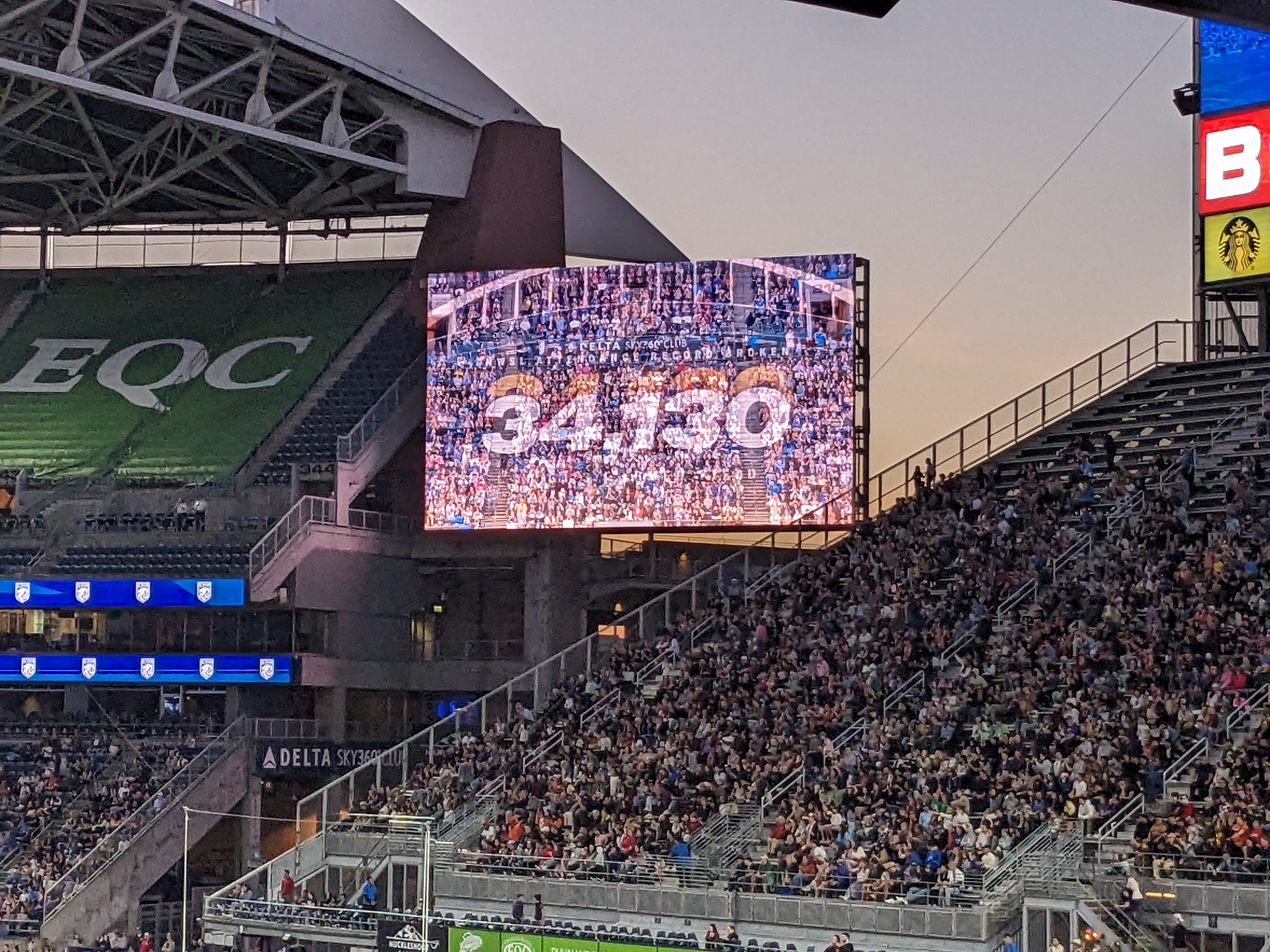
Figure 1. Seattle breaks the National Women's Soccer League (NWSL) attendance record on October 6, 2023. (Photo credit: Deepa Sivarajan)
[1.2] As thrilled as we felt to be part of that moment, we also had misgivings. Rapinoe had been a Reign player since 2013, the team's entire lifetime. Why were so many Seattleites only discovering the Reign now? Rapinoe, who is white and gay, is a player that we enjoy and connect with as queer fans, but we are also critical of her for not doing more to decenter herself in conversations about racism (note 1). How do we have fun in fan spaces while thinking critically about gender, race, and sexuality in women's sports?
[1.3] These questions and their underlying tensions inspired us to investigate our own fandom practices by conducting a collaborative autoethnography of our friendship as women's sports fans. We chose this approach for two reasons. First, we believe that our friendship offers a unique set of perspectives. Cameron (she/her) is a critical feminist sports scholar not involved in transformative fandom. Cameron always enjoyed playing sports, and she applies that passion to her work by using sports as a lens to examine gender and sexuality. Meanwhile, Deepa (no pronouns) has been in transformative fandom since Deepa was fourteen, as a fan fiction writer, fan vidder, and podfic creator. We have much in common: We both grew up in Seattle with substantial class and educational privilege, and we are both queer, transmisogyny-exempt, and in our mid-thirties. But we differ in race and gender, as Cameron is a white cisgender woman, while Deepa is Indian-American and agender. We have been close friends since 2013, and beginning in 2021, a core part of our friendship has been following American women's basketball and soccer together. Collaborative autoethnography allows us to draw out themes from both our distinct lenses and the fan practices we've created together.
[1.4] Second, we feel a sense of alienation from larger women's sports communities, particularly fan communities at the live games we attend and in transformative fandom spaces. As feminists who are inspired by and prioritize Black feminist, decolonial, queer, and trans theorists and theory, we struggle with the commercialization of the industry and its failures to protect players. We also do not always find ourselves aligned with other fans we meet around racism and anti-Blackness in women's sports. Sports are deeply political for us, and we cannot detach our politics from our fandom. Our years of friendship have created a space where we feel commonality and solidarity on our core political and social values, which is not always the case for us elsewhere. Autoethnography is a powerful tool to interrogate the alienation we feel, and to embrace it rather than reject it.
[1.5] Our rejection of racist fan norms positions us as killjoys. Sara Ahmed's (2010) "feminist killjoy" refuses to laugh at sexist and racist jokes, risking backlash and isolation by resisting bigotry in spaces that are meant to be pleasurable and lighthearted. Ahmed recognizes the powerful potential in these moments of refusal, as they call attention to injustice. Rukmini Pande's (2018) "fandom killjoy" builds on Ahmed to describe what it means "for one's pleasure to threaten the invocation of a broadly inclusive, woman-centric, and queer-coded community. To be a fandom killjoy as a nonwhite fan is a deeply alienating experience, as it involves either the internalized acceptance that certain pleasures and explorations are simply unavailable, or the identification of being someone who consistently brings unwanted drama to fan spaces" (13). Women's sports fandoms are indeed constructed as inclusive, woman-centric, and queer, despite pervasive structural racism and neocolonialism. Focusing on alienation we've experienced during live sporting events and amidst attempts to engage with transformative fandom, this article examines why we came to be a fandom of two, as well as what our motivations and practices have to say about the culture of women's sports fandoms.
2. Literature review
[2.1] As modern sport was formed to counter the seeming feminization of society after industrialization, there have always been barriers to women's entry into this sphere (Hargreaves 1994; Messner 2007). Despite barriers, women's participation has grown significantly since the late twentieth century, assisted in the United States by the passage of Title IX in 1972 (Cahn 1994). Participation gains and individual empowerment do not translate to systemic change, and inequalities persist. Modified rules and equipment for women's versions of many sports maintain gender inequality and focus resources in the men's game (Kane 1995; Messner 2007; McDonagh and Pappano 2007). The current moral panic over trans women's inclusion in women's sport highlights sport's role in reifying the sex/gender binary (Travers 2008; Travers 2022). Binary categorization requires surveillance of athletes' bodies, targeting and punishing trans women, intersex people, and women who fail to conform to white heterosexual expectations of femininity (Adjepong and Carrington 2014; Fischer and McClearen 2020).
[2.2] For these reasons, many feminists have written off sports as an irredeemable bastion of patriarchy and hegemonic masculinity, therefore not worth investing energy in to create change (Cooky 2018). Conversely, there is the notion that people who play women's sports are not invested in feminism, and that activism is not their priority (Lenskyj 2003). While there are feminist messages in mainstream women's sporting spaces, they predominantly embrace white feminism and consumerism (Fullagar and Pavlidis 2018). Systemic discrimination that players experience and activism that players engage in beyond equal pay movements are swept aside to highlight neoliberal messages of empowerment.
[2.3] Much of the research on WNBA and NWSL fans has focused on fans as individuals or as consumers, rather than on their interactions with other fans or fan communities. Exceptions exist in research on social media communities, which is outside the scope of this paper, and on fans at live games (Dolance 2005; Guest and Luijten 2018; Henderson 2018; Muller 2007a, 2007b; Muller Myrdahl 2009), some of which we discuss further. While these studies analyze how gender, sexuality, sexism, and homophobia shape the relationships between fans and sports institutions, they do not focus on dissension or alienation within fan communities, nor do they substantively consider the impacts of race and racism.
[2.4] Women's sports real person fiction (RPF) fandoms are similarly understudied. RPF is a subset of transformative fan works that focuses on celebrities, historical figures, and other real people, including professional athletes. Since fan studies has struggled to place sports fandom in conversation with transformative media fandom (Waysdorf 2015), RPF studies should be the clear nexus of fan studies and sports fan research. However, scholarship on sports RPF remains limited and primarily focuses on men's hockey (Popova 2017; Popova 2021; Vist 2023) and men's soccer (Gong 2015; Waysdorf 2015), where only Vist even mentions women's sports RPF. In broader sports fandom, the popular expectation is that sports fans are men (Hoeber and Kerwin 2013); in transformative fandom, the expectation appears to be that most fans are women and gender minorities, but that the athletes fans care most about are still men.
[2.5] There is a need for more stories from fans of women's sports, particularly around dissension within fandoms, race and racism, and women's sports RPF, and this paper offers an example to begin those conversations.
3. Methods
[3.1] In autoethnographic research, personal experience is used as a lens to understand aspects of society (Chang et al. 2013). When analyzed alongside their context, personal stories are data points that provide meaningful insight. This method has been used to highlight embodied experiences in sport, particularly those of marginalized athletes whose stories are often overshadowed by dominant narratives (Greey 2023; Jones 2021). Collaborative autoethnography incorporates multiple interpretations and has been used to showcase the often-underrepresented experiences of female sports fans (Chang et al. 2013; Hoeber and Kerwin 2013).
[3.2] This collaborative autoethnography was conducted over a four-month period in 2023. Data collection began with self-reflection: we journaled independently for two weeks (Cooper and Lilyea 2022). We then spent one month journaling back and forth, reflecting on our past experiences as sports fans. This journaling process was generative, as we responded to each other's entries with observations and questions (Hoeber and Kerwin 2013). We also examined our text messages and a notebook we shared between 2020 and 2022. As our journal entries centered on past events, we supplemented this data by collecting ethnographic field notes at two NWSL games we attended in person and one game we watched separately on television. These field notes included not only thick description of our observations but also reflections on our positionalities and their impact on our shared experiences (Babbie 2009).
[3.3] In autoethnographic research, Xavia Andromeda Publius (2023) recognizes that diary and journal entries can function not only as "evidence/archives to be analyzed from a more objective position but as the method of analysis itself" (¶ 2.5). After identifying salient themes from our journal entries and field notes through open coding and analytic memos, we layered them onto an autobiographical timeline to further ground our analysis and provide a structure for this paper (Charmaz and Belgrave 2012; Cooper and Lilyea 2022). This project was a labor of love, collaboration, and constant communication.
4. Becoming a (killjoy) fandom of two
[4.1] Our fandom of two developed out of our closeness through years of friendship and our positions as killjoys. We (Cameron and Deepa) have been friends for more than a decade, and we lived together from 2020 to 2022. In 2021, looking for newness and excitement during the ongoing COVID-19 pandemic, we decided to get into the Women's National Basketball Association (WNBA) and the Seattle Storm. The fast-paced nature of the sport itself and the queerness of the players were immediately enticing. We googled basketball rules and terminology and quickly learned players' names and who they were dating, using both lenses to analyze games. It was a fun experience that provided us with something to learn together in the early years of the pandemic when we did not see many people other than each other. With each game, we built our knowledge of basketball and further dove into the lore of the players. We felt a little late, as the league had existed for twenty-five years, but when we showed up, it felt like where we were meant to be.
[4.2] Deepa has also been a fan of the NWSL and the Reign since 2015 and got Cameron into women's soccer in 2021. Deepa had largely done Reign fandom alone in the past, so having Cameron become as interested in the Reign as Deepa is has been both really fun and incredibly moving for Deepa, particularly because of how it overlaps with other elements of our friendship. Deepa got to introduce Cameron to Deepa's favorite players and share Deepa's history of Reign fandom, while also cocreating new fan practices.
[4.3] However, we are generally angry about the injustices of the world, and becoming women's sports fans means that there is a steady supply of infuriating facts. Preceding Cameron's investment in the WNBA and the NWSL, she learned how to be a sports feminist killjoy from the podcast Burn It All Down (https://www.burnitalldownpod.com/). She was happy to learn that this approach follows a tradition of critical feminist sports scholarship (Caudwell 2017), particularly since the 2020s have been fraught for women's basketball and soccer in the US, prompting our killjoy responses.
[4.4] In 2020, COVID-19 forced both leagues to play shortened seasons in isolation zones. The pandemic, along with the uprising for Black lives following the murders of George Floyd and Breonna Taylor by police, impacted players immensely. Structural racism within the NWSL led Black players Imani Dorsey, Ifeoma Onumonu, Midge Purce, Crystal Dunn, Lynn Wiliams, Jamia Fields, and Jasmyne Spencer to found the Black Women Player's Collective (https://www.bwplayercollective.org).
[4.5] Meanwhile, WNBA athletes only agreed to play in 2020 if they could dedicate the season to demanding justice for Black women murdered by police (Munro-Cook 2024). Indeed, WNBA players had become leaders among professional athletes in their public support of Black Lives Matter years before, predating even American football player Colin Kaepernick's anthem protests. On July 9, 2016, Minnesota Lynx players Maya Moore, Seimone Augustus, Rebekkah Brunson, and Lindsay Whalen held a press conference about the murder of Philando Castile by a Minneapolis police officer. The next day, New York Liberty players wore warm-up shirts reading "Black Lives Matter." Many other players and teams followed suit (figure 2), and WNBA players have continued to deeply engage with and organize for Black Lives Matter (Ziller and Prada 2017). Most notably, in 2019, Maya Moore left the WNBA to fight the wrongful conviction of a Black man named Jonathan Irons, leading to Irons's release (McClearen and Fischer 2021). Natasha Cloud and Renee Montgomery similarly sat out the 2020 season to fight racial injustice, while those in the WNBA COVID-19 bubble used their platform to draw attention to Breonna Taylor's murder and the "Say Her Name" movement (Munro-Cook 2024).
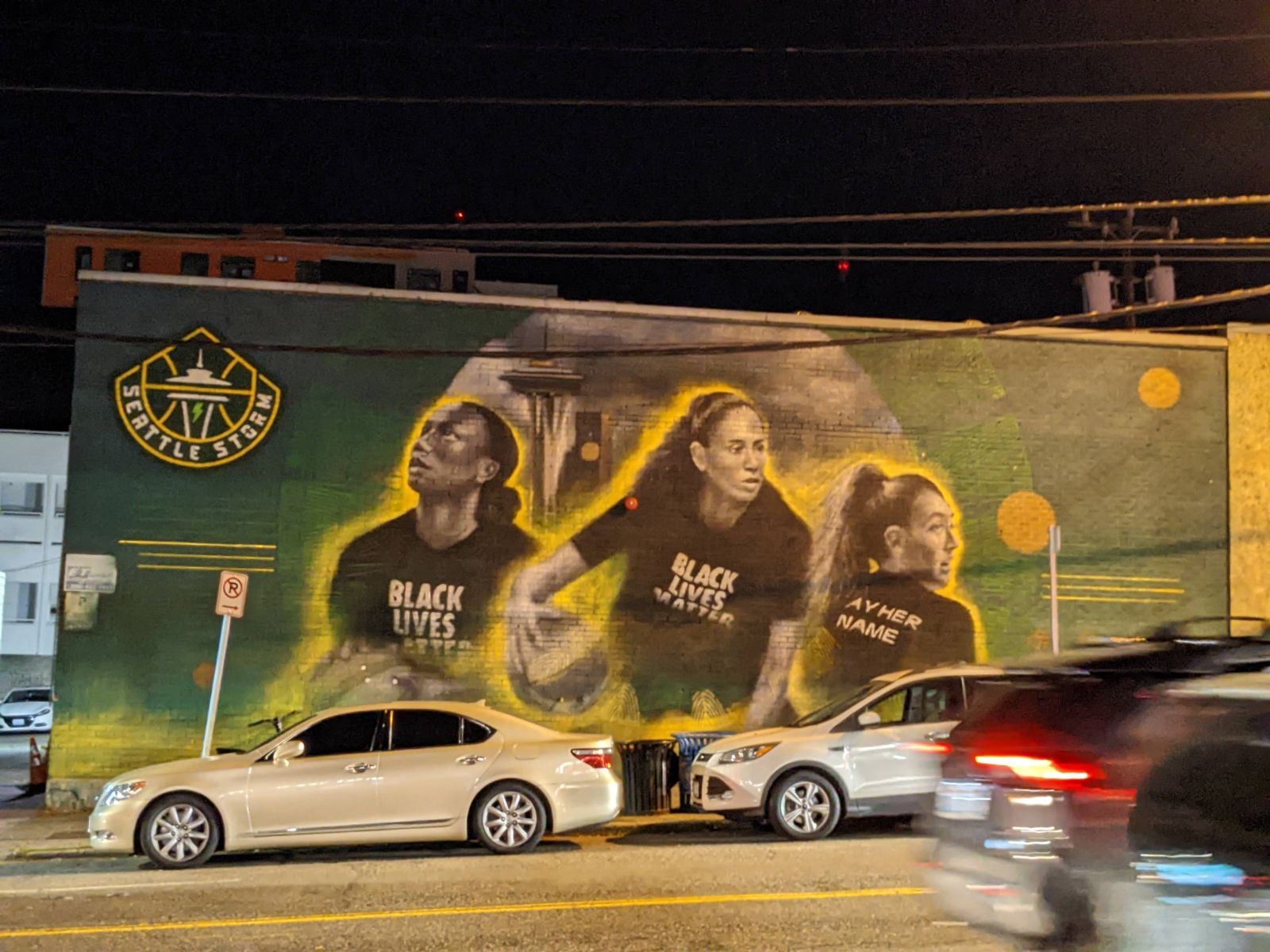
Figure 2. Mural by artists Zahyr and Mari Shibuya featuring Storm players Jewell Loyd, Sue Bird, and Breanna Stewart wearing Black Lives Matter shirts. (Photo credit: Anne Gillies).
[4.6] In 2021, due to extensive advocacy from athletes, the NWSL instituted its first harassment policy. Over the following months, reports of rampant abuse and subsequent cover-ups across the league by coaches, team owners, and managerial staff toward players came to light, some years old, including sexual coercion, harassment, and abuse; fatphobia and body-shaming; racial abuse and profiling; and homophobic and transphobic abuse. By the end of 2021, head coaches for half of the teams and the league commissioner had either been fired or resigned related to abuse allegations or cover-ups. Subsequent investigations found systemic and pervasive abuse at all levels of American women's soccer (Yang 2022).
[4.7] This was soon followed by another injustice that showed the precarity of playing women's sports under the current patriarchal system. WNBA players make so little money—especially compared with their National Basketball Association (NBA) counterparts (Travers 2008)—that many of them play outside the US during the offseason. On February 17, 2022, Brittney Griner was jailed in Russia. Griner had played in Russia since 2014 and made six times her WNBA salary doing so, despite earning the league maximum (Gibbs 2022). This detainment was understood by many as a punishment for her gender nonconformity, Blackness, and queerness, and it was terrifying. The season was haunted by her absence, and watching it was incredibly painful. After being imprisoned for 294 days, Griner was released on December 8, 2022. During a triumphant return to the league, the WNBA's policy preventing teams from chartering flights left her vulnerable to racist harassment in an airport (Bowman 2023).
[4.8] Witnessing the horrific ways that players are treated, and how people in power conspire to harm them, is incredibly disturbing and upsetting to us as fans and impacts the way we engage with these teams and leagues. We love following the NWSL and the WNBA, but these injustices remind us of the actual stakes of the game and keep us vigilant to the way power functions in sports, reinforcing systemic oppression. Our support of the players extends beyond our support of teams and leagues, and we would stop being fans of these organizations if it was deemed that was best for the players.
5. Queering the stadium
[5.1] Racism, sexism, and homophobia within the women's sports industry, the leagues, and their fan bases are made concrete for us at live games. As queer fans, we are forced to navigate the commercialized, heteronormative, and racist expectations of the stadium by reconstructing the stadium as a queer space. We both identify as queer, but we are invested in queering as a practice and in our politics (Caudwell 2006). In this article we use queer both as an identity and community label as well as a framework for dismantling normative structures and harmful binaries.
[5.2] Attending games together is key to our fandom. Cameron moved away from Seattle in 2022, so games provide a structure for us to see each other in person: In 2023, Cameron drove back to Seattle for almost every Reign home game. During the games, we make our own commentary to each other, and to other fans, especially in Lumen Field where we've befriended other season ticket holders. We have inside jokes based on gameplay: We yell "Olímpico!" whenever the Reign takes a corner kick, referring to the rare achievement of scoring a goal directly from the corner, or "throw it in the goal!" when there is a throw-in within the attacking third. We also make jokes to express our queerness and the queerness of players. Deepa, after losing a bet to Cameron, had to yell, "You're a wanker, number nine!" to a player on the opposing team, a reference to one of our favorite lesbian movies, Imagine Me and You. When an out athlete couple on the same team plays together, we yell, "Pass it to your girlfriend!" For Reign players Tziarra King and Jess Fishlock, who got married the month we wrote this paper, we will soon get to yell, "Pass it to your wife!"
[5.3] Some elements of attending games are distressing. Our concerns about COVID-19 in indoor spaces keep us from going to more Storm games (figure 3); when we do attend, we are among the few attendees still wearing masks, a discomfort intensified by the fact that Deepa has long COVID.
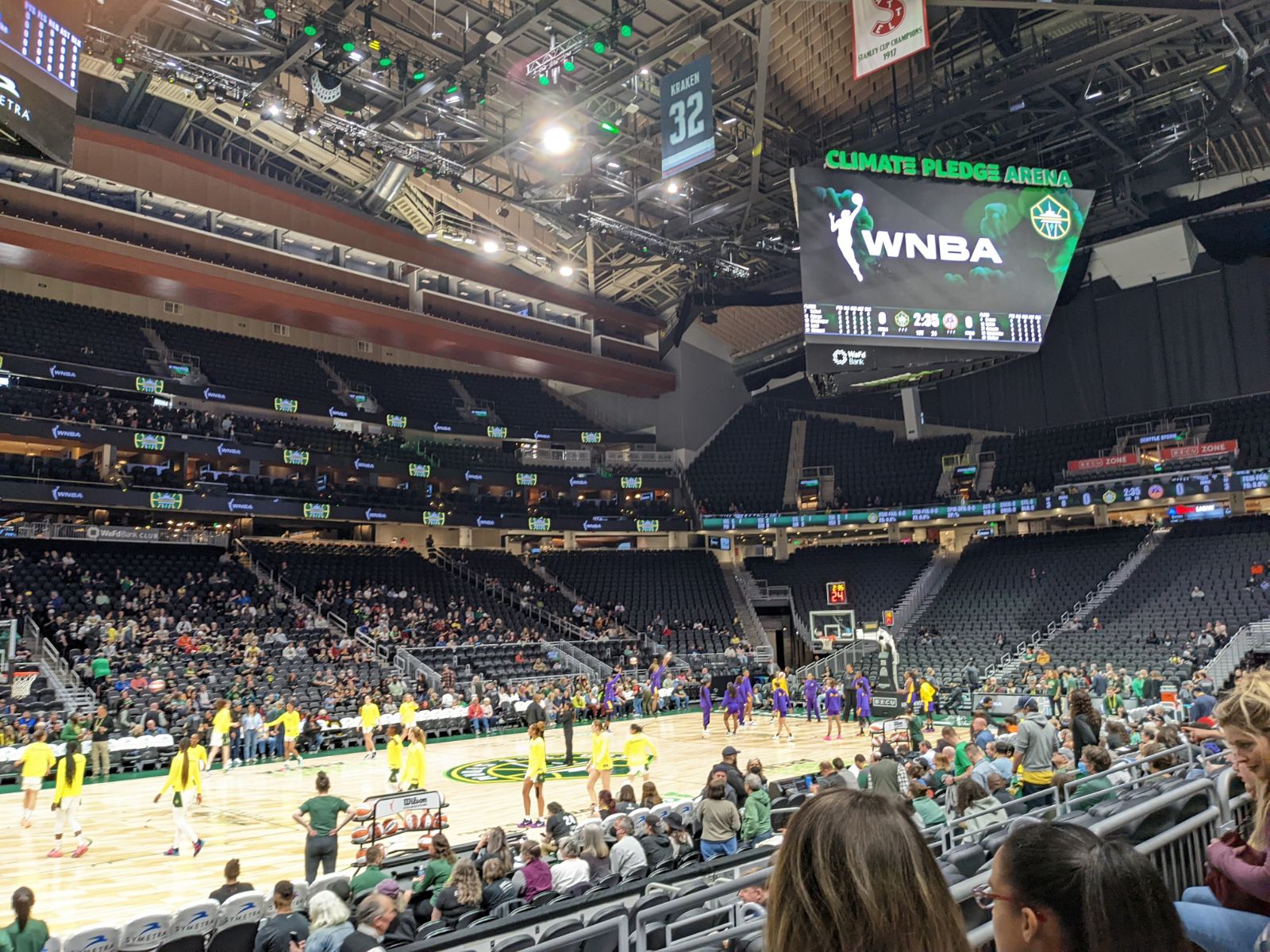
Figure 3. Inside Climate Pledge Arena during Storm warm-ups. (Photo credit: Deepa Sivarajan).
[5.4] The singing of the national anthem, an example of the integration of nationalism, imperialism, and settler colonialism into the foundation of sport, is also a locus of tension for us (Collins 2013). Sports can perpetuate notions of citizenship as embodied by white masculinity and violence—hockey was deployed in Canadian residential schools to shape Indigenous children into conforming subjects under settler colonial rule (Krebs 2012). Sports nationalism leads to moments of profound irony at Lumen Field and Climate Pledge Arena, where the anthem is preceded by a near-meaningless land acknowledgment of Coast Salish peoples, who are indigenous to the land now known as Seattle.
[5.5] As prison abolitionists, the anthem also represents anti-Black police violence for us—and for many athletes. In line with WNBA players' history of advocacy for Black Lives Matter, WNBA player Kelsey Bone was one of the first professional athletes to join Kaepernick in kneeling for the anthem, with other women's sports players soon following (Gibbs 2018). The prevalence of players kneeling for the anthem has fluctuated since 2016. In 2020, leagues even showed support for athletes kneeling when it served corporate interests, but Charlotte Howell (2021) notes the limitations of kneeling and the exploitation of Black trauma to bolster the NWSL's image. Media coverage on teams protesting the anthem has dwindled since 2020, though it appears most WNBA teams choose to stay in their locker rooms to protest the anthem. Tellingly, no American professional stadium, to our knowledge, has stopped playing the anthem, and we are now among the few fans at Storm and Reign games who sit during it.
[5.6] Another area of conflict between team or league profit motives and the values of their fan base relies on corporate feminism and heteronormativity. The WNBA and the NWSL strive to cast women's sports as family-friendly and position their athletes as role models for girls. Originally, this image was grounded in cisheteronormative, patriarchal notions of family, where men were considered to be the prime audience and were encouraged to bring their daughters to games (Henderson 2018; Muller Myrdahl 2009). The WNBA communicated this image by highlighting players who presented as straight and feminine, often depicting them with their husbands and children (McDonald 2000). Although formerly highlighted players like Sheryl Swoopes later came out, the narrative of family-friendliness has now adapted to include queer (mostly white) women, as long as the narratives of the nuclear family and female empowerment are not challenged.
[5.7] For queer and trans fans, sports can be sites of building our own forms of community. Susannah Dolance (2005) found that the largely white, middle-class, lesbian WNBA fans she interviewed saw games as a safe space to be out; an alternative to other queer spaces such as bars or marches; a place to socialize and meet other queer people; and a site of belonging that they felt was uniquely lesbian. Tiffany K. Muller (2007b) similarly notes that despite the fluidity of audiences and the heteronormativity of the stadium, the prevalence of lesbian fans constitutes a form of lesbian community for many. This matches some of our experiences today: We have many queer and trans friends from disparate parts of our lives whom we see at games, including coworkers, friends from transformative fandom, comrades from social justice collectives we belong to, and, in classic queer fashion, our friends' exes. Regardless of the actual demographics of the stadium, our perception at NWSL and WNBA games is that we are surrounded by other queer people.
[5.8] The project of queering sport offers alternative organizational models from the sex/gender binary by instead prioritizing player self-identification and embracing expansive ideas of masculinity and femininity (Travers and Deri 2011). Unfortunately, recreational sports intended to build queer community in Western countries have majority white participants, which suggests that people of color may not feel comfortable or supported in these spaces (Carter and Baliko 2017). Gay and lesbian sports often lose their radical potential when they prioritize visibility over solidarity with oppressed groups (Davidson 2013; King 2008).
[5.9] We see this play out when queer fans attempt to resist the norms of the stadium more overtly. NWSL fans follow the soccer tradition of having supporters' groups that display tifo (choreographed visual displays by fans) (figure 4), and lead music and chants throughout the game. In Chris Henderson's (2018) study of the (predominantly white) Rose City Riveters, the supporters' group for the Portland Thorns, he argues that their co-optation and reinterpretation of rituals from men's sports, including acting "confrontational" and adopting "hyper-masculine" behaviors such as heckling and crude language, represent forms of queer resistance (1037).
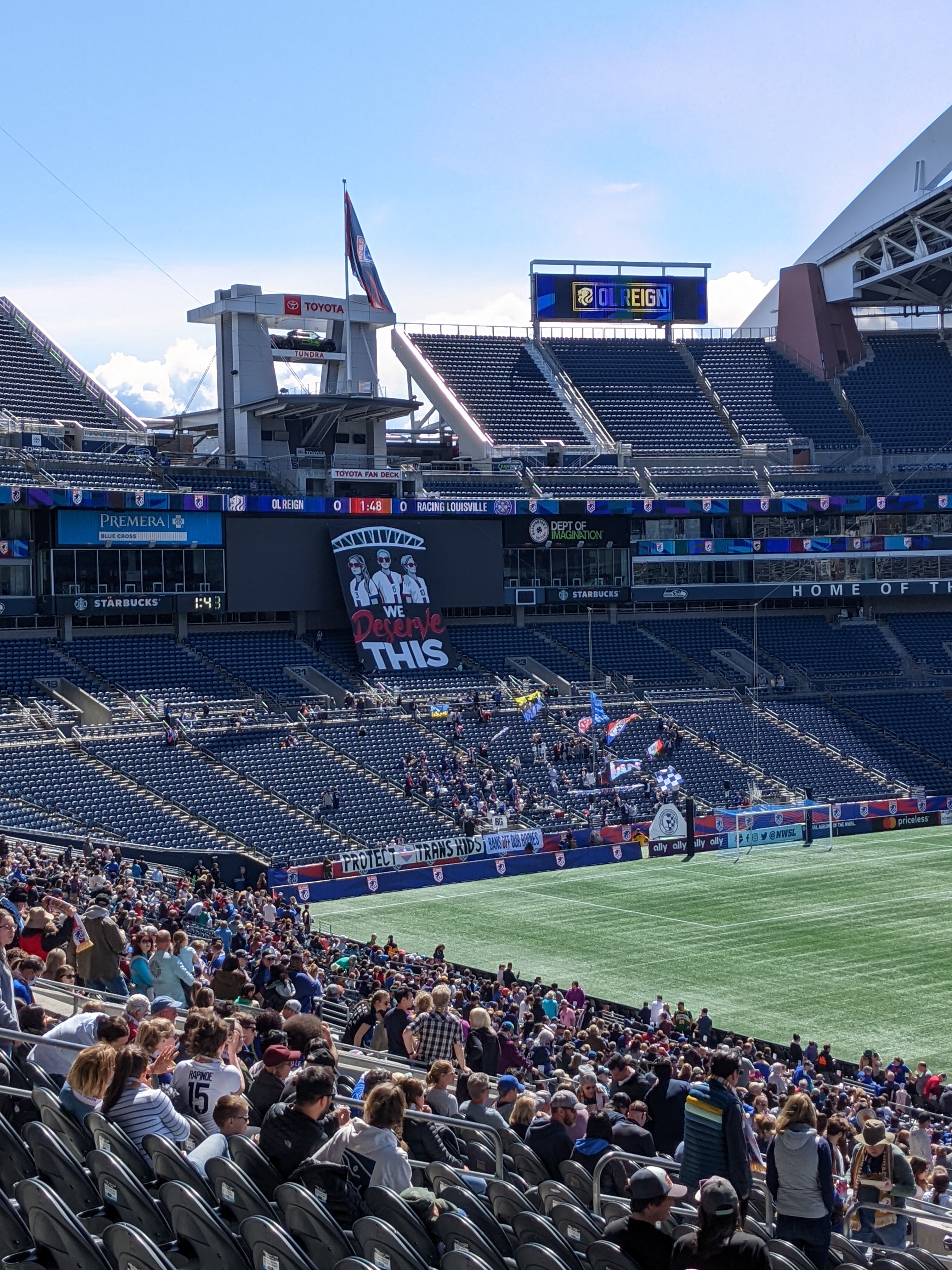
Figure 4. The Reign supporters' group displays tifo of players Lu Barnes, Rapinoe, and Jess Fishlock, the three originating members of the team still playing in 2023. (Photo credit: Deepa Sivarajan)
[5.10] We occasionally find queer joy and solidarity in confrontational fan actions: a memorable Reign game was when a visiting team started a player who was known to be loudly homophobic, and the audience booed every time she received the ball. We experienced this as a queer reclaiming of what are thought to be the approved fan expressions of distaste and disapproval. However, while heckling may contrast with the image of women and gender minorities as quiet and compliant, we question Henderson's assertion that such behaviors are queer and nonnormative in themselves, as we too often see heckling reify dominant oppressive norms rather than counter them—particularly when it comes to anti-Black racism. Athletes of color playing in majority-white countries face disproportionate harassment from fans, including racist abuse at games (Osborne and Coombs 2022; Douglas 2005). Anti-Black heckling by soccer fans impacts player performance (Caselli et al. 2020), and fans' behavior at soccer games may exacerbate colorist discrimination in foul calls (Magistro and Wack 2023).
[5.11] Seattle is a predominantly white city where racial slurs have been wielded at athletes during American football games in the past (Scott 2023). We have not witnessed explicitly racist harassment or slurs by fans at Reign or Storm games; what we see are closer to microinsults—racial microaggressions that "represent subtle snubs, frequently unknown to the perpetrator, but clearly convey a hidden insulting message to the recipient of color" (Sue et al. 2007, 274). We have seen fans berating Black players for behaviors that white players had engaged in during the same game without facing harassment; fans goading referees to apply increased penalties for behavior by Black players, even if the foul call had nothing to do with the safety of other players, such as when technical fouls or cards are given to Black players for visibly expressing frustration or arguing with referees; and fans playing into carceral language like "book 'em!" to urge for stronger penalties.
6. Real person racism
[6.1] The RPF fandoms for women's soccer and basketball are similarly steeped in whiteness. Anti-Blackness and racism are pervasive in transformative fandom at large: Stitch's Media Mix (https://stitchmediamix.com), run by fan and scholar Stitch, includes extensive analysis on how fandom systematically prioritizes whiteness and white characters while ignoring, stereotyping, or demonizing Black characters. Fandom also becomes hostile to fans that point out such racism or anti-Blackness (Pande 2024). These patterns are found in femslash fandoms (Marks 2023; Pande and Moitra 2020; Stanfill 2019) and men's sports RPF fandoms (Gong 2015; Vist 2023). Deepa is a non-Black person of color, but Deepa has still faced harassment and criticism for calling out racism in transformative fandom, positioning Deepa as a fandom killjoy.
[6.2] These dynamics converge in Deepa's experiences with women's sports RPF. Women's sports RPF is considerably less popular than men's sports RPF, which is evident on the Archive Of Our Own (AO3): In December 2023, "Men's Football RPF" was tagged in 38,452 fan works and "Men's Basketball RPF" in 911 fan works, while "Women's Association Football | Women's Soccer RPF" was tagged in 5,635 fan works and "Women's Basketball RPF" in only 59 fan works. Regardless, Deepa has tried to engage with women's soccer RPF fandom numerous times since 2015, but Deepa has found that many of the fan works for Deepa's favorite ship, which pairs a multiracial Black player and a white player, use anti-Black tropes. One baffling trend Deepa has noticed is works set in alternate universes where the multiracial Black player—who in reality is one of the best players in the world—is no longer an athlete or has no interest in sports, while the white character still plays soccer.
[6.3] Deepa's recent attempts to explore women's basketball RPF fandom were similarly upsetting. Even though 70 percent of WNBA players are Black and fewer than 20 percent are white (Lapchick 2022), and despite the existence of many out Black queer players and couples, fan works still heavily prioritize white players. Of the fifty-six works tagged "Women's Basketball RPF'' on AO3 in December 2023 that featured real basketball players and had characters tagged, 61 percent did not tag any Black women's basketball players in the work. Transformative fandom appears to devalue athletes who are Black women and gender minorities—or, when they are featured in fan works, delegitimize them as athletes.
7. Gossip and speculation
[7.1] As killjoys, we turn to each other both to rant about what we find upsetting about women's sports fandoms, and to fulfill what we want as fans that we aren't finding elsewhere. Gossip is in itself a mode of fannish expression: "[Fan] gossip builds common ground between its participants, as those who exchange information assure one another of what they share. Gossip is finally a way of talking about yourself through invoking the actions and values of others" (Jenkins 1992, 81). Gossip is part of the "affective communication" we engage in as queer fans, which gives our fannish experiences color, tone, and intensity (Yang and Bao 2012).
[7.2] To fuel our gossip, we rely on sports news and analysis, but racism in media coverage forces us to be intentional about our sources. Risa F. Isard and E. Nicole Melton (2021) find that Black WNBA players receive less than half as much media coverage as white players, even when controlling for factors like points and rebounds, despite white players making up less than a fifth of the league. Black players with masculine gender expression also receive less media attention than other Black players, while white players who present masculine receive five times as many media mentions as the masculine Black players—and more than other white players! This bears out the experience of Jonquel Jones, who has spoken about how being Black, gay, and presenting masculine has likely cost her endorsements and coverage (Barnes 2022). Sylvs Bullock (2022) discusses how in the majority-white NWSL, when Black players Crystal Dunn, Mal Swanson, Midge Purce, Lynn Williams, and Christen Press do receive media coverage, their skill, sense of strategy, and athletic intelligence is often not recognized, and their playing is instead framed through racist stereotypes of Black physicality, connecting to the idea of the "natural" Black athlete which casts "Black athletic accomplishment as a byproduct of nature rather than as a cultural attainment based on skill or knowledge" (Cahn 1994, 128).
[7.3] To counter the disproportionality in coverage, we focus on independent podcasts that prioritize Black queer voices and players and center Black joy in a media environment that largely fails to do so, primarily Diaspora United by journalists Courtney Stith and André Carlisle (https://diaspora-united.beehiiv.com) and Shea Butter FC by journalists SkyE and Sylvs Bullock (https://sheabutterfc.com). We also were big fans of Tea with A and Phee by WNBA players A'ja Wilson and Napheesa Collier, which ended in 2021 (https://podcasts.apple.com/us/podcast/tea-with-a-phee/id1524751612). We then like to gossip about what we've heard on the podcasts with each other.
[7.4] Key to our gossip is speculation, which Susannah Dolance (2005) identifies as a form of entertainment and connection for queer WNBA fans. During Dolance's data collection, there were no out WNBA athletes, and the league strove to emphasize players' heterosexuality. Lesbian fans countered this by speculating and fantasizing about the sexualities of players, coaches, and even of other fans, to feel identification with others around them, push back against the heteronormative image of the league, and have fun. Dolance notes that "it is important that speculating is done in one's head but also is shared with others. Speculating about players, coaches, and other fans is based on an imagined shared knowledge (even if it is based on perception and never confirmed), a shared interpretation that fans interactively engage in at WNBA games" (80).
[7.5] There are now many queer players and several trans players out in the WNBA and NWSL, so our speculation focuses on relationships between players. We find joy and kinship in learning more about couples who are out, and imagining relationships for those whose status is ambiguous. We create charts to track the relationships that we know about (figure 5), a practice in itself a fannish callback to The L Word that is replicated in femslash fandoms worldwide (Yang and Bao 2012). We send each other pictures of couples that we are invested in (confirmed or imagined) when they post on social media together. Cameron, worried at one point that a couple we liked had broken up when one of them got traded to a different team, assuaged our fears by finding their wedding registry website. Queer tracking and speculation are inseparable from how we engage in sports fandom together. Speculation functions much as shipping does for Deepa in transformative fandom, allowing Deepa to avoid women's RPF fandom spaces, because Deepa can simply talk to Cameron about it instead.
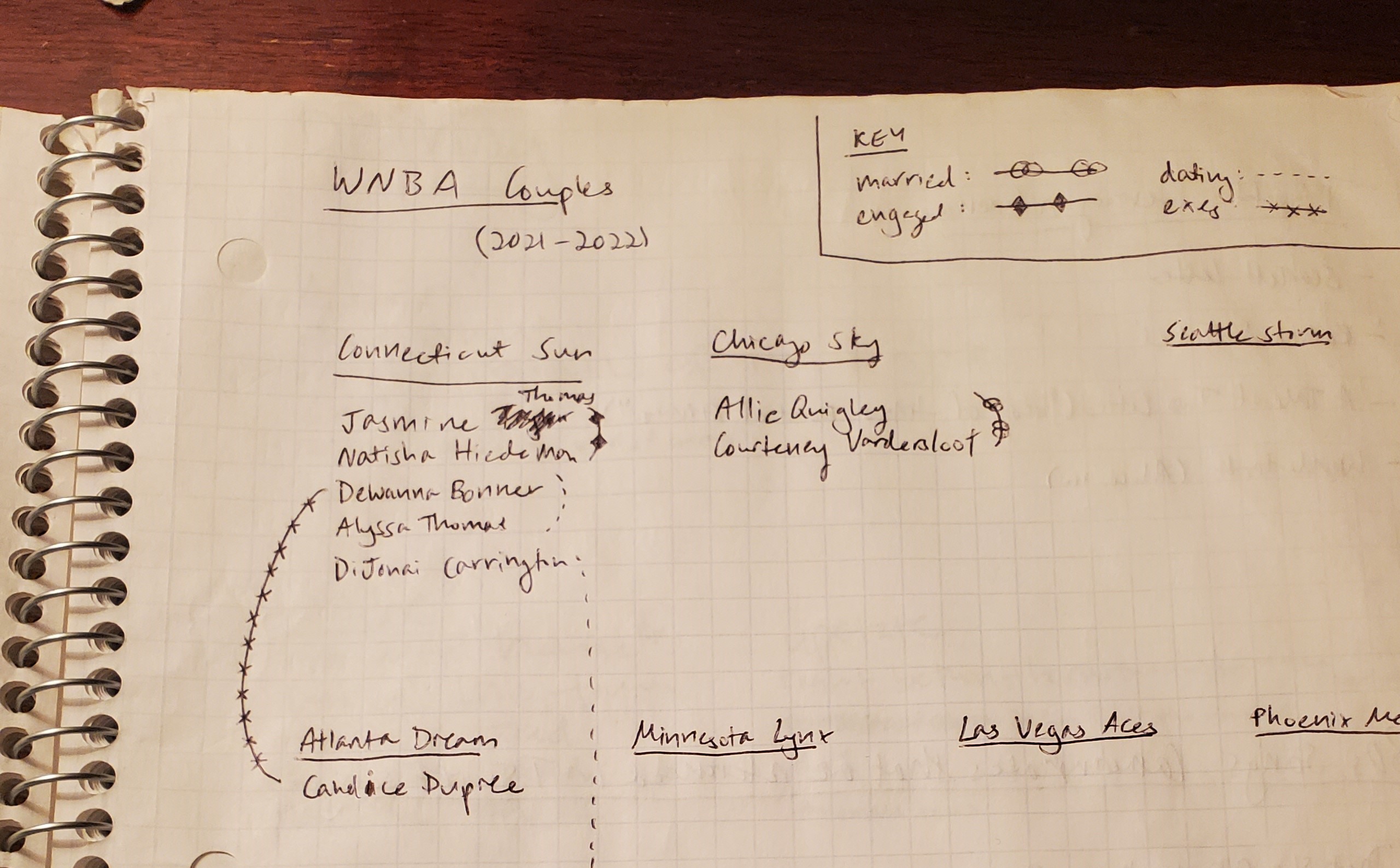
Figure 5. Charting relationships of WNBA couples out together in 2022, including Jasmine Thomas and Natisha Hiedeman, DeWanna Bonner and Alyssa Thomas, DiJonai Carrington and NaLyssa Smith, Allie Quigley and Courtney Vandersloot, and DeWanna Bonner's ex, Candice Dupree. (Photo credit: Cameron Michels)
8. Conclusion
[8.1] The gossip we engage in and the inside jokes we have established make being sports fans workable for us. Ahmed (2015) asserts that laughter can be a powerful strategy for navigating a sexist world: "Laughing about sexism can be a rebellious act; making sexism laughable can be a way of not being undone" (13). The fun that we are able to have in these often-constraining spaces is a practice in sustaining ourselves. In the words of the hosts of Burn it All Down, our fandom of two allows us to "burn on, not out."
[8.2] Our shared lore leads to some profound moments of attunement. The October 6, 2023, game ended with a retirement celebration for Rapinoe (figure 6), where head coach Laura Harvey spoke about how Rapinoe had helped her come into her own queerness and live authentically, as Rapinoe hugged Fishlock and Barnes, the other original members still on the team. Deepa was caught off guard by becoming incredibly emotional during this celebration, but Cameron was not surprised by Deepa's reaction. Deepa finds the bond between the original queer team members and coach incredibly compelling, and despite our complicated feelings about Rapinoe, this is one of the reasons we are so invested in this team. Deepa also realized that Cameron knew how much this goodbye celebration meant to Deepa. This powerful moment demonstrated how connected our shared women's sports fandom has made us.
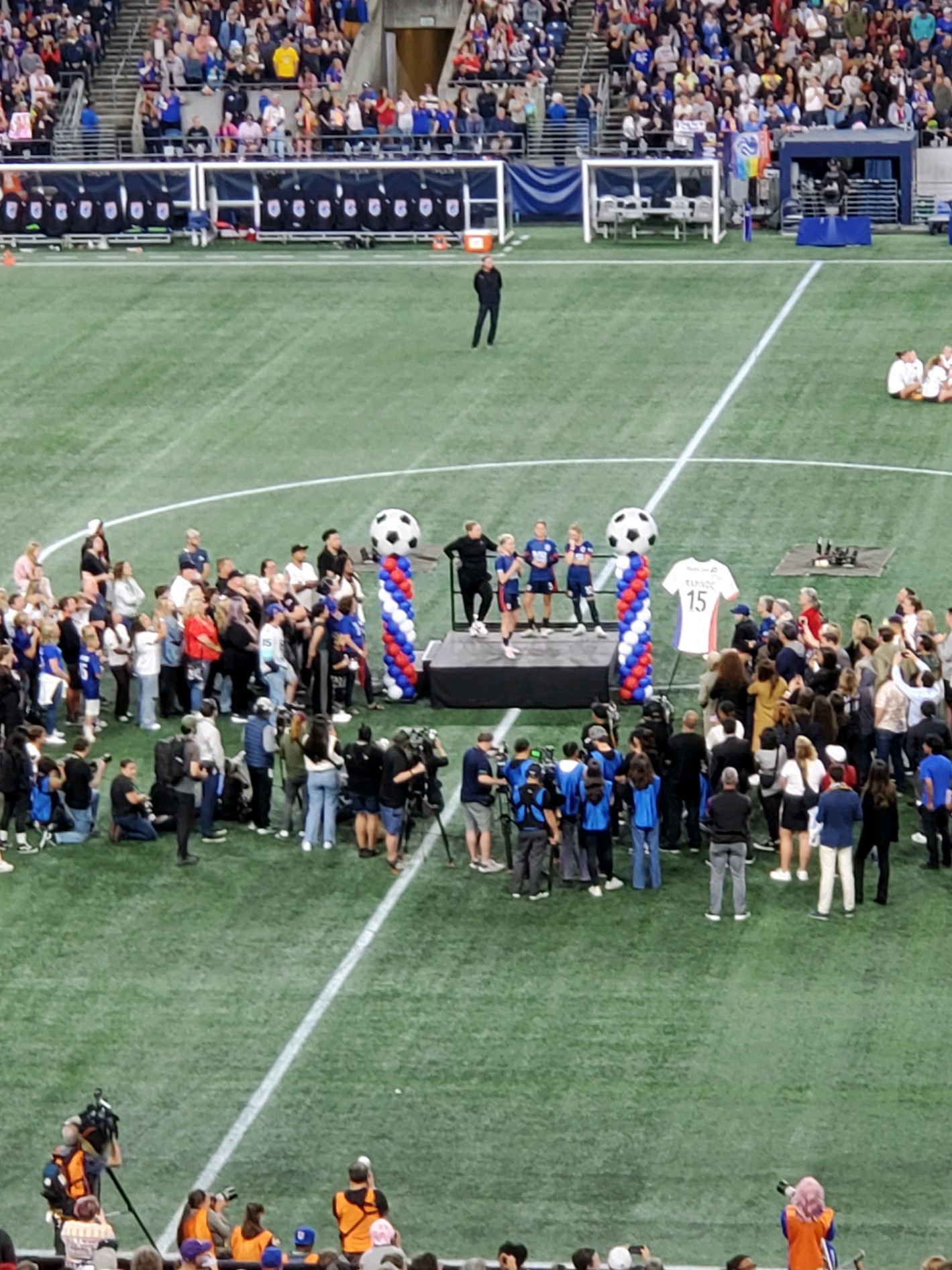
Figure 6. Rapinoe speaking to the crowd while on stage with Fishlock, Barnes, and head coach Laura Harvey, all of whom were founding members of the Reign. (Photo credit: Deepa Sivarajan)
[8.3] Watching women's sports brings us happiness, makes us closer, and helps us articulate our hopes for a more just future. Thomas Carter (2008) highlights the importance of emotions for sports fans as they provide a connection "between the ideal and the embodied world" (86–87). Even in the face of obstructions to justice, the players themselves give us hope. The organizing and advocacy by Black players against racial injustice and police violence puts them not only at risk of censure or recrimination from their leagues, but of harassment and abuse from other opponents, including sports fans. Still, we see players like Maya Moore put their careers aside to live their values. This has powerful impacts: Breonna Taylor's mother Tamika Palmer has credited WNBA players' advocacy with bringing attention to her daughter's murder by police and giving Palmer herself relief and support (Munro-Cook 2024).
[8.4] Although fraught, the feeling of being a women's sports fan is also one of hope. Women's sports can model an approach to sport separate from patriarchal values and racial capitalism. The space we are creating for ourselves as fans is an investment in the possibility of women's sports becoming a site for challenging white cisheteropatriarchal norms and dominance—a site for change.